

Plugging gaps in pursuit of decent work
By Calvin Cheng and Chau Weng Yin
Foreword by Datuk Prof Dr Mohd Faiz Abdullah
July 2026
Key takeaways
The Gig Workers Act 2025 marks an important first step towards regulating gig work in Malaysia but significant gaps remain. While the act lays important groundwork in protecting gig workers through its provisions, significant reforms are necessary to make meaningful progress towards addressing decent work deficits in the platform economy.
Future policy dialogues and policy refinement could prioritise enhancing economic security and social protection of gig workers. The Gig Workers’ Consultative Council established under the act can develop evidence-based minimum earning formulas that account for actual working time and out-of-pocket costs. Furthermore, through the council, stakeholders could explore a co-contribution model for the social protection of gig workers, under which they and platform providers share responsibility for financing coverage against a broader range of risks.
Introducing working time regulations and refining deactivation procedures. The Gig Workers’ Consultative Council could explore introducing reasonable caps on cumulative working hours and mandatory rest periods in high-risk sectors to safeguard public health and safety. On the issue of deactivation, policy evolution could focus on clearly defining valid grounds for termination while prohibiting deactivations based solely on opaque or arbitrary performance metrics.
Advancing algorithmic governance requires a shift towards a more substantive, rights-based frameworks. In consultation with relevant stakeholders, future regulation could explore taking steps towards requiring meaningful explanations of how automated systems operate, including the criteria and weights used to assign tasks or evaluate performance. There is also a strong case to establish explicit guardrails in service of data protection, privacy and fair use.
Strengthening gig workers’ voice and institutionalising worker representation is essential to address structural power imbalances in the gig economy. While the act affirms gig workers’ freedom of association, future social dialogue could explore pathways for gig worker associations to exercise this right, including by initiating collective bargaining and concluding enforceable collective agreements.
More broadly, the act’s effectiveness ultimately depends on the Gig Workers’ Consultative Council’s ability to function as a central forum for consensus-based policy development and strong inter-agency coordination.
1 Introduction
Gig work has, over the past decade, transformed the world of work in Malaysia.1The advent of ride-hailing, food delivery and online freelancing platforms has given rise to arrangements that offer flexible income opportunities with extremely low barriers of entry. However, such perceived flexibility often comes with hidden economic and social costs that often undermine key elements of decent work, rather than serving as a pathway towards it.
Our estimates suggest that the share of Malaysian workers engaged in gig work has surged 24-fold over the past eight years. While no statistics exist on the number of gig workers in Malaysia, our approximations suggest this is a large and growing share of the labour force. Some 1.6 million Malaysians now earn income from gig work (many of them as a primary source of income), representing a staggering 32-fold growth since 2016 (Fig. 1). This figure would rise to 3.3 million if using broader definitions of “own-account workers”, which is sometimes used as a proxy for gig work. Accordingly, we estimate that between 9% and 19% of total employed workers or nearly one in six employed in Malaysia is engaged in gig work to some extent (Fig. 1).2
This means that prior to the introduction of the Gig Workers Act 2025, millions of these workers were excluded from longstanding labour regulations designed to safeguard working conditions. As gig work mediated through “service agreements” expand, a rapidly growing number of the labour force fell outside the scope of statutory protections that apply to traditional forms of employment. These include basic legal protections and redress against unfair treatment, occupational safety and health standards, and the ability to collectively bargain to improve working conditions and wages. As Table 1 shows, before the act, none of nine core labour statutes, secured through decades of worker and trade union struggle in Malaysia, applies in full to gig workers.3,4
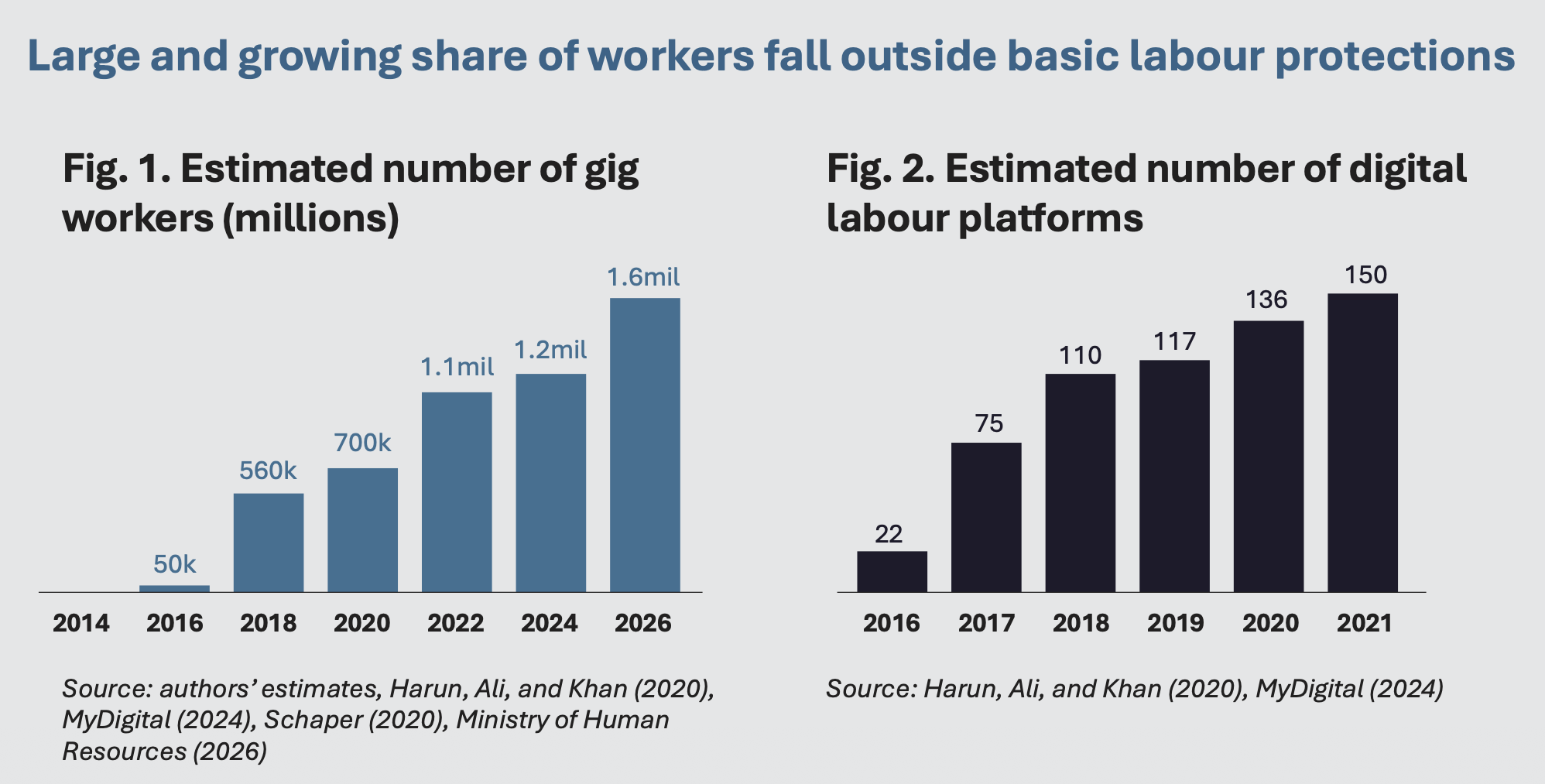
Beyond decent work concerns, the rapid expansion of largely unregulated platform labour could create market imperfections that reduce allocative efficiency. Platform providers often exercise monopsony-like power over labour supply (i.e. wield dominant “employer” power), while information asymmetries and multi-sided externalities distort market outcomes away from competitive market benchmarks.5In fact, survey evidence suggests that opaque pricing and job-assignment algorithms, coupled with unilateral deactivation, create information asymmetries that constrain worker choice and weaken effective labour supply responses (i.e. how much they work in response to changing pay).6 At the same time, multi-sided risk and safety externalities create a coordination failure on minimum standards, encouraging a “race to the bottom” in which firms compete by shifting costs onto workers and users rather than through quality-enhancing innovation.7 These dynamics are magnified by strong market concentration in key segments. Despite roughly 150 registered platforms (Fig.2) in major segments, such as e‑hailing and food delivery, industry reports indicate an effective duopoly, with the leading platform estimated to account for almost 90% of e‑hailing trips and around 65% of food‑delivery transactions.8 Together, these conditions enable higher take-up rates and downward pressure on worker earnings, outcomes consistent with rent extraction under weakened competitive pressure and reduced dynamic efficiency.9As such, well-designed regulatory guardrails could both enhance allocative efficiency while narrowing decent work gaps inherent in gig work.10
Malaysia’s Gig Workers’ Act 2025 (Act 872) has great potential in reducing both these decent work deficits and efficiency-impeding market frictions. It mandates basic transparency in service agreement and timely payment, provides practical pathways for dispute resolution, and create legal mandates for platform providers to ensure gig workers register and contribute to social security protections (see Section 4 for more details).
This policy paper aims to inform and contribute to the public discourse on the future of gig work in Malaysia. Section 2 provides an overview of the Gig Workers Act passed recently in Malaysia. Section 3 proposes and illustrates an analytical framework grounded in the International Labour Organisation (ILO) decent work agenda to assess the adequacy of the act in addressing key labour-related challenges in Malaysia’s gig economy. Section 4 utilises the said analytical framework to examine the various dimensions of gig work, drawing on existing evidence from ILO publications as well as selected international legislative or policy responses. Section 5 concludes with preliminary findings and highlights keys implementation challenges that will need to be addressed.
2 Overview of the Gig Workers Act 2025 (Act 872)
Malaysia’s Gig Workers Act 2025 was passed on 9 September 2025 and gazetted on 31 December.11 This piece of legislation marks the culmination of some seven years of legislative development, drawing on multiple rounds of consultations and repeated revisions.12
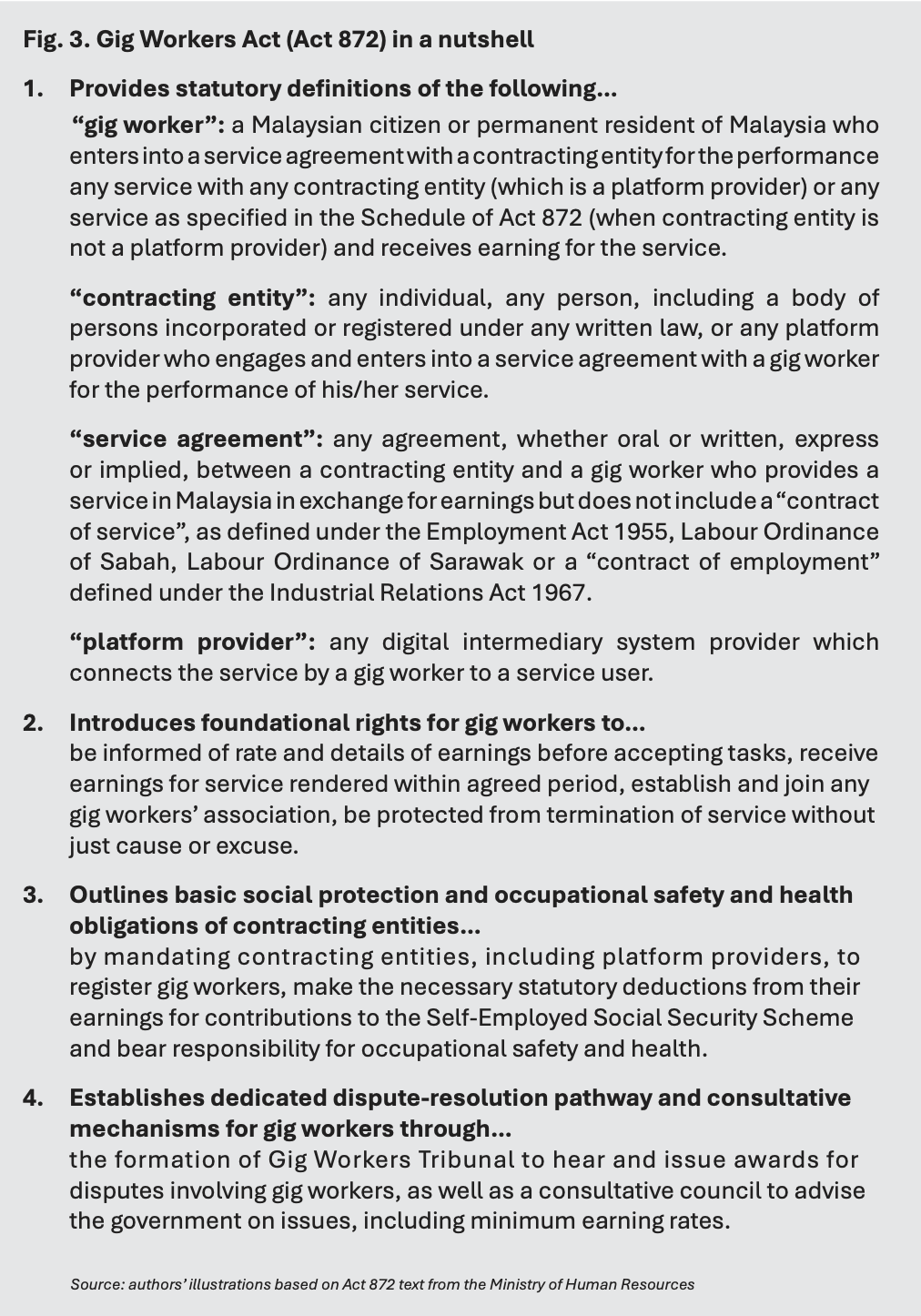
Act 872 introduces a statutory definition of “gig worker” as a Malaysian citizen or permanent resident who performs services for earnings under a service agreement either for a platform provider or, in specified cases, for a non-platform contracting entity in specific industries (Fig. 3).13 Despite the long list of services covered, there is a sense that its enactment was primarily driven by the urgent need to address working conditions issues of a large and growing number of workers providing food or parcel deliveries and passenger transport services through location-based digital platforms.
More importantly, Act 872 codifies the usage of a “service agreement” to govern the relationship between gig workers and contracting entities (platform provider or otherwise). It draws a clear distinction between a “service agreement” and a “contract of service” (which underpins and forms the basis of an employment relationship as found in other labour legislation ), further solidifying the demarcation between “employee” in the traditional sense and “gig worker” and to a large extent, putting the ongoing legal and policy debate over the potential classifications of “gig workers” as employees to rest.
Act 872 establishes some foundational rights and introduces some non- discrimination measures. Every service agreement must spell out relevant parties and their respective obligations, period of agreement, services to be provided by the gig worker, as well as payment details. Gig workers will also gain the statutory rights to see payment rates before accepting tasks, to be paid within the agreed period and to receive earnings slips. At the same time, contracting entities, including platform providers, are prohibited from restricting multi-homing (a defining feature of gig work), discriminating against gig workers on conditions of work, assignment of service or payment of earnings or unilaterally terminating service agreements.
The act introduces a multi-layered dispute-resolution pathway between gig workers and contracting entities (including platform providers).If disputes arise between gig workers and contracting entities, a dedicated dispute-resolution pathway is outlined, starting with internal grievance mechanism (except when the contracting entity is an individual or a sole proprietor), then to conciliation procedures under the Department of Industrial Relations and finally, to a newly formed Gig Workers Tribunal, whose awards are binding and enforceable. Interestingly, the act also provides for the power of the minister to conciliate any dispute, a legacy feature from the Industrial Relations Act 1967.
It incorporates some mandatory social security and occupational safety elements into gig work, while creating a tripartite consultative council to review minimum standards applicable to gig workers. A contracting entity who is also a platform provider must ensure that gig workers are registered under with the Self-Employed Social Security Scheme (Lindung Kendiri) administered by the Social Security Organisation (Perkeso), deduct from the earnings of gig workers and remit contributions to Perkeso and build system linkages with Perkeso’s system for the purposes of the social security scheme. The act also extends occupational safety and health duties to contracting entities (other than individuals) and to gig workers, backed by investigation and enforcement powers through the Department of Occupational Safety and Health. A tripartite consultative council – comprising public officers, platform representatives, worker representatives and experts – will be established to advise the government on minimum earnings, formulas and other baseline standards, with effect being given via ministerial orders, if fully accepted by the government.
Notwithstanding these promising legal developments, notable gaps remain to close decent work deficits in the gig economy. In the following sections, we present a structured framework to assess to what extent the act addresses these deficits, identify some major outstanding gaps, introduce comparable reforms in other countries and outline options for future reforms to safeguard and strengthen labour protections of Malaysia’s gig workers.
3 Towards a decent work framework
To assess the strengths and gaps of the Gig Workers Act, this paper examines the legislation through a decent work lens. The proposed framework identifies nine priority labour dimensions that, while not meant to be exhaustive, aim to capture some of the most pressing regulatory challenges associated with gig work in Malaysia (Fig. 3).
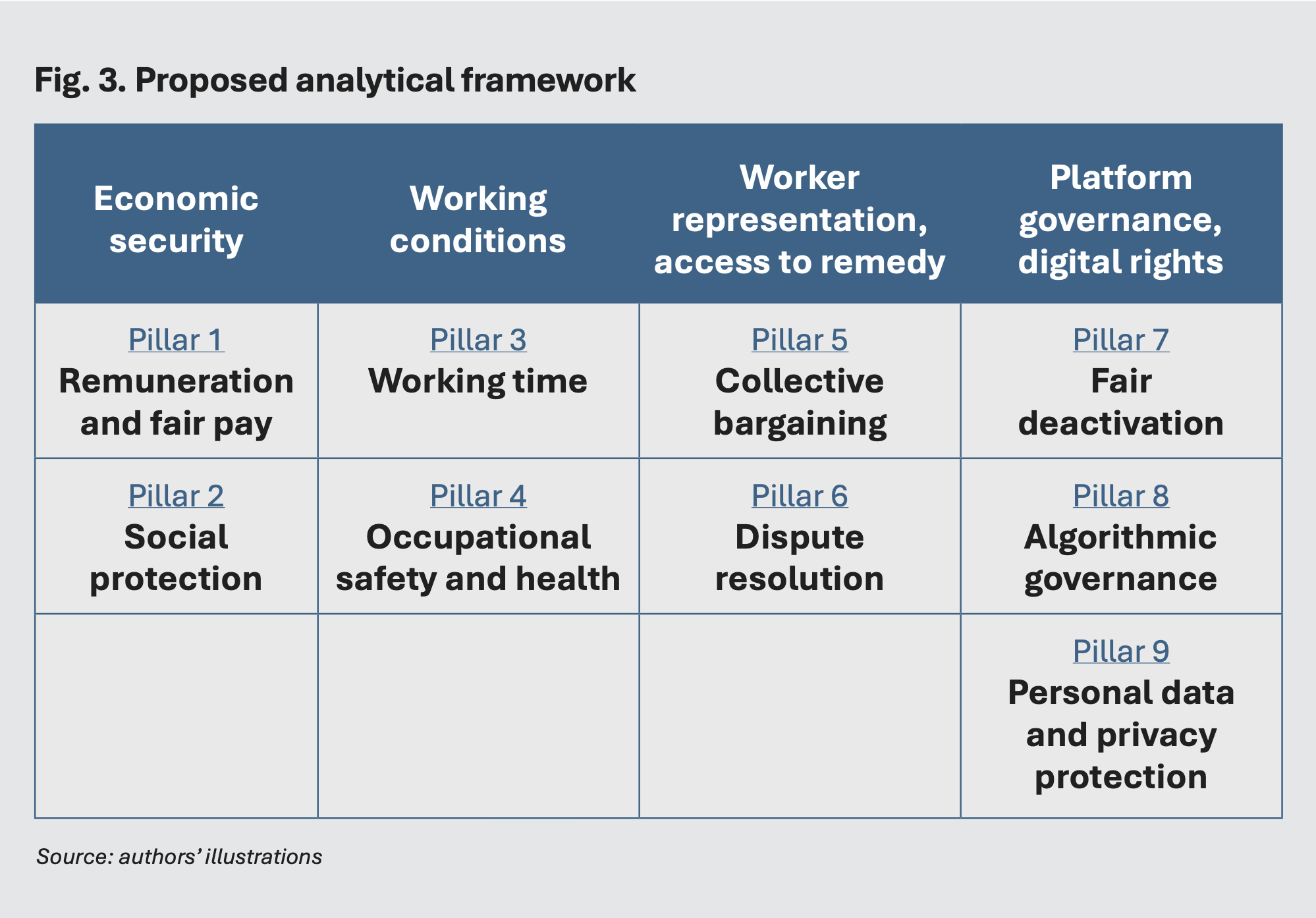
The analytical framework is used as an organising lens to assess the act along each pillar. First, we outline the core labour issue and its significance for gig workers. We then examine how the act addresses that issue and identify the major gaps. Finally, we draw on comparative experience from other jurisdictions and propose options for future reforms in the Malaysian context.
4 Assessing the Gig Workers Act and exploring options for future reform
4.1 Pillar 1: remuneration and fair pay
Core issue
Gig work is often characterised by unpredictable, task-based earnings, which make assessing pay adequacy difficult. Remuneration is based on completed task rather than hourly basis, complicating comparisons with minimum wage standards and conventional benchmarks of fair remuneration. At the core of the relationship between gig workers and platform providers is the algorithm that allocates tasks and determines (then continuously adjusting) rates of payment. This unique characteristic of gig work further reduces predictability and transparency, limiting gig workers’ ability to plan their income, negotiate terms or contest outcomes they perceive as unfair.
International wage instruments have historically focused on workers in standard employment relationships. The Protection of Wages Convention 1949 (No. 95), Protection of Workers’ Claims (Employer’s Insolvency) Convention 1992 (No. 173) and Minimum Wage Fixing Convention,1970 (No. 131) apply only to employees. As a result, to the extent that gig workers continue to be categorised as “self-employed” in Malaysia, current International Labour Standards provide only a limited and indirect basis for assessing the adequacy of their wage protection.
What the act does
The act responds by improving rules relating to pay transparency, documentation and timing. It narrows information asymmetries by giving gig workers a right to information on the terms and conditions of their service agreement, including services to be performed, rates and details of earnings, and payment methods. It also introduces a mandatory seven-day deadline for payment from completion of each service and grants a right to gig workers to receive earnings slips from contracting entities.
Together, these measures align gig work more closely with longstanding wage protection measures in standard employment relationships. The act brings key elements of wage protection, i.e. timely payment, regulation on remuneration deductions and written records, all of which are some of the rights long accorded to standard employees, into the context of gig work without altering the underlying classification of gig workers.
Remaining gaps
The act stops short of directly regulating on issues related to adequacy and minimum rate of remuneration. Instead, it delegates questions of earnings adequacy to a newly formed Gig Workers’ Consultative Council, mandated to advise the human resources minister on minimum earning rates, on formulas to calculate those rates and on standards tailored to different sectors, regions and categories of gig workers (Section 47). Widely understood to be modelled on the National Wages Consultative Council, this council serves the purpose of bringing together public officials, platform providers and gig workers to develop sector‑specific and responsive remuneration policies through social dialogue, as much as gig workers continue to be treated as “self‑employed” within the broader legal framework.
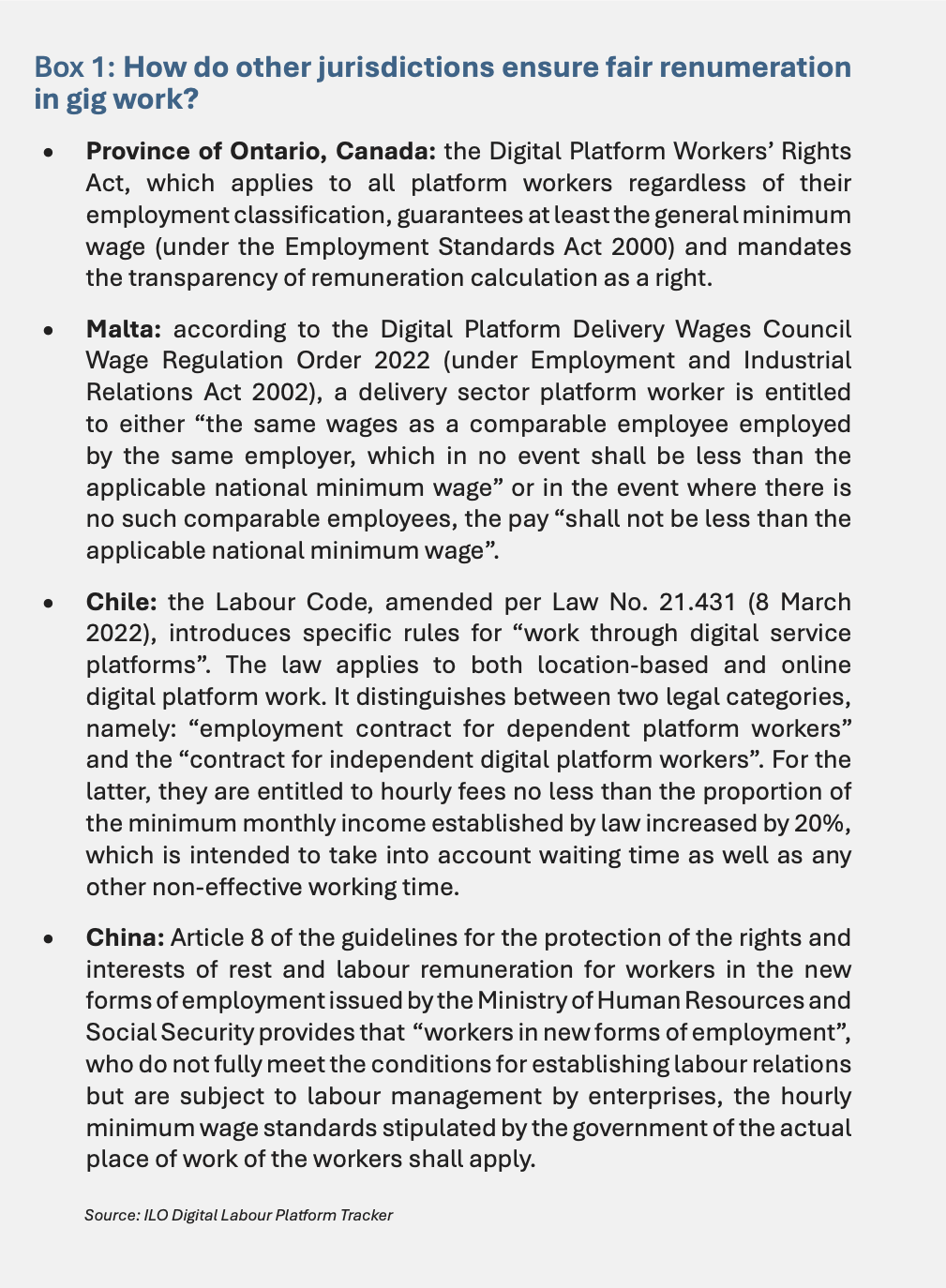
This institutional design could leave open the question of whether workers’ earnings meet minimum wage or living wage benchmarks, once work‑related costs are accounted for. While the act improves how the rate of earnings is disclosed, delivered and recorded, it does not in itself guarantee that net earnings be above a defined floor nor does it link gig work earning to existing statutory minimum wages setting framework under the existing Minimum Wage Order.Consequently, its effectiveness on ensuring fair pay hinges entirely on how the consultative council exercises its mandate and the extent to which its deliberations and recommendations are reflective of and responsive to the realities of gig workers. Around the world, there is no shortage of emerging regulatory examples on platform workers’ remuneration that have gone extra miles to ensure fair pay for workers (Box 1).
Reform options
Recent policy and regulatory discussions have signalled a growing attention on how adequate remuneration may be secured for workers. Interestingly, this emphasis extends beyond traditional employment relationships and there is increasing recognition that principles of fair and adequate pay may need to be adapted to a wider range of work arrangements, including those that fall outside standard employer-employee models. This points to a broader policy shift towards ensuring that remuneration frameworks remain relevant and effective in the context of evolving labour market structures.
Looking ahead, the Gig Workers’ Consultative Council could play a pivotal role in ensuring adequate remuneration by spearheading the gradual development of robust earning standards. These include: (i) developing evidence‑based minimum earnings formulas that account for actual working time, waiting time and out‑of‑pocket costs associated with gig works; (ii) proposing sector- and region-specific minimum earnings rates for gig workers that are at least equivalent to existing minimum wages; and (iii) embedding these proposals in formal recommendations to the minister, with a clear roadmap for phased implementation and periodic revision.
Over the medium term, the council could consider moving beyond the existing minimum wage and progressively adopting a living wage benchmark.14 This is defined as the level of remuneration necessary to secure a decent standard of living for workers and their families, based on normal working hours and estimated using ILO principles on living wage calculation and wage setting.15 The council can leverage on social dialogue to align the gig workers’ earnings with that benchmark over time and/or directly indexing adjustments to potential earnings floors to the living wage benchmark.
4.2 Pillar 2: social protection
Core issue
Gig workers are frequently excluded from mainstream social protection systems, leaving them to bear significant risks related to income security, health and old age on their own. As they are generally classified as non-employees, gig workers are not automatically covered by mandatory social security schemes under the Employees’ Social Security Act 1969. Instead, they are required to self-enrol in and self-finance in the Self-Employed Social Security Scheme under the Self-Employment Social Security Act 2017. This has contributed to persistently low take-up rates and substantial gaps in social protection coverage.16
As a result, when gig workers experience work-related injury, illness or disability, or reach old age without adequate savings, the associated social security costs are borne either directly by workers and their families or indirectly by the state through public healthcare and social assistance. This reveals a fundamental policy concern: although gig workers are integral and primary driving force of the value creation within the gig economy, the risks arising from their work remain largely externalised to individual workers and the public sector.
What the act does
The act responds by shifting the implementation obligation relating to gig workers in the Lindung Kendiri scheme to platform providers. It requires platform providers to bear the legal responsibility to register gig workers under the Self-Employment Social Security Scheme (Lindung Kendiri) and to submit worker information to the Social Security Organisation (Socso).17 Platform providers are also required to deduct contributions from gig workers’ earnings at 1.25% per task or job, which will be accumulated into a gig worker’s account (wallet). A monthly contribution (deductible from gig workers’ earning) would be based on the different plans that gig workers subscribe to (four plans available in total) with the maximum monthly insured earning being up to RM3,950.18
Through this mechanism, it is believed that the issue of low take-up rate under the Lindung Kendiri scheme would be largely addressed. Through the anticipated expansion of coverage, most if not all gig workers are expected to benefit from up to eight types of benefits, including medical; temporary and permanent disability; dependants; funeral; constant attendance allowance; education loan; and physical rehabilitation and vocational training facilities when occupational injuries or diseases occur.
Remaining gaps
The current framework does not make shared social protection financing compulsory. Beside some limited voluntary matching initiatives between Socso and selected platform providers, there is no generally legal obligation on platform providers to co‑contribute to social security protection on behalf of gig workers. Hence much of the cost of social protection falls solely on gig workers themselves, with any residual risk absorbed by taxpayers and public systems, raising questions of equity and long‑term sustainability, particularly for lower‑paid gig workers who must now devote a larger share of their earnings to secure basic protection.
While the act makes Lindung Kendiri more robust, significant protection gaps relating to old-age and income insecurity remain. The risks linked to old-age, income loss due to illness unrelated to work, demand shocks or account suspension remain largely uncovered or depend on voluntary arrangements. For old‑age protection, gig workers can participate in the Employees’ Provident Fund’s (EPF) voluntary i‑Saraan/i‑Saraan Plus schemes with matching government contributions of up to RM600 per year (capped at RM6,000 over a lifetime) but participation and adequacy depend on workers’ ability to contribute regularly from often volatile earnings.19 Meanwhile, policymakers are exploring the feasibility of extending unemployment insurance coverage under the Employment Insurance System Act 2017 to gig workers who remain outside the scope of such protections.
Reform options
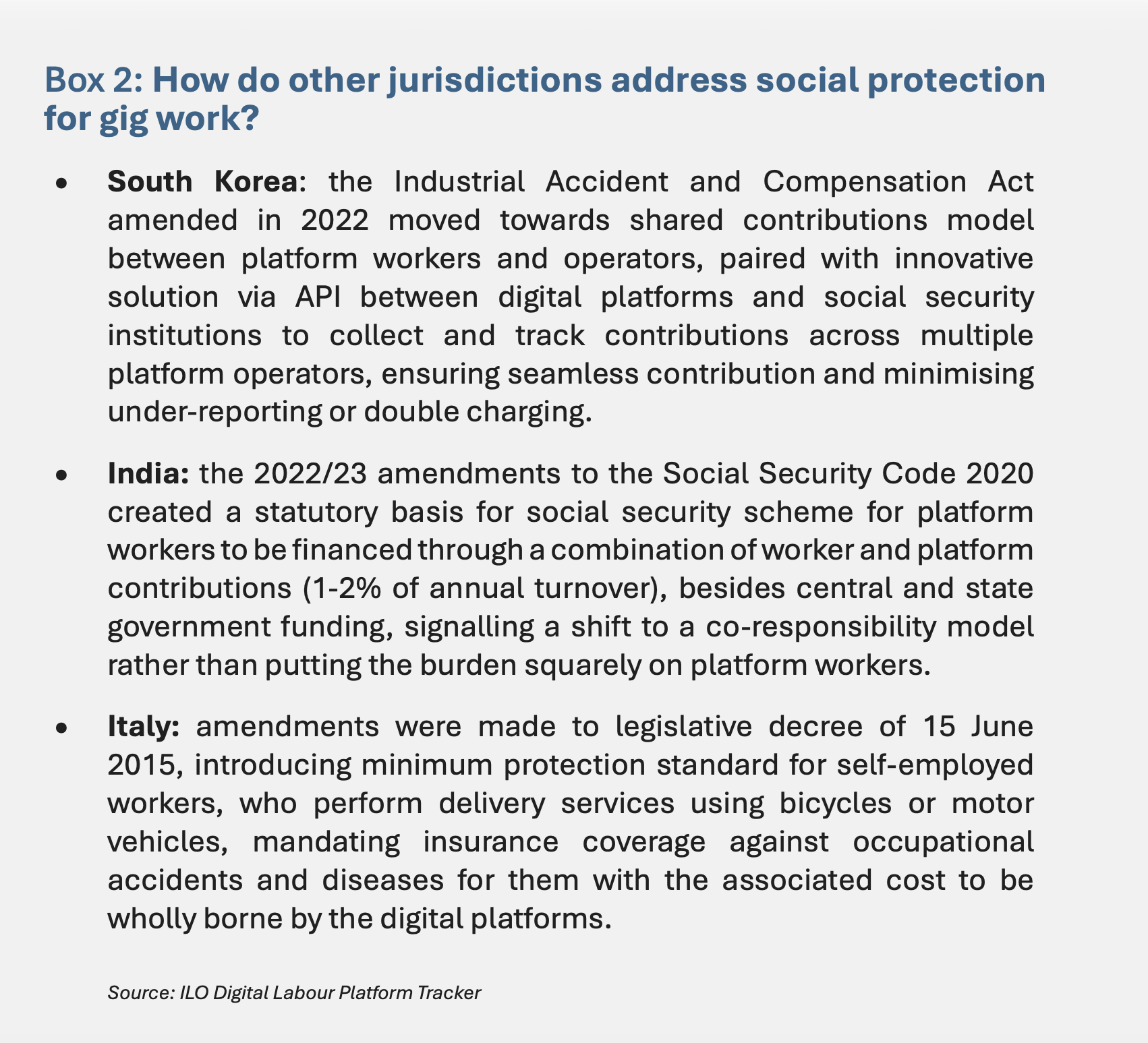
International experience indicates a growing focus on shared responsibility and broader risk coverage for gig workers’ social protection. Many countries (Box 2) are exploring and implementing models that combine platform provider contributions, worker contributions and public financing to cover a wider set of risks, including work injury, unemployment-related income shocks and old‑age protection. These approaches often rely on clearer definitions of platform workers in social security law, mandatory or quasi‑mandatory schemes for specific categories of digital labour platform and platform workers, and closer integration of platform data with social security systems to facilitate contribution collection and benefit delivery.
Within this evolving context, the Gig Workers’ Consultative Council could examine future options for strengthening gig workers’ social protection in a phased manner. Through tripartite dialogue and coordination among relevant ministries, Perkeso, EPF, platform providers, gig worker association representatives, the council could consider:(i) ways to broaden social protection coverage of gig workers beyond Lindung Kendiri, for example, by exploring mechanisms that support income security through existing unemployment insurance scheme and to boost retirement savings for gig workers via targeted measures; (ii) options to clarify and, if appropriate, recalibrate the respective roles and financing responsibilities of platforms, workers and the state; and (iii) measures to improve take‑up rate and continuity of coverage in existing voluntary schemes. Any discussion could consider national circumstances, fiscal sustainability, the distinctive features of platform work and relevant International Labour Standards, while leaving room for gradual adjustment as evidence and experience accumulate.
4.3 Pillar 3: working time
Core issue
Flexibility in working time is often presented as one of the main attractions of gig work. In practice, however, many gig workers experience long hours and only limited autonomy over their schedules. The ability to choose when, where and how much to work is especially important for workers who face barriers to standard employment or who rely on gig work as supplementary income.20 Yet this apparent autonomy is frequently undermined by algorithmic management tools frequently used in gig work, including performance-based task allocation, surge pricing and gamification of gig work, which create strong external incentives for gig workers to stay connected and accept as many tasks as possible.21 This is exacerbated by frequent downward pressure on per task earnings arising from competition among gig workers and between platform providers, which pushes gig workers to work longer hours to maintain a target daily income. Taken together, these factors suggest that the much touted “flexibility” of gig work increasingly exists more on “on paper” than in practice.22 Survey evidence from selected G20 countries supported such observation, showing that workers on taxi platforms work an average of around 70 hours per week, while those on delivery platforms around 61 hours, underscoring the prevalence of excessively long hours in location-based platform work.23
What the act does
The act does not regulate working time or rest periods for gig workers. It sets no limits on daily or weekly working hours and does not require minimum rest periods or clarify how “working time” should be understood in the context of gig work, including whether and to what extent waiting time counts as working time. As a result, gig workers’ working hours remain governed largely and influenced through platform incentives, market conditions and individual choice.
Remaining gaps
The absence of working-time regulation creates a risk of excessively long work hours for gig workers, with implications for health, safety and the quality of work. This raises concerns not only for workers’ health and work-life balance, but also for public safety in sectors, such as passenger transport and delivery. There is likewise no clear framework for distinguishing between active time, waiting time and related work duties. In practice, gig workers may spend substantial periods logged in and available for work without being paid while still being expected to remain ready to accept assignments. Without clear definitions or guidance on what counts as “work”, important elements, such as extensive period of waiting time and time spent on travel between jobs or tasks, administrative work or vehicle cleaning, would remain invisible and ignored in the assessments of working time and earnings adequacy.
Reform options
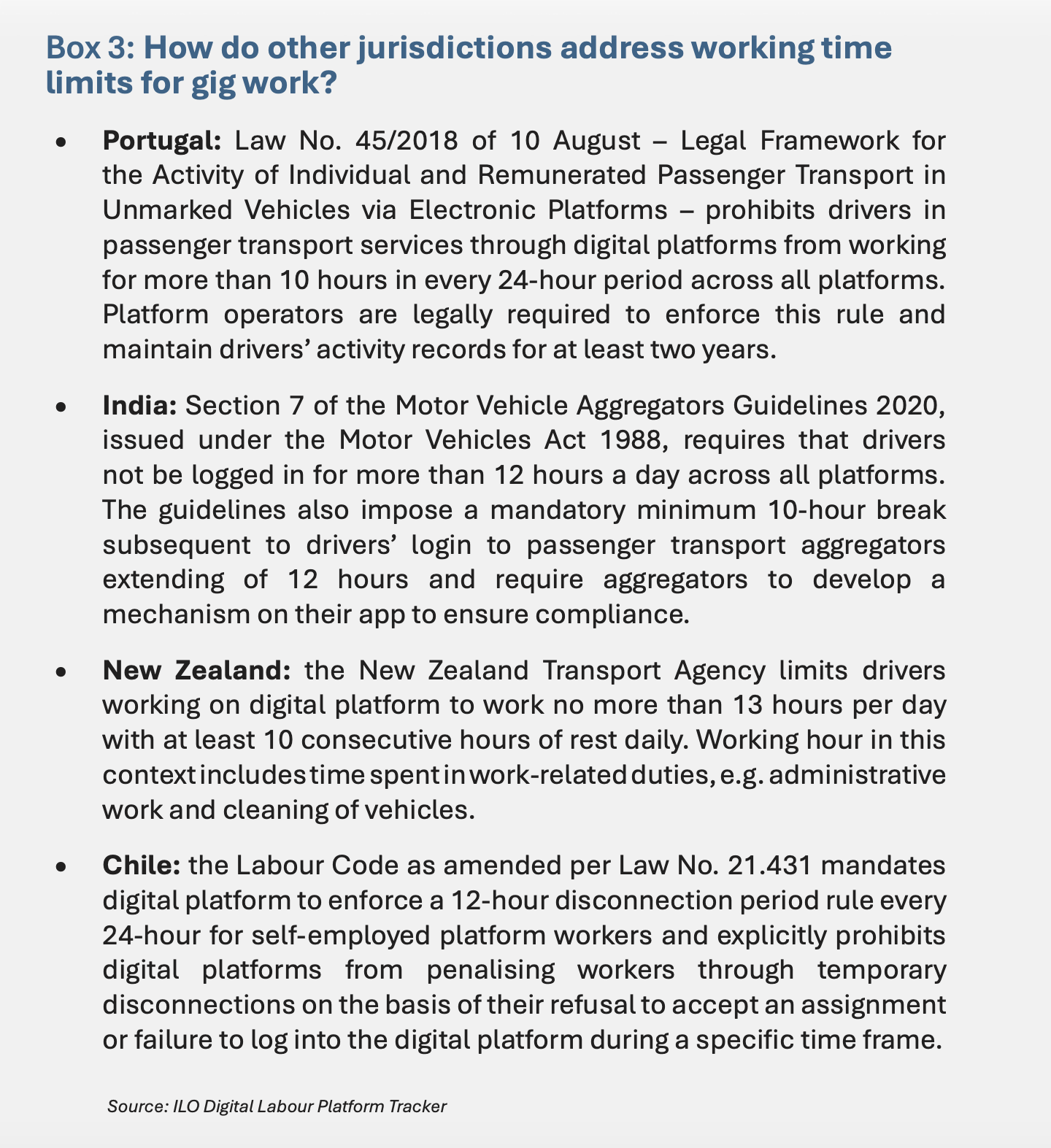
As Malaysia’s legal framework on gig work continues to evolve, working time issues could be examined more systematically through the Gig Workers’ Consultative Council. The council could consider policy options, such as minimum daily rest periods, reasonable limits on cumulative working hours across multiple platforms in high-risk sectors, and clearer recognition of both active and waiting time when assessing gig workers’ working conditions. Carefully designed measures that consider the operational realities of digital labour platforms and actual working conditions would not undermine flexibility. On the contrary, they could complement the act’s emphasis on transparency and fair treatment by helping to prevent excessively long working hours and fatigue-related risks.
Tripartite dialogue is essential to balancing flexibility with protection and promoting sustainable labour market outcomes. Meaningful engagement among platform providers, gig workers’ representatives, and the relevant government departments and agencies can help identify approaches that support innovation in the gig economy while guarding against excessive working hours and the related health and safety risks. Once established, the Gig Workers’ Consultative Council could provide an institutional forum for these discussions to take place in an evidence-based and incremental manner.
4.4 Pillar 4: occupational safety and health
Core issue
Formally recognised since June 2022 as a category and an integral component of the ILO Declaration on Fundamental Principles and Rights at Work, occupational safety and health is one of the most significant aspects in the context of considering decent work of gig workers.24According to the gap analysis on decent work in platform economy conducted by ILO, thePromotional Framework for Occupational Safety and Health Convention 2006 (No. 187) is broad in scope and promotes the right of workers to a safe and healthy working environment (Article 3(2)).25 It also recognises that support mechanisms for the progressive improvement of occupational safety and health (OSH) conditions in the informal economy are an important part of a national OSH system (Article 4(3)(h)). This is reinforced by the Promotional Framework for Occupational Safety and Health Recommendation 2006 (No. 197), which states that the national OSH system should provide measures for the protection of all workers, particularly those in high-risk sectors and vulnerable workers, such as those in the informal economy, as well as migrant and young workers (paragraph 3).
In contrast, the Occupational Safety and Health Convention 1981 (No. 155) has a narrower scope, as its rights and duties apply to “all employed persons, including public employees,” within the meaning of “workers” under Article 3(b). However, the Occupational Safety and Health Recommendation 1981 (No. 164), which supplements Convention No. 155, provides that measures should be taken, where necessary and practicable, to give self-employed persons protection analogous to that provided under Convention No. 155 and Recommendation No. 164. Considering everything holistically, International Labour Standards provide a clear direction for Malaysia to work towards improving OSH of gig workers.
What the act does
The act introduces the jurisdiction of Department of Occupational Safety and Health (DOSH) with respect to enforcement, investigation and inspection of OSH-related matters for gig workers. Through the act, DOSH has the authority to enter any premises, inspect any document, record or other relevant thing to ensure compliance with the act, as well as to seize any document or record for the purposes of investigation.
The act imposes specific occupational safety and health duties on contracting entities, including platform providers. These duties are relatively limited in scope. They mainly require contracting entities to ensure that equipment and facilities provided to gig workers are safe, to protect gig workers from risks arising from work arrangements and processes, to provide the necessary safety information, instruction, training and supervision, and to establish and implement emergency procedures. Contracting entities are also required to notify the director-general of any occupational accident or occupational diseases occurring while the gig worker is performing the service.
Remaining gaps
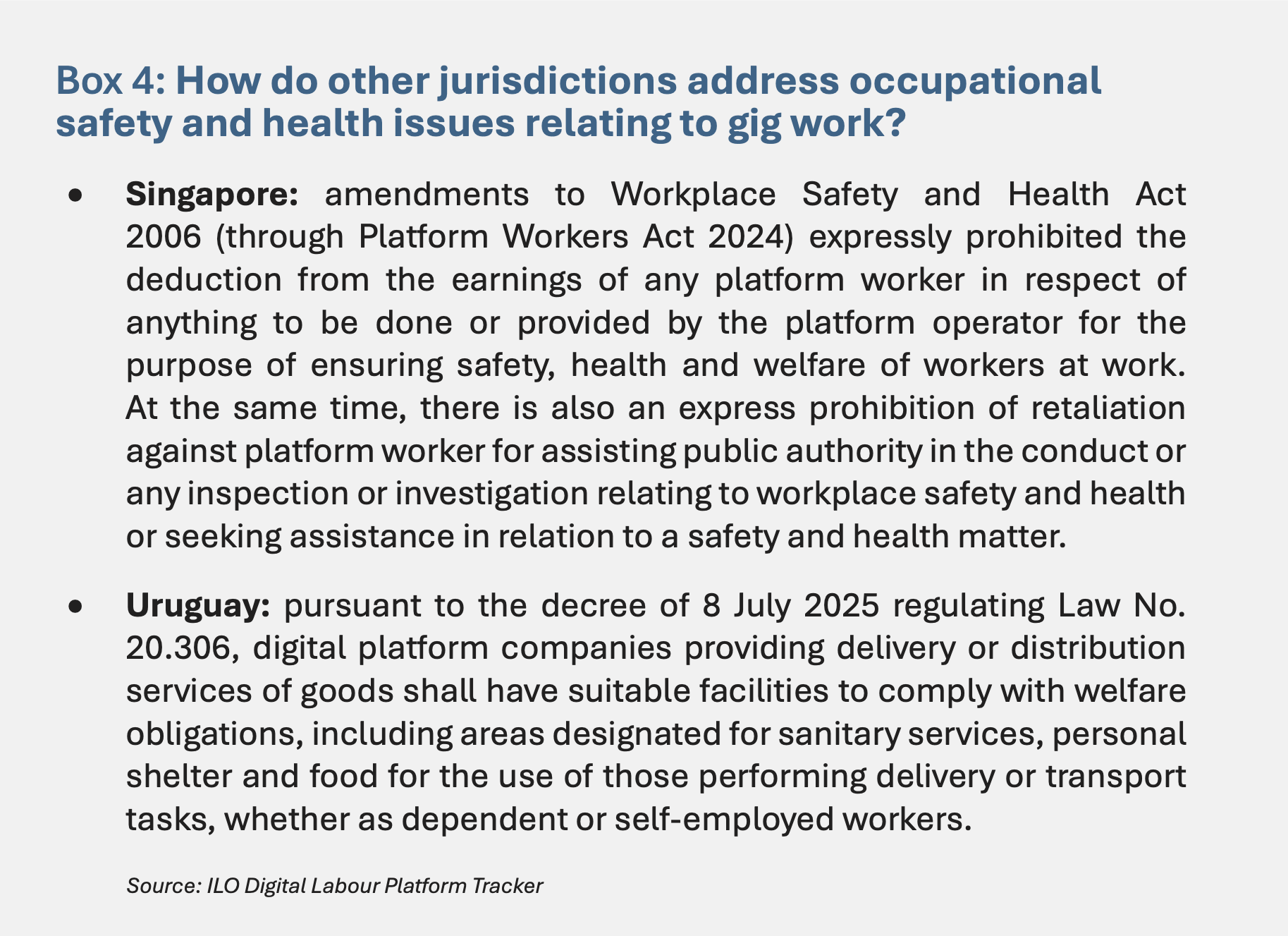
There seems to be an absence of clear anti-retaliation protection in the OSH context. The act does not sufficiently protect gig workers who report unsafe conditions, cooperate with DOSH inspections or investigations, or seek help on safety and health matters, and could leave gig workers vulnerable to suspension, reduced work allocation, deactivation or similar penalties.
Equally, it is not clear whether the act mandates contracting entities (including platform providers) to bear the costs of OSH measures. While the act imposes OSH duties as described above, it is important to ensure that the cost of compliance not to be shifted onto gig workers through deductions from their earnings or other indirect means.
Reform options
Reforms should consider strengthening statutory language with respect to the parties bearing the cost of OSH measures and providing protection against retaliation. This could take the form of statutory language clarifying that contracting entities (including platform providers) would be responsible for the costs associated with occupational safety and health measures in the performance of service by gig workers. The act could also benefit from explicitly providing stronger protection against retaliation, so that gig workers are empowered to report unsafe working conditions, cooperate and assist in inspections and investigation conducted by DOSH, and seek assistance on safety and health issues without fear of adverse consequences.
In addition, reforms could consider strengthening platform providers’ obligation to provide or at least finance access to basic welfare facilities. These could include toilets, rest areas, shelter, drinking water and charging points for electric vehicles at designated areas. Such protections should apply to all platform workers regardless of their employment status, so that minimum welfare standards are secured because of the work performed rather than on legal classification.
4.5 Pillar 5: collective bargaining
Core issue
In Malaysia, gig workers are classified as self-employed and, therefore, have no access to collective bargaining. Yet freedom of association and collective bargaining are fundamental labour rights under the ILO Declaration on Fundamental Principles and Rights at Work. In gig work, collective bargaining is especially important to address unequal bargaining power and help secure fairer pay and working conditions for gig workers.
International Labour Standards clearly requires freedom of association and the right to collective bargaining be accorded to gig workers. Article 2 of the Freedom of Association and Protection of the Right to Organise Convention 1948 (No. 87) provided that the convention applies to all “workers”, “without distinction whatsoever”. The Committee of Experts on the Application of Conventions and Recommendations (CEACR) has also unequivocally clarified that the convention covers, among others, workers in the informal economy and self-employed workers.26 At the same time, Article 1 of the Right to Organise and Collective Bargaining Convention 1949 (No. 98), applies to “workers”, which seems to exclude gig workers to the extent they are categorised as self-employed. In this regard, CEACR stated that the right to collective bargaining should also cover organisations representing self-employed workers.
What the act does
The act affirms the freedom of association of gig workers, as well as giving them a collective voice through representation by way of gig workers’ associations in the Gig Workers’ Consultative Council. The act recognises gig workers’ right to form and join gig workers’ associations and to participate in their activities, recognising that the right to freedom of association extends to gig workers. In addition, the act envisages representation of gig workers’ associations in the consultative council, giving them a formal voice in national discussions on matters relating to minimum earnings rates and minimum standards, etc.
Remaining gaps
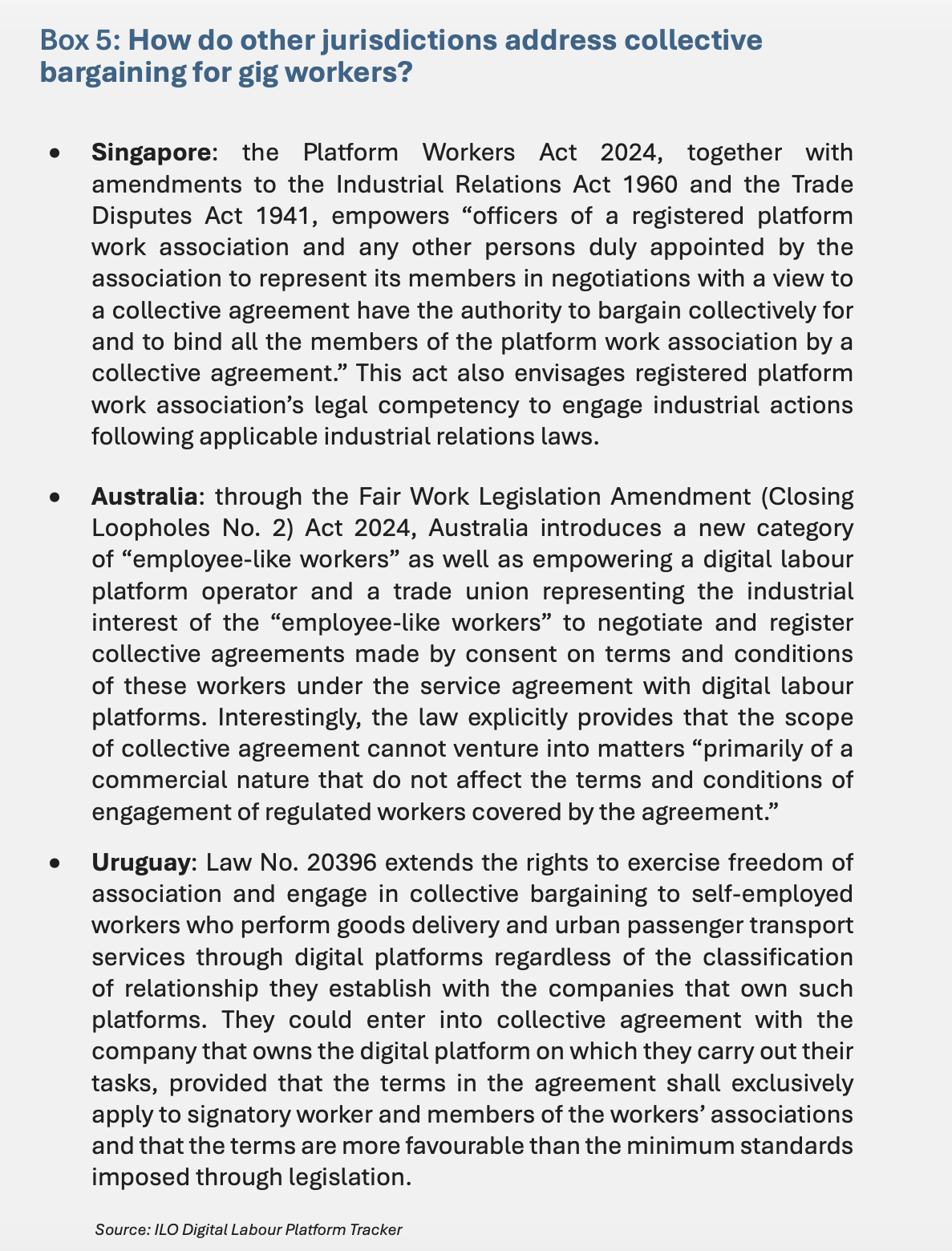
The act does not create a pathway for gig workers to conduct collective bargaining with contracting entities, including platform providers. Despite affirming freedom of association, the act stops short of allowing gig workers to conduct collective bargaining through gig workers’ associations. The act does not make an attempt to amend the definitions or procedures in existing industrial relations legislation governing the recognition of bargaining agents and conclusion of collective agreements, nor does it establish a mechanism for gig workers’ associations to be recognised as collective bargaining units able to initiate recognition processes or conclude collective agreements in the same way as trade unions. As a result, even after the introduction of the act, under the current Malaysian labour law framework, collective bargaining remains an exclusive right of “workman” and “trade union” defined under the Industrial Relations Act 1967 and Trade Unions Act 1959.
Reform options
International developments suggest that it is not uncommon for countries to extend collective bargaining rights to gig workers. Box 4 illustrates real-world examples of countries recognising platform or gig worker organisations as legally capable of conducting collective bargaining and concluding collective agreements on behalf of platform gig workers, defining the scope of bargaining, and providing procedures for registering and enforcing agreements. Common elements include clear rules on which organisations may represent platform workers, structured recognition processes vis‑à‑vis platforms, and some form of oversight by a public body over collective agreement.
Looking ahead, this raises an important question as to whether balanced labour relations in the gig economy can be achieved without mechanisms for collective bargaining. Further policy development may be relevant and necessary to ensure greater coherence with fundamental labour rights principles and evolving international practice. In this regard, bodies like the Gig Workers’ Consultative Council, coordinating with the Ministry of Human Resources and social partners, could play an important role in assessing the feasibility of extending full collective bargaining rights to gig workers, whether through existing associations or reforms to the current legal framework that would allow gig workers to form trade unions.
4.6 Pillar 6: dispute resolution
Core issue
Gig workers have traditionally had limited channels to raise and resolve grievances. Complaints relating to remuneration, unfair deactivation, algorithmic decision-making, harassment or unsafe working conditions have often had to be pursued through mechanisms designed and entirely controlled by platform providers. This tends to reinforce the imbalance of power between gig workers and platform providers, as gig workers are left without predictable procedures, accessible human points of contact or affordable and independent avenues for challenging decisions that directly affect their livelihoods.
What the act does
The act introduces multi-layered dispute-resolution procedures and recognises access to dispute resolution as a statutory right. Non-individual contracting entities must provide an internal grievance mechanism in the service agreement and any dispute lodged by a gig worker must be addressed and resolved within 30 days. This is a novel feature absent even in the formal industrial relations framework between employees and their employers in Malaysia. If the dispute is not resolved internally, the gig worker may lodge a complaint for conciliation by the Department of Industrial Relations. Where conciliation fails, the matter is referred to a newly established Gig Workers Tribunal, which has jurisdiction to hear and determine disputes and issue binding awards, with a further right of appeal to the high court for aggrieved parties.
This multi-step structure offers more transparency and predictability. It takes into account a balance of interests of all parties, encourages resolution at the lowest possible level (internal grievance handling) while providing access to neutral third-party conciliation and a tribunal with powers to deliver enforceable award when necessary.
Remaining gaps
The act leaves the content and quality of internal grievance mechanisms largely undefined. While the act mandates an internal grievance mechanism to be set up by digital platforms through the service agreement (which should usually already be in place in most digital platforms), it does not specify minimum standards or what such mechanisms should entail as well as how it would be implemented. In practice, this may increase the risk that some internal grievance mechanisms falling short of providing meaningful, accessible or timely resolution.
There is still uncertainty about how the tribunal would approach key issues, such as deactivation and contract termination. As will be discussed under the fair deactivation pillar (Section 4.7), the relationship between the terms of the service agreement, the concept of “misconduct” and “just cause and excuse” protection seems murky and how these elements affect adjudication of fair deactivation remains unsettled. It is unclear whether and to what extent the tribunal will draw on existing and well-established jurisprudence of unfair dismissal, in particular the legal concept of “misconduct” developed under Section 20 of the Industrial Relations Act 1967 or how it will interpret and reconcile the seemingly conflicting position of supremacy of contract and statutory standards.
Effective representation before the tribunal depends on the capacity of gig workers’ associations, which would require comprehensive support. The act anticipates that gig workers may be represented by an “authorised member of the gig workers’ association” (or family members). For associations to play this role effectively and adequately, their organisational development, legal literacy, access to relevant information and data, as well as their ability to engage in grievance and policy processes would be critical. Without adequate financial and institutional-strengthening support, there is a risk that representation would be rendered formalistic rather than substantive, limiting the potential of the dispute-resolution framework established through the act to correct power asymmetries between workers and technology platforms.
Reform options
The multi-layered system in the act has strong potential to enhance access to remedy but its effectiveness will depend on how it addresses some of the issues highlighted above. In the short to medium term, it may be useful to develop guidance or subsidiary regulations setting minimum standards with respect to internal grievance mechanisms, clarifying how the tribunal should approach deactivation and contract-termination cases within the statutory framework envisaged in the act, and allocate sufficient resources in supporting gig workers’ associations with adequate institutional strengthening and capacity building so they can represent their members effectively in case of disputes within this newly established dispute-resolution framework.
4.7 Pillar 7: fair deactivation
Core issue
Deactivation of gig workers from digital labour platform has emerged as a critical governance issue in the gig economy, yet protections accorded to workers are limited. For gig workers, deactivation, even on a temporary basis, often means immediate disruption of their access to income and livelihood. In Malaysia, the relationship between platform providers and gig workers is typically governed through commercial service agreements, raising recurring concerns about the adequacy of prior notice, procedural fairness and sufficient oversight in deactivation decisions. These concerns stand in stark contrast to the stronger protections and due process requirements afforded to “workman” under standard labour legislations, including under Section 20 of the Industrial Relations Act.
What the act does
The act grants platform providers broad statutory rights to “deactivate” gig workers’ access to their digital intermediary system. “Deactivation” is broadly defined as when “the platform provider modifies, suspends or terminates the gig worker’s access to his digital intermediary system in a way that prevent the gig worker from performing his service under the service agreement.” Subsection 14(1)(a) grants platform provider the right to deactivate gig workers’ access to the digital intermediary system if it is “in accordance with the terms and conditions under the service agreement”, while subsection 14(1)(b) further allows deactivation where any “misconduct” is committed in the course of performance of service by gig workers. At the same time, subsection 14(6)(a) empowers platform providers to permanently terminate both the gig workers’ access to digital intermediary system as well as their service agreement with the platform provider, if deactivation is found to be supported by either subsection 14(1)(a) or subsection 14(1)(b).
Platform providers also have the power to modify or suspend access of gig workers to his digital intermediary system for the purpose of conducting an inquiry and impose penal measures. Platform providers can suspend access to the digital intermediary system for up to 14 days for the purpose of conducting an inquiry. If the platform provider finds that deactivation is justified under subsection 14(1)(a) or 14(1)(b), they can choose to either impose a further seven-day suspension against the relevant gig workers by way of disciplinary measure or permanently terminate the said gig workers’ access to the digital intermediary system as well as their service agreement with the platform provider. Conversely, if the platform provider ultimately finds no reason to support decision on deactivation, it must reactivate gig workers’ access but only has to pay the gig workers half of their average daily earnings for the modification or suspension period as compensation.
Remaining gaps
The act does not set clear and substantive standards for what counts as a valid or invalid reason for deactivation. Instead of taking the opportunity to clearly define and articulate normative grounds for deactivation, the act defers to service agreement terms and broad notions of “misconduct”. This arrangement leaves wide discretion with platform providers, with little clarity and guardrails to ensure that deactivation decision is as transparent and predictable as possible. Without clearer standards, deactivation decisions could be driven by opaque, automated or commercial criteria, weakening transparency and predictability. It also increases the risk of inconsistent enforcement and makes it harder for workers to understand expectations or challenge questionable decisions.
The inquiry procedures appear to fall short of basic due process and expose gig workers to substantial income risk. Although the act recognises a gig worker’s “right to be heard”, based on the plain reading of the legislative language, this right arises only (a) after an initial suspension of up to 14 days pending an inquiry; (b) after the platform provider has already reached a conclusive finding that deactivation is justified (under the service agreement or for alleged misconduct); and (c) immediately before any disciplinary action (which take the form of either a further suspension of up to seven days or permanent termination of access to the digital intermediary system and the service agreement) is imposed. In practice, this mean gig workers could lose access to the digital intermediary system and thus, earning opportunities, for up to 14 days without being fully informed of the allegations against him or given a meaningful chance to respond to such allegation. In addition, even if no valid basis for deactivation is found after an inquiry, compensation is capped at half of the worker’s average daily earnings for the suspension period. Overall, the rules shift much of the economic risk of precautionary or erroneous suspensions of access to the digital intermediary system onto gig workers without adequate justification.
The potential interplay between the concept of “deactivation” and termination of service agreement “with just cause and excuse” raises several questions that require further clarification. Questions arise as to what would be considered as service agreement termination “with just cause or excuse” in the context of the act – and how this relates to the procedures concerning deactivation. Specifically zooming into the concept of “misconduct”, further unanswered questions include to what extent the tribunal should refer to and apply the jurisprudence of the same legal concept developed in the Industrial Court when adjudicating on deactivation related disputes? All these are crucial questions that need to be clarified to ensure consistency and predictability in the gig economy.
Reform options
Deactivation rules can be strengthened by clearly setting out both valid grounds and prohibited factors for deactivation and contract termination, alongside with earlier and fuller procedural protections (Box 7). Minimum statutory standards could, for instance, specify categories of conduct that amount to lawful grounds for deactivation and identify factors that cannot be used as stand‑alone reasons for deactivation, such as certain availability or rating metrics. This would improve predictability and legal certainty for both platforms and gig workers. In addition, it would be equally important to ensure the principle of natural justice be adhered to by allowing gig workers the earliest possible chance to respond to allegations against them.
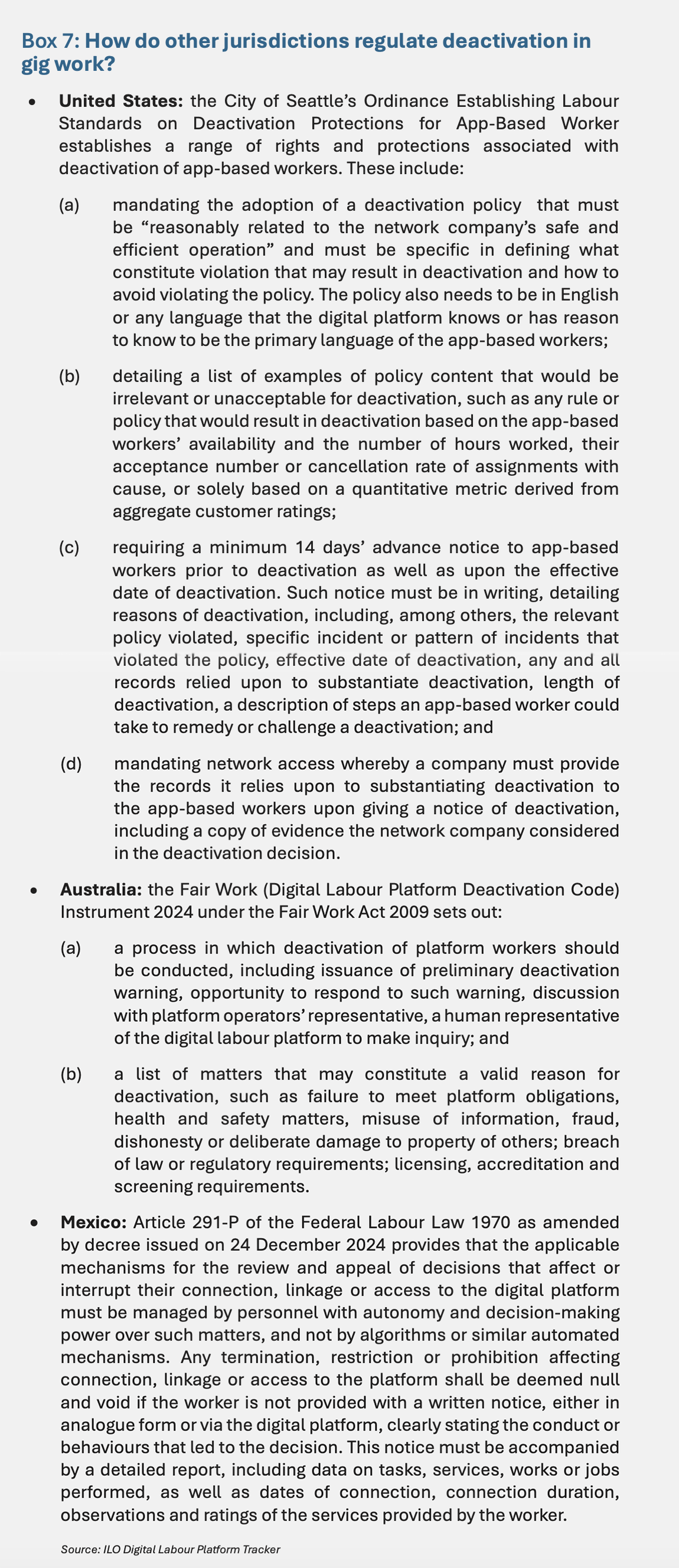
Within this framework, Malaysia could consider enhancing procedural fairness and risk allocation in a more balanced and calibrated manner. Options might include requiring advance written notice before any suspension that materially affects income, early disclosure of allegations and supporting evidence, and a meaningful opportunity for gig workers to respond before suspension or deactivation takes effect, except in clearly defined emergency situations. Where suspensions are ultimately found to be unjustified, providing full rather than partial compensation for lost earnings would better align the allocation of risk with the party whose decision gave rise to the loss. Incorporating such elements into the act or its subsidiary legislation would move the deactivation framework closer to principles of natural justice and due process, while still allowing room to accommodate legitimate operational and safety concerns of digital platforms.
4.8 Pillar 8: algorithmic governance
Core issue
Algorithms are central to platform work but often operate opaquely, making it hard for gig workers to anticipate or challenge decisions that affect their livelihoods.27 Algorithmic systems plan and optimise operations, allocate tasks or jobs, monitor and control performance, manage and evaluate workers, as well as discipline or reward them depending on the circumstances, yet the exact criteria used and the consequences of these automated systems are rarely clear to workers.28 This lack of clarity and transparency often means gig workers would struggle to understand how and why their earnings, access to jobs and account status are subjected to moment-to-moment changes. They also typically have limited ability to contest potentially erroneous, arbitrary or unfair decisions.
What the act does
In response, the act introduces basic information and review rights in relation to automated systems used by platform providers. Section 8(2) requires that gig workers who contract with a platform provider to be informed of the automated monitoring systems used “to monitor, supervise or evaluate” them, including the consequences of such systems, and of any automated decision-making used to assign services and working conditions. The act also provides that gig workers must be given access to a “non-automated review mechanism” in relation to these systems.
Remaining gaps
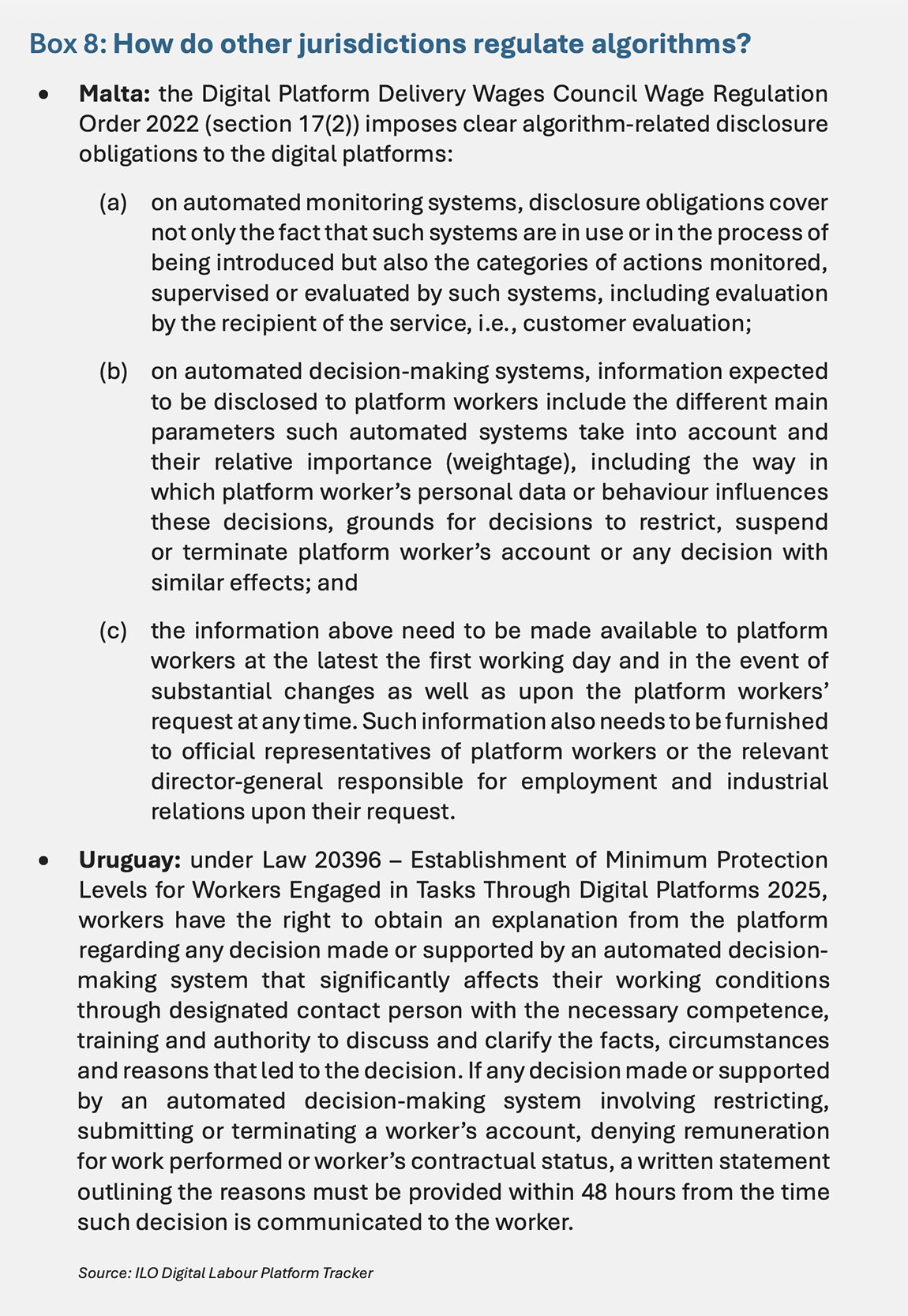
The act requires that workers are “informed” of automated systems but does not seem to require meaningful explanation of how they operate. The act provides that digital labour platforms must inform gig workers when automated systems are used but there is no legal requirement to disclose exactly what data are monitored, which specific actions or behaviours are evaluated, what criteria are applied, the relative weight of those criteria or the logical rules by which decisions (such as task allocation, prioritisation or punishment) would be reached.
The act also does not set substantive standards for the design or use of algorithms to safeguard decent working conditions. There are no explicit requirements that automated systems be proportionate, non‑discriminatory or designed to avoid arbitrary or excessive impacts on gig workers, nor is there any obligation to test for or mitigate bias, unfair differential treatment or unreasonable penalties. Likewise, while a “non‑automated review mechanism” is mentioned, the act does not specify in what situations it must be made available, any time limit, responsible parties conducting the review, what level of human authority is expected or the extent of powers such a review mechanism wields to uphold or overturn automated decisions.
Reform options
To improve the regulation of algorithmic management, the act could adopt a more substantive and rights-based framework. This would include, among others, mandating digital platforms to explain in clear and accessible terms how automated systems operate in practice, including criteria, their relative weight and consequences for workers. The act could also take the opportunity to introduce minimum standards governing the design and use of algorithms, such as proportionality and non-discrimination.
Similarly, the provision related to non-automated review could be strengthened through clarifying specific details. This includes setting out when human review must be made available, who conducts it, applicable timelines and relevant authority empowered to review and overturn automated decisions. Similarly, written explanation for decisions made or supported by algorithms would also go a long way in improving access to opportunities in challenging and overturning automated decisions.
4.9 Pillar 9: personal data and privacy protection
Core issue
Data collection and use in platform work is increasingly understood as a working conditions issue, rather than just a technical data protection concern.29 Common workplace-monitoring practices in the context of gig work include performance monitoring, behaviour monitoring and monitoring of personal characteristics.30 These practices can directly affect job allocation and, therefore, level of income, disciplinary action and gig workers’ continued access to work. Suffice to say, data governance is linked to core aspects of gig workers’ livelihoods.
What the act does
The act does not explicitly regulate personal data protection or privacy for gig workers. Although it acknowledges automated monitoring and decision‑making systems in relation to algorithmic management, there does not appear to be any clear provision that sets out substantive limits on the types of personal data that could be collected or processed, how long data may be retained or for what purposes such data could be used. Nor does it articulate specific privacy rights or data‑access rights for gig workers, leaving their data protection interests primarily to the general framework of the Personal Data Protection Act 2010 (PDPA) and its subsidiary legislations.
Remaining gaps
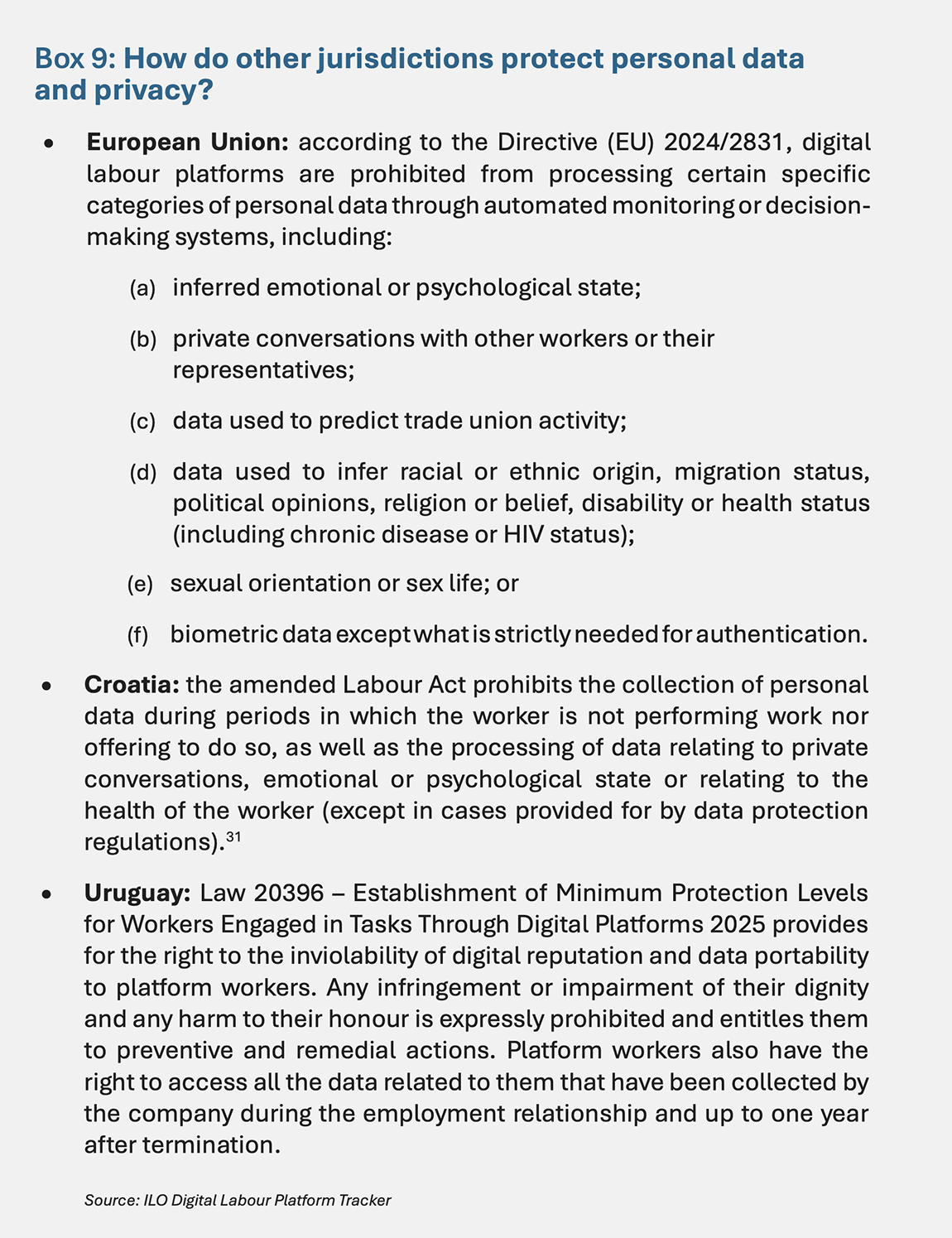
There are no explicit guardrails on the categories of worker data that platforms may process in connection with algorithmic management. In particular, the act does not address whether sensitive or highly intrusive categories of personal data, such as inferred emotional state, health status, workers’ association or trade union activity or private communications, may be used in monitoring or decision-making systems and, if so, whether any applicable limit applies. Similarly, worker-oriented rights around data access, portability and reputational protections are also not articulated. Unlike some emerging practices (Box 9), the act at first glance does not seem to grant gig workers explicit rights to access all data held about them by platform providers. In addition, there is also no clarity whether gig workers have the right to obtain their respective personal data in reusable formats (data portability) or have the right to have their “digital reputation” protected from unfair harm.
Reform options
Given the centrality of algorithmic systems and data in the platform economy, data protection and privacy protection may merit closer, coordinated attention. If the regulation of gig workers’ personal data is to be governed primarily under PDPA, there is enormous value in establishing strong governance and coordination mechanisms between the consultative council under the act, Department of Labour in Peninsular Malaysia, Sabah and Sarawak, as well as the Personal Data Protection Commissioner Office and Personal Data Protection Department under the Ministry of Digital. Such coordination could support tripartite discussions on whether restrictions on the processing of gig workers’ personal data, particularly sensitive data, such as inferred emotional or psychological state, data with respect to gig workers’ associations or trade union activities, and political opinions are warranted in the gig work context, and how such limits could be implemented in practice.
Within this framework, stakeholders could also explore sector-specific guidance or codes of practice tailored to platform work. A code of practice developed under PDPA, in consultation with social partners and relevant agencies, could clarify expectations on the types of data that may be collected for platform management, conditions for processing sensitive data, retention limits, workers’ access and portability rights, and safeguards for digital reputation.
5 Conclusions and implementation challenges
The Gig Workers Act represents a significant and reasonable starting point in advancing decent work among gig workers but important gaps remain and, as a result, gig worker power imbalances are only addressed partially. As the analysis here demonstrates, concerns and key questions persist in relation to remuneration adequacy; substantive safeguards around deactivation; governance of algorithmic management; access to collective bargaining; social security financing; working time arrangements; as well as personal data and privacy protection. In several areas, protections are procedural rather than setting clear substantive standards. If some of these decent work concerns are not progressively addressed, there is a risk that the legal framework will entrench relationships in which platform providers retain a structurally dominant position over gig workers’ income, voice and security.
The tripartite Gig Workers’ Consultative Council will be pivotal in deciding to what extent this structural imbalance is corrected or left intact. If effectively constituted and supported, the council can act as the central forum for evidence-based, phased and consensus-driven policy development on matters, such as minimum earnings standards, social security contributions, deactivation and disciplinary rules, algorithmic transparency and review. As such, how the council chooses to exercise this role, including how substantively balanced its membership is in practice (see 4.4), will heavily influence whether the act can bring labour standards and protections in gig work closer to the norms applied to other parts of the labour market.
Robust implementation, enforcement and interagency coordination will be critical in ensuring that this translates into shifts in protection and wellbeing. Effective protection for gig workers will depend on how consistently they are applied and enforced by the Department of Labour, DOSH, Perkeso, EPF, Department of Personal Data Protection as well as the soon-to-be-established Malaysian Gig Economy Commission (SEGiM).32 It must be emphasised that clear allocation of mandates and regulatory power, regular information sharing and close coordination among government departments, statutory bodies and the consultative council will go a long way in ensuring robust implementation of the act and continuous improvement of the welfare of gig workers.
In the longer run, achieving a truly equitable platform economy may require contending with the structurally uneven dynamics of the platform model itself. This could mean that beyond closing decent work deficits, policymakers could also consider long-term approaches that democratise control over digital infrastructure and orient technology towards inclusive developmental goals. Emerging examples of such democratic platform models internationally, including worker cooperatives, public or community platform models, suggest that viable pathways towards decent work already exist.33