Transformational adaptation refers to climate change adaptation efforts that aim to achieve long-term systemic improvements across sectors, as compared to incremental changes. Malaysia, as a developing nation in Southeast Asia, is set to face increased vulnerabilities unique to the region in the coming future, and it must move beyond mitigation efforts to invest in adaptation strategies. Its ongoing efforts, primarily through the Malaysia National Adaptation Plan, aims to map out a more holistic approach toward the country’s climate action strategies, conceptually moving toward transformational adaptation. The plan identifies infrastructure and cities as a national priority sector with unique vulnerabilities, given the rapid urbanization rates that are expected to reach up to 90% by 2050, as well as increased concentration of climate impacts such as heat waves and flash floods. It also aims to be informed by equity through measures such as inclusion of gendered perspectives. Despite this approach, efforts are still sidelined by an overemphasis on climate mitigation, on top of existing fundamental gaps such as lack of climate risk assessments, reliance on band-aid measures and weak cross-sectoral coordination. Marginalized communities such as urban poor, women, children, and youth also face these vulnerabilities, but many times over. Hence, this commentary aims to explore the readiness of urban Klang Valley in adopting transformational adaptation measures, with emphasis on adaptive capacity and climate justice principles. It will stock-take existing policy measures on adaptation and assess understanding of structural change across stakeholders. It will also provide recommendations toward adaptation measures that embody more whole-of-society approaches aimed at achieving long-term societal change.
Introduction
Climate adaptation is no longer an option but an imperative among countries in a world that continues to breach tipping points and obscure the view toward a 1.5°C future. This statement is particularly true for developing nations, who are far more likely to face climate impacts and far less likely to have the ability to cope with its escalating effects. Adaptation pertains to one of three key pillars of climate action outlined under the Paris Agreement (United Nations, 2015). In particular, it sets out to achieve a global goal on adaptation for “enhancing adaptive capacity, strengthening resilience and reducing vulnerability to climate change,” acknowledging that adaptation action must involve a country-driven, inclusive approach that takes into account all stakeholders and lived environments.
As the world’s understanding of adaptation continues to develop, the concept of transformational adaptation has increasingly entered the lexicon of international climate governance. In its Sixth Assessment Report (AR6), the Intergovernmental Panel on Climate Change (IPCC, 2022) refers to transformational adaptation as “adaptation that changes the fundamental attributes of a social-ecological system in response to climate change and its effects.” In other words, it signals the need to move beyond incremental efforts of conventional adaptation methods and opt for long-term systemic improvements across all spatial scales and sectors alongside sustainable development frameworks (UNFCCC, 2024).
The IPCC AR6 recognizes that while progress in adaptation planning and implementation has increased across all sectors and regions, most of these measures prioritize immediate and near-term climate risk reduction, hence reducing the opportunity to implement transformational adaptation measures (IPCC, 2023). At the United Nations Framework Convention on Climate Change (UNFCCC) level, during the 29th Conference of Parties (COP29), negotiations on adaptation recognized the role of transformational adaptation as an enabler of global adaptation efforts (Chandrasekhar et al., 2024).
Malaysia, as a nation located in one of the most climate-vulnerable regions in the world, is set to face increased vulnerability toward climate impacts, including extreme weather conditions and sea-level rise (Hicks, 2021). Indeed, in recent years, the country has been hit with heavy rainfalls and heat waves, notably the “once-in-a-century” rainfall-induced flood in 2021, leading to at least 50 deaths and 400,000 displacements across Peninsular Malaysia (Rahman, 2022), the effects of which are still felt today. Beyond that event, frequencies of heat waves across Southeast Asia have not spared Malaysia, with 2024 reporting 45 cases of heat-related illnesses, including two fatalities from heatstroke (Paramasivan & Ismail, 2025).
Currently, Malaysia largely employs a band-aid, reactive approach toward addressing these issues, taking on a mitigation-centric approach in tackling the climate crisis. However, the country has begun to develop a more holistic understanding and approach toward climate action. At the national level, the Malaysian government is on a journey toward strengthening its policy framework. For example, Malaysia recently updated its National Climate Change Policy in 2024, and it is now working on the National Climate Change Bill (RUUPIN) and Malaysia’s National Adaptation Plan (MyNAP), both long-awaited policies.
Tangential to these efforts, Malaysia is currently undergoing a rapid process of urbanization, with 77% of Malaysia’s total population living in cities in 2024 (United Nations, 2025); this figure is expected to reach 85–90% by 2050 (UN-DESA, 2018). Along with this urbanization, Malaysia is an emerging economy that is expected to achieve developed nation status by 2028 (World Bank, 2021).
The central hub of urbanization in Malaysia is “Klang Valley.” Klang Valley is actually an unofficial term largely used to describe the urban agglomeration spanning the federal territories of Kuala Lumpur and Putrajaya, as well as several districts within the state of Selangor, according to the Economic Transformation Programme. Klang Valley is the most economically productive conurbation within Malaysia, resulting in major migratory shifts on a national scale spanning decades. As such, approximately 26% of all Malaysians currently reside in Klang Valley, amounting to 9 million Malaysians. As no specific definition is prescribed for usage by the Malaysian government, this paper includes all of Selangor within Klang Valley’s boundaries.
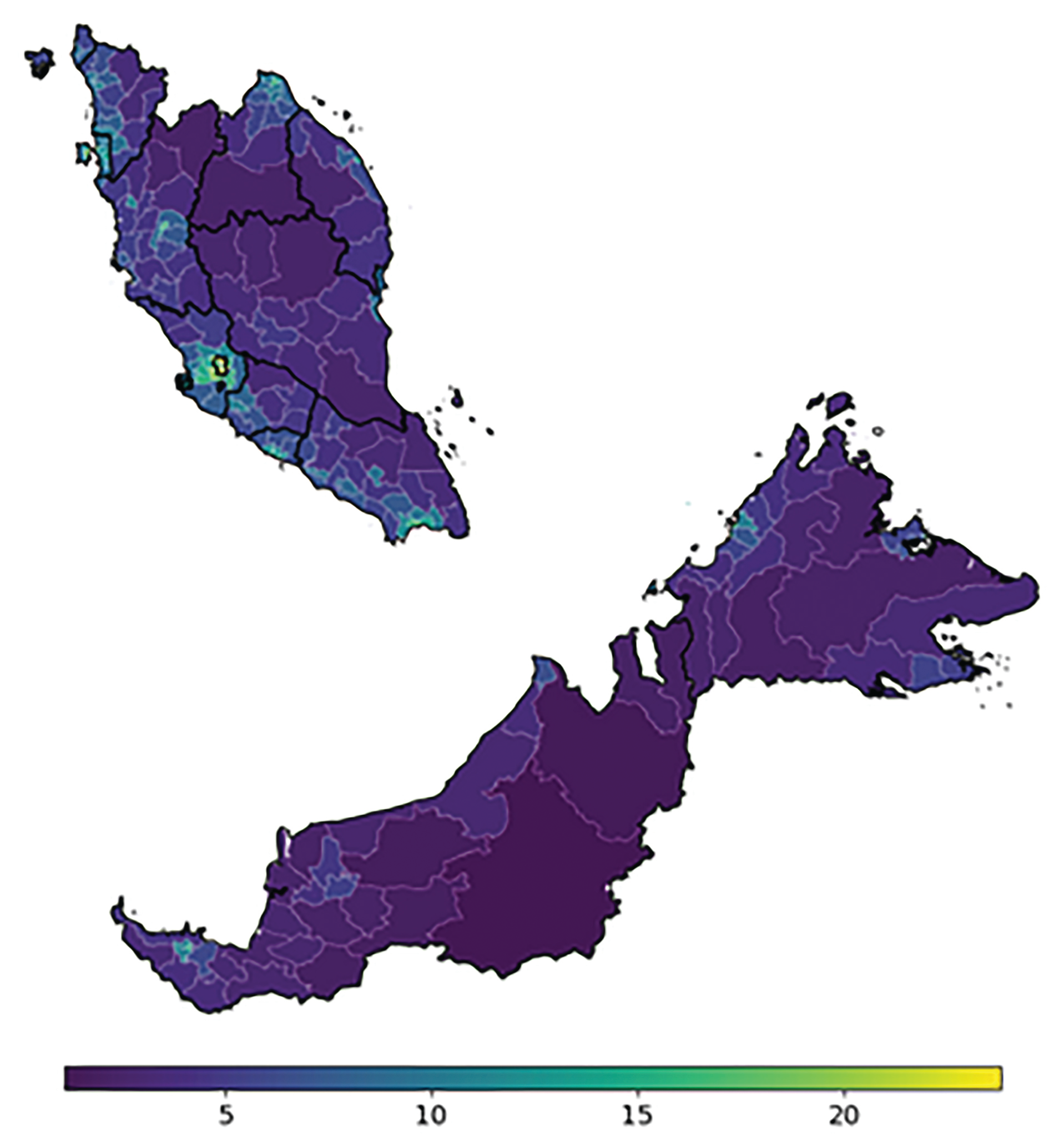
Source: Department of Statistics Malaysia, 2020 census data Note: Klang Valley is the densest region in Malaysia
Figure 1: Population density of Malaysia by parliamentary boundaries per km2
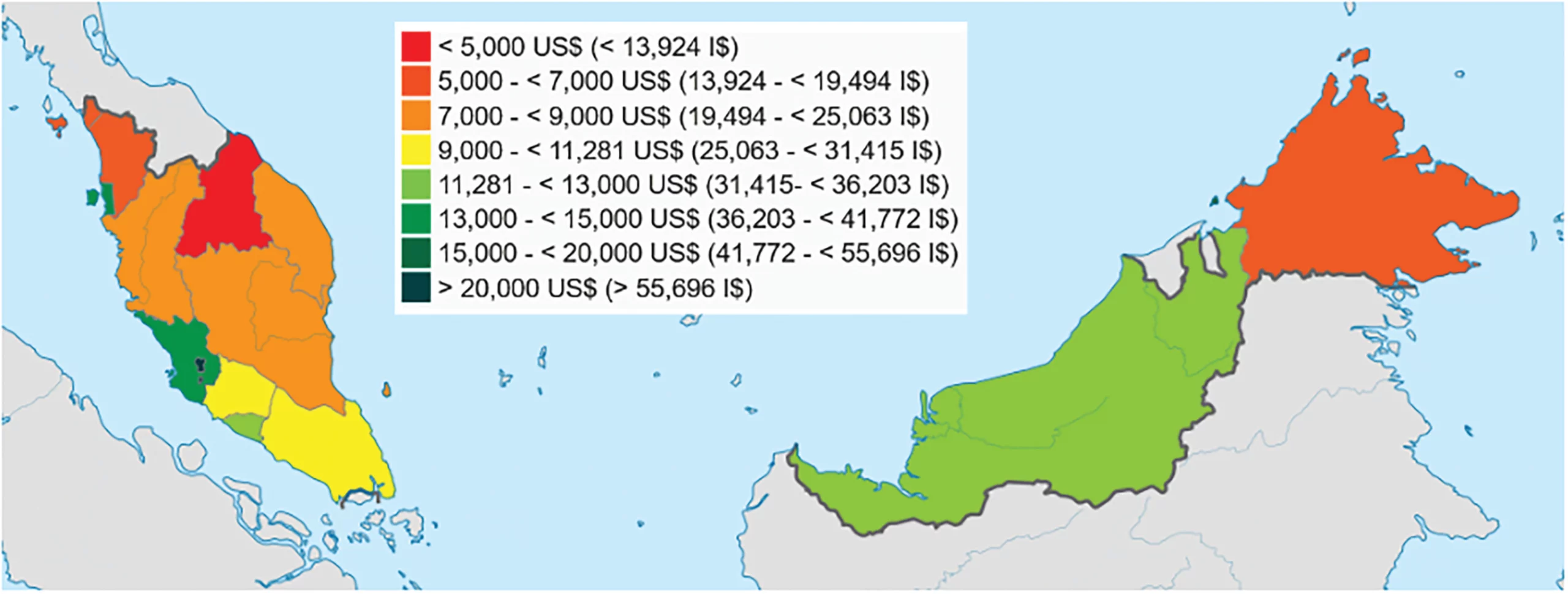
Source: Department of Statistics Malaysia Note: Nominal GDP per capita in Malaysia is the highest in the Klang Valley
Figure 2: Malaysian states and Federal Territories by nominal GDP per capita (USD) in 2020.
According to Malaysia’s first Biennial Transparency Report (2024), sector-specific vulnerabilities are identified for urban infrastructure, primarily the increased frequency of floods and urban heat island effect impacting transport, housing, and economic activities (NRES, 2024). These factors are only set to increase as the years pass, on top of the cascading impacts for vulnerable communities. UNICEF (2021) highlighted the unique impacts of climate change faced by children in Malaysia, particularly the increased risk of illness. These issues are also crosscutting, wherein their impacts are more acutely felt by additionally vulnerable communities, such as low-income communities and girls, due to barriers in accessibility of vital care services and existing societal barriers, respectively. With these issues, there is a great need for targeted, strategic measures to integrate equity and justice-oriented policymaking to ensure nobody gets left behind.
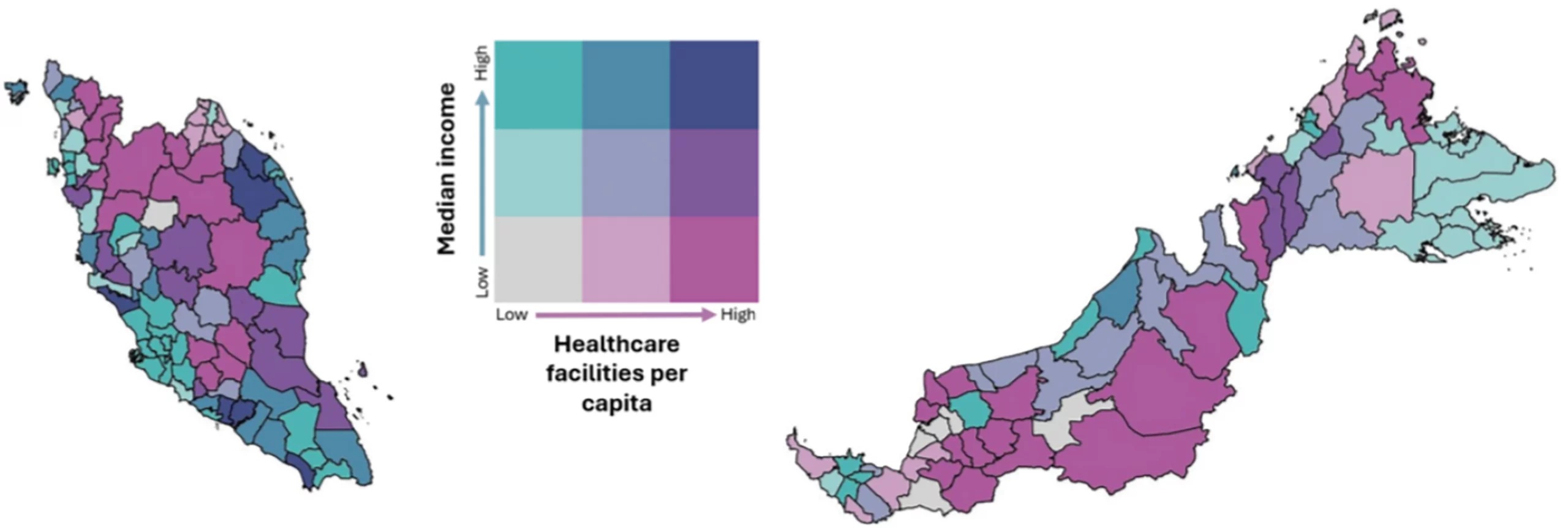
Source: Department of Statistics Malaysia, Ministry of Health Malaysia Note: Only a handful of Malaysian districts exhibit both a high median income and a high concentration of public health care facilities
Figure 3: Bivariate map displaying the relationship between median income to number of health care facilities per capita by district.
Malaysia has been giving urban areas and infrastructure its due attention when it comes to resilience-building measures; however, many gaps still remain at the implementation level. Given this issue, there is a crucial need to explore the readiness of Malaysian urban areas, particularly Klang Valley, in adopting transformational adaptation measures. This commentary sets out to do so, with emphasis on current adaptive capacity as well as climate justice principles employed in this process. It stock-takes existing urban and climate adaptation measures, and it also assesses the embodiment of structural, systemic change across sectors and stakeholders. Through this assessment, the commentary delves into gaps, offers a case study, and subsequently provides recommendations toward adaptation measures that embody a whole-of-society approach aimed at achieving the long-term societal changes needed for Malaysia to achieve resilience against escalating climate impacts in urban areas.
Current situation
Urban flood incidences
As an economic heartland, the intense urban expansion in Klang Valley has magnified climate risks. Floods, for example, are not just a result of natural disasters but also consequences of poor planning and land-use change (Rahman, 2022). Over the past two decades, authorities have built highways, shopping malls, and high-density housing without restoring upstream wetlands or upgrading drainage accordingly.
As a result, flash floods have escalated in severity. In addition, monsoon downpours and intense convective storms routinely overwhelm drainage networks. Impervious concrete now covers much of the watershed, sharply increasing stormwater runoff into rivers and canals (Afandi, 2022). For this reason, each new flood inundates this hardscape before it can drain away. In one recent record-breaking event, the state of Selangor saw continuous rains exceed 380 mm in a single day—more than double the volume of historical records (Rosmadi et al., 2023).
In December 2021, this event coalesced into a catastrophe: anomalous rainfall triggered massive floods across Malaysia, forcing many residents into evacuation centres and causing official losses of about USD 1.5 billion (Rahman, 2022). The state of Selangor bore the brunt of these losses, with USD 97 million representing losses of homes and businesses in the districts of Klang, Petaling, and Hulu Langat. These patterns evidently proved that new building developments that result in hardened surfaces, blocked waterways, and fringing levees have been outpaced by climate change–driven rainfall surges (Rahman, 2022). Each new flood drives home that Malaysian infrastructure and masterplans currently lag behind real-time trends.
Other climate aggravated extremes
Beyond urban floodings in Klang Valley, climate stress also comes in the form of heat waves and transboundary haze. Rising global temperatures have made extreme heat spells more common even in typically mild climates like those found in Malaysia. By the country’s standards, Klang Valley has experienced significant heat waves in 2019 and again in 2020, where it saw more than three days of consecutive heat waves of 37°C and above (Muhamad et al., 2024). These urban heat episodes are magnified by the dense concrete cityscape, also known as the urban heat island effect, which drives local temperatures to dangerous levels. As such, it is shown that Peninsular Malaysia’s extreme-heat area is growing rapidly—on the order of more than 9 km² per decade since 1950—which means that more people will face prolonged heat stress as time progresses (Muhamad et al., 2024).
Meanwhile, recurrent dry-season haze has become a calendar risk. For example, government analyses of past haze episodes note that stagnant weather and local sources, including but not limited to vehicle exhausts and factory fumes, compound aggravated air quality during events such as the 1997 crisis (DOE, 2021). Added stress onto health care systems are also common with an uptick of health impacts, with increased frequencies of hospital visits for treatments related to respiratory function and even mortalities, particularly with children and the elderly (Latif et al., 2018).
Malaysians are also known for their heavy reliance on private vehicles, and this factor is noted as a major driver of local smog. As the city continues to develop into a metropolis, ownership and use of cars in Kuala Lumpur itself is recorded as one of the highest in Asia, with nearly 900 vehicles per 1000 people (Asian Transport Observatory, 2024). The result of this rise in the number of motor vehicles is a steady rise in exhaust emissions; recent records show a 4–5% jump in registered cars and motorcycles in 2022 alone (Awani International, 2024), and higher urban ozone and carbon monoxide levels trace growth in the number of motor vehicles.
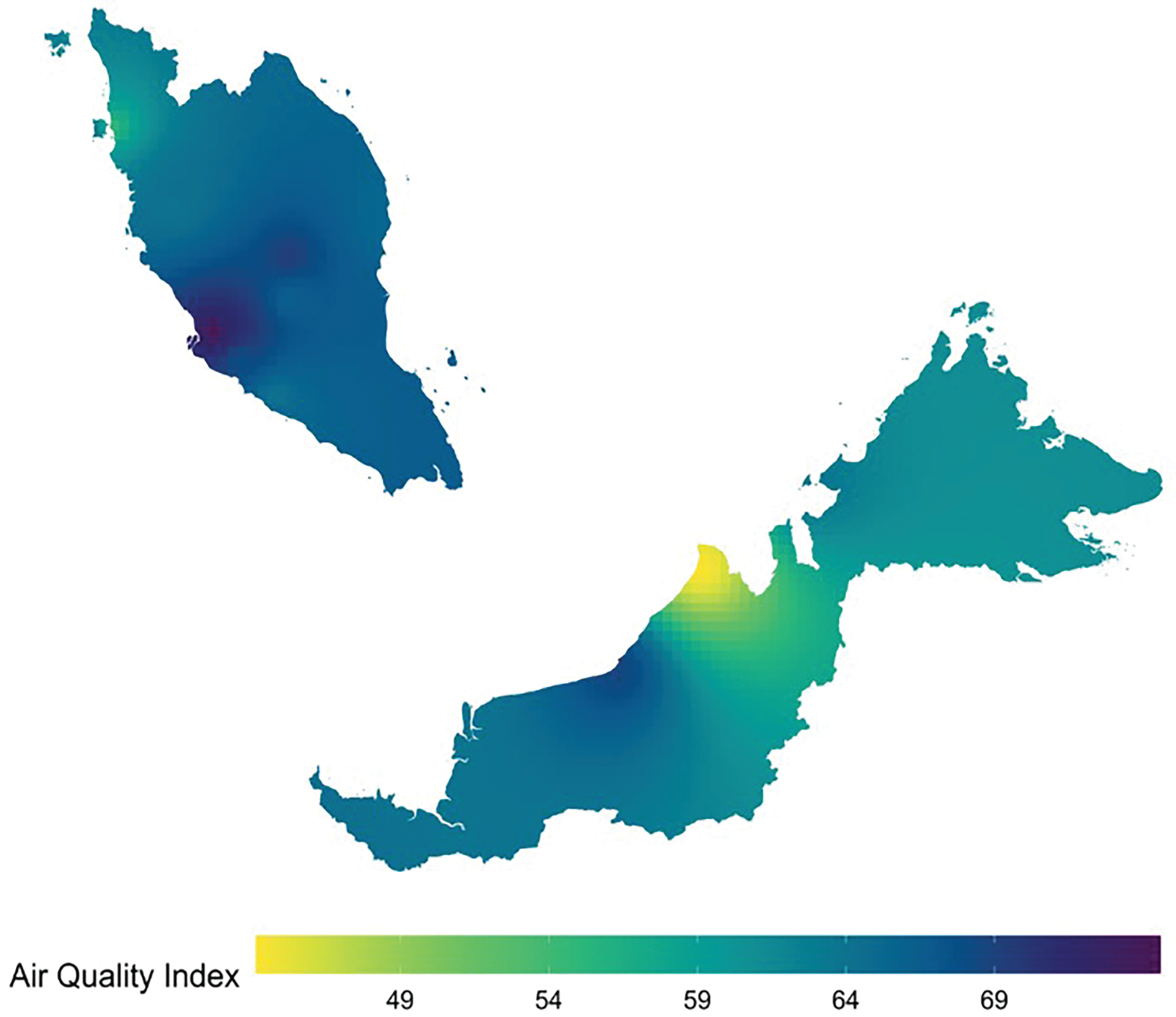
Source: waqi.info Note: Klang Valley has the worst levels of air quality within Malaysia
Figure 4: Air pollution index map for Malaysia using interpolated WAQI data
Worsening this issue are the frequent transboundary haze occurrences that plague the Klang Valley, stemming from dry-season peat fires in Sumatra and Kalimantan blowing smoke across the straits.
As haze exacerbates, other urban climate stresses are also compounded. These smoke episodes typically occur during the same hot and dry periods that also drive urban heat waves, water shortages, and drought‐related health problems (Sahani et al., 2022). When heavy rainfall strikes, flood risk surges; hence, cities face a double burden of burning summers and flooding monsoons. Climate research in Malaysia warns that air pollution hazards will amplify heat stress, and low-income communities bear the brunt of these exacerbated conditions (Sahani et al., 2022). In effect, haze acts as a cascading climate risk: it overlaps with extreme heat and flood events, which eventually heighten health impacts especially for the poor and marginalized.
Inequalities in governance hinge on geographical contexts
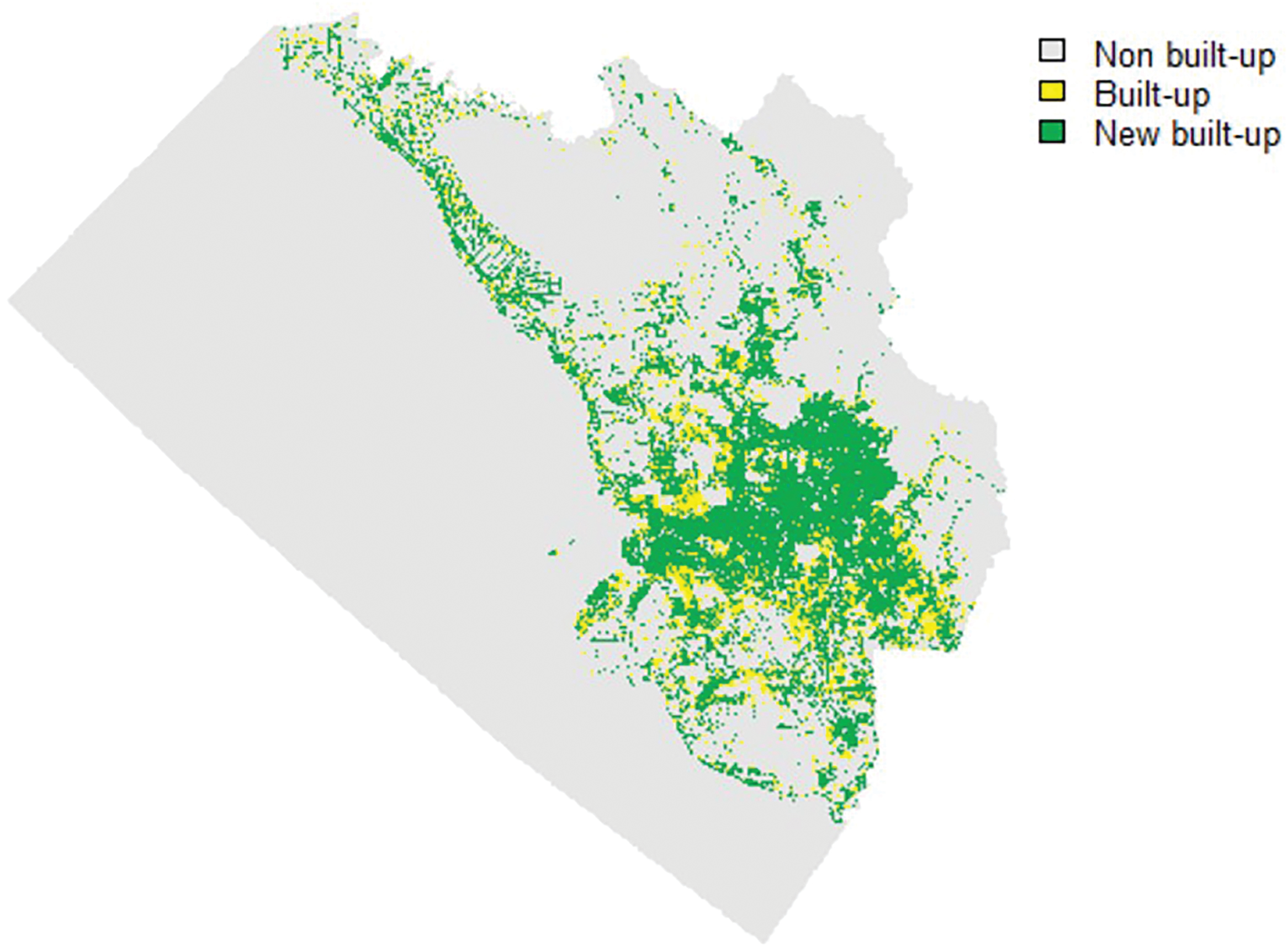
By constitutional design, key resources lie with the states. For example, land, water, and forests are under state jurisdiction. This arrangement is where it gets complicated for the districts in Klang Valley that are separated by geographical lines. In practice, Klang Valley spans multiple jurisdictions: Kuala Lumpur’s City Hall (DBKL) is under federal authority, while surrounding towns and municipalities (e.g., Petaling Jaya, Shah Alam, Klang) fall under Selangor’s state government. These layered boundaries mean different agencies share responsibility for land use, infrastructure, and environment. Local governments in Selangor, for instance, answer to the state government, whereas DBKL reports to the federal Ministry of Housing and Local Government. This split system can complicate unified planning, since each body has its own rules and priorities.
Source: Global Land Analysis and Discovery and OpenStreetMap contributors
Figure 5: Land-use cover and change of built-up lands in Klang Valley from 2000 to 2020
The fragmented governance in Klang Valley makes coordination across agencies essential but deeply challenging. Evidently, centralized coordination among stakeholders is critical for flood management, and that to enhance resilience, there needs to be collaboration between government agencies, local authorities, and communities (Rahman, 2022). However, the reality is that Malaysia’s local system is highly decentralized, and this situation creates challenges in the implementation of green infrastructure and adaptation measures. These issues undercut the Malaysian policy ideal of a “whole-of-society” adaptation effort.
This decentralized coordination stems from the lack of local accountability, borne from the indefinite suspension of local government elections beginning in the 1960s. As a result, key resources remain at the behest of the state, while the authority to approve funding for local projects rests with the federal government. This disconnect compels state authorities to rely on state-owned resources as primary sources of revenue generation. Consequently, representatives appointed by the state are not directly accountable to the communities they serve, but to the state government itself. Therefore, appropriate resource allocation to manage state authorities is often constrained by political dependencies and misaligned priorities across federal, state, and local levels.
Without a unified framework and mechanisms to empower states or cities, adaptation measures may be designed from the top and poorly implemented on the ground. For example, drainage improvements in one municipality may not account for upstream or downstream impacts in the next. The area’s multilevel bureaucracy requires formal mechanisms to bring together city planners, state departments, and federal ministries; however, adaptation policies that lack this coordination risk being piecemeal efforts (Nizarudin & Zakariya, 2025).
Additionally, local governments also face hurdles with regards to deficient budget allocation. Inequitable budget allocation risks jeopardizing the effective operationalization of coordinated efforts between local governments, as some receive more funding than others due to prioritization by federal and state authorities. The aforementioned funding presents itself in the form of financial grants, which allow local governments to carry out infrastructure development projects and restructuring initiatives (Harding, 2022). However, certain grant sizes are reliant on factors such as expected revenue accruement and population size, putting several local governments at an inherent disadvantage. As it stands, Klang Valley houses four city councils, while municipal councils and district councils stand at seven and one respectively.
Compounding this issue are the tax revenue collection capacities of local governments, which are heavily reliant on property taxes of annual rental property value assessments within a locality—known as an assessment tax (Talib et al., 2017). In this regard, the urban–rural divide is prominent, as assessment tax collection amounts in rural areas are unable to compete with urban localities, causing local governments of rural areas to fall behind financially. The asymmetrical nature of funding allocation therefore entrenches long-standing disparities present within Malaysia’s governmental structure, thus exacerbating the impacts of climate change as underfunded localities struggle to recover over extended periods of exposure to climate extremes.
Human security, equity, and climate justice: A case study of Taman Sri Muda
The IPCC’s assessment of impacts, adaptation, and vulnerability in the Working Group II contribution to the Fifth Assessment Report (WGII AR5) recognizes human security as a crucial component to address in the climate crisis (IPCC, 2014, Chapter 12). As a high-level framework, it sheds light onto the disproportionate impacts faced by vulnerable communities; in this commentary’s context, that means the urban poor, women and children, the elderly, people with disabilities, and informal workers who are exposed to urban impacts of climate change. These vulnerabilities are often systemic and intersectional in nature, and it is therefore through these disparities that the need for equitable and justice-oriented approaches to climate solutions, including drivers for transformational adaptation, emerges.
The floods experienced by the Taman Sri Muda, a township located in the Klang district, act as a case study that highlights these disparities, particularly the 2021 incident, wherein the area faced disastrous impacts as a result of the “once-in-a-hundred-years” rainfall. While urban Malaysia faced widespread impacts that year—up to USD 1.5 billion of losses, particularly concentrated in the states of Selangor, Pahang, and Melaka (Bedi, 2022)—the experience in Taman Sri Muda was notoriously bad due to a series of systemic failures that resulted in preventable losses and damage faced by its residents. These failures included inadequate drainage systems, overdevelopment, and inefficient response measures from relevant warning systems, emergency response systems, and governing bodies. Such negligence has even caused a USD 970,000 lawsuit from at least 50 Taman Sri Muda residents seeking compensation over the damages faced, including intangible losses such as emotional distress and trauma faced as a result (Lim, 2022). However, there are several other issues worth highlighting.
First, Taman Sri Muda represents an inadequacy of geographical planning. Taman Sri Muda was developed on low-lying terrain adjacent to Klang River, making it a natural floodplain. It is also inherently prone to inundation, as the site’s ground elevation is only about 1–1.5 m above sea level. In fact, early planning documents had designated the area as not for housing but as a flood retention basin (Rahman, 2022). This geographic reality was apparent from the township’s vulnerability to flooding even before the first house was built, effectively sending vulnerable residents to live in a high-risk zone.
Given these conditions, proper land-filling and drainage infrastructure would have been critical toward Taman Sri Muda’s development. However, the site was largely developed at only 1–3 m above sea level (Mokhtar, 2022). This elevation is below historic flood high-water marks and would guarantee that any extreme rainfall or river overflow would pose a flood risk to the new township. These measures provided years of relief, but such ponds have a finite capacity, as they do not prevent flooding if rain exceeds the design limits and only delay the inevitable. Ultimately, this example shows that mitigation infrastructures alone cannot stop extreme events unless they are well maintained and complemented by wider watershed management.
Second, Taman Sri Muda signals a systemic failure in governance. Prior to the 2021 disaster, government agencies had knowledge of the flood risks, but subsequent responses were sluggish. In fact, a pumping station and tidal gate are installed in Taman Sri Muda precisely because it depends on artificial drainage; however, local officials also revealed that one major water pump was out of commission and a crucial sluice gate malfunctioned during floods, greatly slowing water release (Mokhtar, 2022). Hence, when the storm hit, these neglected systems became inadequate as nearby developments had already diverted their stormwater into Sri Muda’s drains, roughly tripling the volume the system was built to hold (Lim, 2022). Community leaders had even warned about these issues months before—in October 2021, the area’s assemblyman warned the Department of Irrigation and Drainage (DID) about failing to replace a faulty pump, noting that funds of USD 2.5 billion had been approved, but the project never started due to bureaucratic delays (Mokhtar, 2022).
While the flooding risks in Taman Sri Muda were known from the outset, authorities also focused primarily on mitigation efforts, rather than pursuing systemic adaptation, to prevent and reduce vulnerabilities. For example, a retention pond of about 3 hectares was constructed near the township, and a pump station was installed to help divert water into the Klang River. These actions were undertaken after the first flood struck in 1995. River embankments were also raised and new drainage canals were dug as part of post-1995 flood mitigation efforts (Mokhtar, 2022). However, while these measures provided temporary relief (as no floods were recorded for many years after), there were still occasional flash floods due to local drainage clogs (Mokhtar, 2022).
Taman Sri Muda then began to face annual flooding as more areas in its surroundings became developed in the early 2000s. In this way, the township’s drainage network was gradually being co-opted to serve new upstream developments. Moreover, large projects such as Taman Kemuning Utama were built adjacent to Sri Muda without initially constructing adequate outflows of their own (Idris, 2022).
Third, this series of planning flaws ultimately came to a head in December 2021, when the unprecedented rainfall caused flooding across Selangor. As a result of being surrounded by the Klang River, Taman Sri Muda was one of the worst-hit areas. The upstream dam and a king tide at Port Klang created a surge that funnelled into the Klang River just as torrential rain fell. Despite the implemented mitigation efforts, Taman Sri Muda’s tidal gate and pumps were overwhelmed, as they unable to discharge water fast enough. The limited retention pond filled and overflowed, and the drainage canals backflowed into the streets (Rahman, 2022).
It is here that the most vulnerable residents of Taman Sri Muda were victimized by the series of structural and systemic failures highlighted. For one, dissemination of flood information during the critical period of evacuation not only came too late, but also most of these communications took place over online portals such as X, which did not reflect the lived reality needs of Taman Sri Muda residents—many of whom were elderly and therefore lacked online access to information (Zaikariah & Nair, 2025).
In general, such flood incidences also disproportionately jeopardize the well-being of women, children, and disabled people. For one, women are more impacted by the effects of flooding due to taking on additional unpaid care work on top of other livelihood insecurities and increased household burdens (NRES, 2024). Meanwhile, children’s well-being and education are compromised due to schools’ extended usage as flood shelters (UNICEF, 2021), which was very much the case in the 2021 Taman Sri Muda flooding. For instance, a victim details how the 2021 incident greatly compromised her family’s safety, including elderly family members, and how the woman’s disabled husband had to be “placed in a wheelchair and sunk to the waist” (Yusry, 2024). Needless to say, these conditions should not exist, nor should they have been experienced by the most vulnerable communities to the point of emotional turmoil and trauma.
Finally, with no adaptation policies in place, the residents of Taman Sri Muda were left overburdened by the post-flood damages since there were no proper compensation plans in place. To begin with, many were ill-informed or unaware of their rights to seek compensatory measures, reflecting an additional layer of injustice. Furthermore, testimonies from Taman Sri Muda residents state that despite pledges from the city council, proper flood mitigation measures beyond flood emergency sirens were still not improved upon, while measures such as improved sewerage, drainage, and flood retention infrastructure are far more vital and effective to address the issues at hand (Yusry, 2024). As a result, residents have had to rely on legal mechanisms such as the above-mentioned USD 950,000 lawsuit to seek compensatory action. Up until the time of writing, residents are still demanding for more substantive measures from governing bodies to address these issues, with dissatisfaction being raised over the state government’s overreliance on mitigation actions and lack of adequate compensatory measures to prevent the yearly recurrence of such climate disasters (Tsen, 2025).
Overall, Taman Sri Muda’s floods, particularly the 2021 incidence, represent a series of failures and inadequacies not only in urban planning, but also in adapting to the amplified impacts of climate change and safeguarding the most vulnerable among Malaysian communities.
Adaptation progress in Malaysia
While there are no specific adaptation policies in place as of writing, current adaptation efforts are scattered across many different policies, with responsibilities separated across agencies and projects, thus signalling the lack of a unified strategy.
The recent National Climate Change Policy 2.0, published in 2024, acts as a renewal of the original 2008 framework; it lists five key strategic thrusts as an overarching approach toward climate action, including the need “to emphasise adaptation and climate resilience measures that benefits socio-economic and development goals” (NRES, 2024). This framework spearheads Malaysia’s National Adaptation Plan (MyNAP), which, pursuant to a holistic, whole-of-nation approach toward climate adaptation, shortlists five key sectors to address resilience in the country, one of them being infrastructure and cities (NRES, 2025). This document also recognizes the role of the third sector; gender-responsive measures; community- and ecosystem-based approaches; short-, medium-, and long-term goals; and the rural–urban divide as crucial dimensions toward systemic adaptation. As of writing, the document aims for a 2026 publication (The Star, 2025).
The upcoming RUUPIN, expected to be tabled in parliament by 2025, will include a section specifically addressing climate adaptation, including the incorporation of a climate risk assessment and climate targets to be eventually aligned with the outcomes of the Global Goal on Adaptation negotiations at the UNFCCC level.
The Twelfth Malaysia Plan, 2021–2025 (EPU, 2021), which is part of Malaysia’s 5-year development plans, lists the launch of a nationwide disaster risk management policy as a target to coordinate adaptation measures. Aptly, the National Disaster Risk Reduction Policy 2030 was released by the National Disaster Management Agency (NADMA) in October 2024, outlining a cross-sectoral and stakeholder approach in “mak[ing] Malaysia a safer and disaster-resilient country by mainstreaming comprehensive and inclusive disaster risk reduction towards the well-being of the people and sustainable development,” per the deputy prime minister (NADMA, 2024).
In monetary terms, Malaysia’s 2025 national budget earmarked substantial funds for disaster resilience for the first time, where USD 77 million was allocated for twelve flood mitigation projects, USD 1.5 million for NADMA to boost flood preparedness, and USD 65 million to stabilize landslide-prone slopes. However, adaptation tends to be on the losing end when it comes to the budget, as it has yet to receive a specific allocation; instead, it is being indirectly attributed across sectors, such as disaster risk management, agriculture, and conservation. This approach also does not entirely align with policy commitments toward increased adaptation measures—progress in this regard remains very gradual in comparison to the escalating urgency of climate impacts (Cheng et al., 2024).
In Klang Valley and other cities, adaptation is increasingly part of urban planning. Goal 4 of Kuala Lumpur’s new 2040 Structure Plan explicitly embraces the “climate smart and low-carbon” vision to empower KL as a low-carbon city that is resilient to climate change (DBKL, 2023). In addition to this plan, DBKL has developed a Climate Action Plan 2050, in which it extended its 2030 emissions targets and embedded resilience goals into its city planning. This policy charts strategies for carbon neutrality and climate resilience by the middle of the century by including a strategy on a “green adaptive city,” with the aim of reducing urban climate risks. It calls for retrofitting infrastructure, such as flood drainage and waterworks, and green infrastructure, such as urban wetlands, to cope with weather extremes, as well as building the systems that keep transport and utilities running during shocks (DBKL, 2023).
In Selangor, city councils have also begun implementing more detailed measures. For example, Petaling Jaya City Council has adopted a long-term climate action plan that aims to cut a third of citywide emissions by 2030 while at the same time enhancing resilience and quality of life of residents. MBPJ has also begun acting on policies such as enforcing green building codes, retrofitting public facilities, expanding cycling and public transit, and even planting green roofs, vertical gardens, and reflective cooling pavements to temper urban heat. These measures, although considered mitigation by nature, yield co-benefits for adaptation. For example, increased green spaces and surfaces reduce flooding and heat islands, while denser transit and lower energy waste lessen climate pressure impacts on infrastructure. Other local authorities, such as Shah Alam City Council, have piloted similar low-carbon and resilience initiatives into their local planning frameworks. In practice, however, local adaptation still hinges on traditional fixes such as expanding drainage, conserving rivers and wetlands, enforcing building standards, and educating the public on disaster preparedness.
However, plans alone are not enough. It has been identified that the top solution for inadequate drainage during rapid urbanization is for urban planning to be more comprehensive, mainly through the expansion of drainage infrastructure (Mohamed et al., 2024). There is also a great need for more centralized coordination—managing floods effectively requires integrating mitigation, preparedness, and response phases across agencies and communities. Similarly, cities must retrofit ageing infrastructure and invest in nature-based sponge-cities solutions, while empowering local governments and communities with the resources to act on the ground (Nair, 2023). That said, implementing planned road maps, facilities, and social capacity is the next critical task.
Malaysia has significantly expanded its climate adaptation architecture at both national and city levels through the policies plans that are in place. However, significant challenges remain as the severe floods of recent years and projections of hotter, dryer dry seasons mean that the country’s resilience will be tested anew.
Conclusion
While Malaysia has made steps toward incorporating systemic changes into its urban adaptation strategies, more needs to be done to ensure that the transformational adaptation measures toward the evolving status of climate change are sufficient. The developmental trends of Klang Valley, as well as cases such as the 2021 Taman Sri Muda floods, expose challenges including but not limited to existing structural flaws, the need for strong political will/enforcement, and a lack of participatory inclusion for vulnerable and marginalized communities, all of which remain prominent in Klang Valley’s implementation of adaptation actions.
Nevertheless, as Malaysia’s understanding toward climate change, urbanization, and adaptation continues to grow, a holistic directional framework for moving forward can be developed, as well as existing measures improved, so that transformational adaptation measures can not only be implemented, but also that current incremental adaptation measures can inhabit transformational changes in the long term.
First, it is crucial to emphasize a bottom-up approach in which local authorities, such as city, municipal, and councils, coordinate their disaster risk response plans with one another as well as with federal authorities. The effects of this approach are double: (a) local authorities can secure federal buy-in, thus increasing the possibility of obtaining larger grant sizes for the purpose of adaptive infrastructure development, while (b) decreasing an overreliance on federal initiatives to coordinate disaster risk responses. In this vein, funding and capacity building is effectively sourced for governing authorities, service providers, and local communities to ensure that the accessibility and capacity of adaptation measures can withstand the increasing severity and frequency of climate impacts.
From an environmental standpoint, given that current climate action in Malaysia leans toward mitigating measures, integrating outcomes that would lead to adaptation co-benefits would also streamline the process toward achieving transformational adaptation in Klang Valley. Structural mitigation measures, such as the incorporation and retrofitting of green and blue spaces into urban areas, as well as nature-based solutions per concepts such as sponge cities, provide a framework to integrate mitigation and adaptation measures together. Such solutions should also be co-created with local communities to cater toward local contexts and avoid maladaptation, particularly for at-risk localities.
Climate risk assessments and climate budget-tagging would also enable Malaysia to take on a more targeted approach toward urban vulnerabilities. At the current rate, urban areas concentrate not only populations but also economic assets, making them hotspots of climate exposure and socio-economic vulnerability. If localized and science-based diagnostics of the existing and eventual risks are delayed, adaptation investments risk being misaligned. A robust climate risk assessment at the city and district level would allow governments to map the exposure, sensitivity, and adaptive capacity of each area, thus allowing communities and businesses to reduce losses and shift development trajectories toward long-term resilience.
When hotspots are identified through risk assessments, climate budget-tagging will complement and institutionalize the flow of public funds toward adaptation projects. This course of action will ensure budget allocations are directed not just toward general adaptation but also toward the most critical urban structures and at-risk groups.
Next, the 2021 Taman Sri Muda case, on top of everything else, represented a lack of equity and justice-oriented avenues to seek compensation for the damages induced by negligence. For this reason, there must be more emphasis toward rights-based frameworks to ensure that nobody gets left behind and that all quadrants of resilience-building are addressed. This perspective should also aim to facilitate a participatory approach toward adaptation formulation across not only sectors and stakeholders but also grassroots and local communities. Doing so will ensure that all vulnerabilities are accounted for, and more targeted, long-term approaches can be facilitated.
Finally, at the federal and international level, Malaysia should seek to integrate transformational adaptation frameworks into its national-level policies and international climate commitments, including further emphasis and integration into MyNAP, nationally determined contributions, and other national reporting to the UNFCCC. This course of action would also assist in forming a cohesive, regional adaptation approach that ensures global adaptation targets account for the unique vulnerabilities and cultural makeup of ASEAN urban areas.
Kieran’s research interests lie in climate adaptation, diplomacy, finance and justice. She has extensive experience volunteering in numerous forms of advocacy, although her strongest passion lies with climate advocacy. She has published a paper on climate resilience in urban areas and more recently acted as a Malaysian youth representative to the 28th Conference of Parties in Dubai. Kieran currently acts as the co-focal point of the Malaysian Youth Delegation. She holds a Bachelor of Arts and Social Sciences from Monash University Malaysia.
Executive Chairman Institute of Strategic & International Studies (ISIS) Malaysia
Prof Faiz leads the institute’s policy development and Track 2 diplomacy, including through the ASEAN Institutes of Strategic and International Studies and Pacific Economic Cooperation Council. He is also the Malaysian representative to the ASEAN Regional Forum Experts and Eminent Persons meeting, co-chair of the Council for Security Cooperation in the Asia-Pacific and a member of the World Economic Forum’s Global Future Council on Good Governance.
Siti Farhana Sheikh Yahya
News Anchor Astro AWANI
Farhana presents AWANI International, Astro’s flagship English news segment analysing global power shifts and geopolitical rivalries shaping the international order. She also hosts the weekly talk show It’s About Youth, leading discussions with diverse guests on issues central to young Malaysians. Her expertise extends across the organisation, contributing to major programmes, including AWANI Global, Agenda AWANI and Dialog ASEAN25.
Marweena Manan
Senior Director Strategic Negotiations Division Ministry of Investment, Trade and Industry
Marweena oversees strategic trade negotiations, and the advancement of Malaysia’s bilateral and regional economic frameworks at MITI. She is the former director of the Digital Economy Division, where she spearheaded the digitalisation of trade and investment policies. Her experience includes roles as director of the Investment Policy Section; economic counsellor in Brussels and as a pioneer secretariat member of the Special Task Force to Facilitate Business (PEMUDAH).
Thomas Daniel
Director of Foreign Policy and Security Studies Institute of Strategic & International Studies (ISIS) Malaysia
Thomas has more than a decade’s experience in foreign policy and security analysis. His work focuses on how major-power dynamics impact on the strategic-security considerations of Southeast Asia. Within this scope, he mainly looks at the South China Sea dispute, political-security cohesion within ASEAN and Malaysia’s security and foreign policies. He also focuses on policies towards refugees and asylum seekers in Malaysia and ASEAN’s response to the Myanmar crisis.
Fairuz Adli Mohd Rozali
Deputy Director General ASEAN External Affairs Division Ministry of Foreign Affairs
Fairuz Adli assumed the current position in January, following his tenure as Deputy Chief of Mission at the Embassy of Malaysia in Washington, DC. He joined the administrative and diplomatic service in 2002. His previous stints include assistant director at the ASEAN-Malaysia National Secretariat and principal assistant director at the Coordination and Implementation Department. He has also served as second secretary at the Embassy of Malaysia in Kuwait, counsellor and minister-counsellor at the Embassy of Malaysia in the Republic of Korea.
Assoc Prof Dr Roy Anthony Rogers
Head, Department of International and Strategic Studies Faculty of Arts and Social Sciences Universiti Malaya
Dr Rogers has taught at the Malaysian Armed Forces Staff College and the Malaysian Defence Armed Forces College. His area of specialisation includes political science, international relations and history (China and Central Asia). His research interests are government and politics of the Central Asian republics in Xinjiang.
Dr Jung Hojai
Secretary-General Asia Vision Forum South Korea
Dr Jung is a scholar of Southeast Asian media, cultural diplomacy and the expanding global influence of K-culture. He is currently serving as secretary-general of Asia Vision Forum (AVF), South Korea’s first private think-tank focused on ASEAN and wider Asian regional cooperation. AVF advances dialogue, cultural exchange and strategic understanding between Korea and its Asian counterparts. He is also a research fellow at the Institute for Hallyu Studies at Dongguk University, where he leads research on K-content strategy, soft power and digital fandom.
Dr Lee Jaehyon
Principal Fellow Asan Institute for Policy Studies South Korea
Dr Lee is a member of the advisory group for the Korean Coast Guard and previously served in an advisory capacity for the Presidential Committee for New Southern Policy and Ministry of Foreign Affairs. His research focuses on ASEAN, Southeast Asian politics and regionalism. He is also interested in the superpower competition in the Indo-Pacific region. His publications include ‘South Korea and the South China Sea: A Domestic and International Balancing Act’, ‘What Asia Wants from the US: Voices from the Region’ and ‘Southeast Asian Perspectives of the United States and China: A SWOT Analysis’.
Norhaslinda Mohd Sibi
Director Social Institute of Malaysia (ISM)
Norhaslinda has vast experience in the public sector, having served various ministries and agencies, including the Ministry of Finance; Economic Planning Uni; Maritime Institute of Malaysia; and Ministry of Home Affairs. Prior to joining ISM, she was the director of Public Research Centre at the Institute of Public Security.
Dr Nurliana Kamaruddin
Head, Department of East Asian Studies Universiti Malaya
Dr Nurliana is attached to the Department of East Asian Studies, Faculty of Arts and Social Science, Universiti Malaya. She is also fellow at the Centre for ASEAN Regionalism, AEI. Her recent publications include Southward Bound: Examining the Regional Policies of Taiwan and South Korea and The New Normal and Its Impact on Society: Perspectives from ASEAN and the European Union. She was a recipient of the Korea Foundation ASEAN fellowship and POSCO TJ Park Foundation Asia fellowship. Her research interests include international security and development with a focus on East Asia and specifically, Malaysia-Korea relations.
Dr Geetha Govindasamy
Senior Lecturer Department of East Asian Studies Universiti Malaya
Dr Geetha is an expert on East Asian international relations. She mostly researches and publishes on inter-Korean issues and East Asian international relations. Her publications can be found in local and international journals. She is a recipient of various research grants from the Korea Foundation, Sumitomo Foundation and local funding. She is also a non-resident fellow at the Centre for Human Security and International Affairs, India.
HE Yeo Seung-bae
Ambassador ROK Embassy in Malaysia
Yeo was appointed as ambassador of the Republic of Korea to Malaysia in October. Prior to the appointment, he served as deputy minister for political affairs in the Ministry of Foreign Affairs, which he joined in 1990. Yeo has held postings in China, Norway, Afghanistan and New Zealand. He had also served as foreign policy adviser to the prime minister.
Dr Teo Sue Ann
Director of Parliamentary Policy Research and Advocacy All-Party Parliamentary Group Malaysia SDG Secretariat
Dr Teo’s interests are qualitative and action-based research methodology, socio-anthropology, religion and gender. Her work is centred on the belief that development often involves actions that challenge or reinforce existing social norms and stereotypes. She is focused on localising SDGs to ensure that no one is left behind.
Dr Teoh Ai Hua
Senior Lecturer School of Applied Psychology, Social Work and Policy Universiti Utara Malaysia
Dr Teoh’s interests span public social services, social work practice, professionalisation of social work, case management, and community care. He also serves as president of the Malaysian Association of Social Workers and deputy president of the Malaysian Council on Welfare and Social Development. Regionally, he is president of the International Council of Social Welfare and regional vice-president of the International Federation of Social Workers.
Datuk Prof Dr Denison Jayasooria
Chair Society for the Promotion of the Sustainable Development Goals
Denison holds a PhD in sociology from Oxford Brookes University, United Kingdom and was a Chevening scholar. He is the head of the secretariat for the All-Party Parliamentary Group Malaysia on Sustainable Development Goals (APPGM-SDG) since Oct 2019. He is an honorary professor at the Institute of Ethnic Studies, Universiti Kebangsaan Malaysia (UKM).
Tan Heang-Lee
Fellow, Social Policy and National Integration ISIS Malaysia
Tan brings nine years of experience in research and advocacy at the intersection of gender and public health work. Using a gender lens, she has worked on a range of issues including care work, employment rights, chronic illnesses, and gender-based violence. She previously served as a Research Associate at the Johns Hopkins Bloomberg School of Public Health, where she coordinated a large qualitative study on how Long COVID patients navigate the healthcare system, workplace accommodations, and disability benefits. Prior to that, as the Head of Campaigns at the Women’s Aid Organisation, she co-led successful national campaigns that contributed to the introduction of seven days of paternity leave, the enactment of anti-stalking laws, and legal protections against pregnancy discrimination in the workplace. She holds a Master of Public Health from Johns Hopkins University, where she was as a Sommer Scholar.
Arifah Sharifuddin
Institute Director Tech For Good Institute
Arifah is the Institute Director at the Tech For Good Institute, where she leads the Institute’s strategy and operations to advance responsible, inclusive, and evidence-based digital development across Southeast Asia. She brings extensive experience in national-level digital transformation, cross-sector collaboration, and ecosystem building in government and sectors. Her work reflects a strong commitment to leveraging technology for inclusive growth and strengthening institutional capacity to shape the region’s digital future. She was previously with the Malaysia Digital Economy Corporation (MDEC) where she drove programmes such as DE Rantau, Malaysia’s digital nomad programme.
Farlina Said
Director Institute of Strategic & International Studies (ISIS) Malaysia
Farlina is a Director in the Cyber and Technology Policy programme. She graduated from S Rajaratnam School of International Studies, Nanyang Technological University with an MSc (Strategic Studies). She was involved in crafting various dialogues and forums on cybersecurity, radicalisation and Malaysia-Korea relations. Her work and comments have appeared in the local and international media, such as New Straits Times and South China Morning Post. She was a part of SEARCCT’s Experts on Violent Extremism and Community Engagement (EVOKE) Council (2018-2019).
Zayana Zaikariah
Researcher ISIS Malaysia
Zayana is part of the Climate, Environment and Energy programme at ISIS Malaysia. Her research interests revolve around environment and sustainability with a focus on finding solutions to mitigate flood impacts and preserve mangrove ecosystems. During her internship with ISIS, she worked on human rights law addressing climate-related floods in Malaysia.
Dr Zelina Zaiton Ibrahim
Director Centre for Environment, Technology and Development
Dr Zelina is an environmental scientist with experience in integrative, multidisciplinary studies and environmental impact assessments. She is currently a voluntary Amal Putra Associate Professor at the Department of Environment, Faculty of Forestry and Environment, Universiti Putra Malaysia. She was a coordinating lead author for the Intergovernmental Panel on Climate Change (IPCC) Sixth Assessment Report in Working Group II and will be a coordinating lead author in the IPCC Seventh Assessment Report in Working Group II.
Yin Shao Loong
Deputy Director of Research Khazanah Research Institute (KRI)
Yin focuses on industrial policy, climate change and future technologies at KRI. He spent a decade working in the federal and state governments, and another decade in civil society and academia.
Nithi Nesadurai
Director and Regional Coordinator Climate Action Network Southeast Asia (CANSEA)
Nithi serves as president of the Environmental Protection Society Malaysia. He is directly involved with multiple just transition activities in Southeast Asia, managing the Oxfam-CANSEA Influencing Just Energy Transition project in Indonesia, Malaysia and the Philippines. He represents CANSEA in the consortium implementing the Innovation Regions for a Just Energy Transition project in East Kalimantan and South Sumatra in Indonesia and as co-host of Just Transition Forum Asia, organised annually since 2021.
Kieran Li Nair
Senior Researcher ISIS Malaysia
Kieran’s research interests lie in international relations and climate justice. She acted as a Malaysian youth representative to the 28th and 29th Conference of Parties. Beyond her professional experience, she has extensive involvement in civil society advocacy, most crucially with the Malaysian Youth Delegation and Malaysian CSO-SDG Alliance.
Hilary Kung
Senior Researcher Third World Network
Kung is trained as a political ecologist. Her work focuses on the United Nations Framework Convention on Climate Change (UNFCCC) processes and negotiations, specifically on the Just Transition Work Programme (JTWP). She also works for Sahabat Alam Malaysia on climate, energy, forests and finance and community rights issues. Her experience includes environmental impact assessment, audit and monitoring, as well as responsible supply chain in the Malaysian palm oil industry.
Farhana Shukor
Visiting Researcher Khazanah Research Institute
Farhana is a climate policy researcher whose passion for building local capacity in climate diplomacy stems from her extensive experience with climate NGOs. Starting as a youth climate advocate, she has witnessed firsthand the stark difference in narratives between the Global South and the Global North at UNFCCC conferences. Her academic background in risk management and insurance, combined with experience in a hard-to-abate industry, shapes her unique approach to climate solutions and navigating complex stakeholder engagements.
Meenakshi Raman
Head of Programmes Third World Network
Meena is a public interest lawyer and expert on climate change negotiations, having attended around 16 COPs and co-authored a book published by TWN entitled A Clash of Climate Change Paradigms. She also served as the first active observer from developing countries on the board of the Green Climate Fund.
Ganesha Pillai
Analyst ISIS Malaysia
Ganesha’s research focuses on renewable energy and climate policy. He is a former senior research associate in the Centre for Technology, Strategy and Sustainability at Asia School of Business; and at the Sustainable Energy Development Authority (SEDA) Malaysia, where he was the focal point for Malaysia Renewable Energy Roadmap (MyRER) implementation. He also engages in advocating for sustainable energy and volunteers in capacity-building initiatives.
Eqram Mustaqeem Muhamad
Climate Policy Analyst Third World Network Malaysia
Eqram is a lawyer and is currently a climate policy analyst at TWN and Sahabat Alam Malaysia (SAM). At TWN, a big part of his work involves tracking UNFCCC negotiations, particularly on the adaptation agenda and conducting climate policy research from a Global South and climate justice lens.
Aroe Ajoeni
Communications Director, Klima Action Malaysia (KAMY)
Aroe supports KAMY’s advocacy on climate legislation, just energy transition and public participation. She has a key role in KAMY’s interventions on Malaysia’s Climate Change Bill (RUUPIN) and the Carbon Capture, Utilisation and Storage (CCUS) Act – developing public education tools, leading consultations and advancing more inclusive climate policymaking. She is COP27 and COP28 attendee.
André Aquino
Head of Economics and Environment Office Ministry of Environment and Climate Change Brazil
Aquino’s role at the ministry is to redirect financial flows to environmental priorities. He coordinated Brazil’s G20 Presidency for the environment agenda in 2024. He is a former director for forest development at the Brazilian Forest Service, responsible for promoting sustainable management of forests and large-scale restoration of native vegetation, and for managing Brazil’s forest information system, including the national forest inventory.
HE Daniella Ortega de Paiva Menezes
Ambassador-designate of Brazil to Malaysia and Brunei
HE Ortega Menezes is a Brazilian career diplomat with 29 years’ experience in the Brazilian Foreign Service. She is a former director of the Foreign Service Department at the Ministry of Foreign Affairs. Her extensive diplomatic career includes postings as deputy head of mission in Berlin, Singapore, and Yangon, and senior roles in Beijing, London and Brasília.
Ahmad Afandi Nor Azmi
Independent Consultant and Researcher Gleenglaive Consulting
Afandi is a sustainable development professional specialising in climate and environmental policy and planning, with deep understanding of the Malaysian context. He has extensive experience gleaned from working in a think-tank and the consulting industry, leading and contributing to key national initiatives and policy processes, including Malaysia’s 3rd Voluntary National Reviews (VNR), National Climate Change Policy 2.0 and National Policy on Biological Diversity. He serves as a resource person with the Malaysian CSO-SDG Alliance and the All-Party Parliamentary Group on SDGs.
Gayathri Vadivel
Head of Employment Services Division Social Security Organisation (SOCSO)
Gayathri is trained in counselling and applied psychology. She is a pioneer in Socso’s ‘return-to-work’ programme, drawing its work process and modules and training new case managers. She has not only played a key role in the development of disability management in Malaysia but also assisted countries like Indonesia, Namibia and the Philippines in their disability management programmes. She is also the project director of the National Employment Services Portal, MYFutureJobs and is active in the development of initiatives pertaining to active labour market programmes and career exploration at secondary schools.
Dr Nor Saidatul Rajeah Zamzam Amin
Director of Educational Planning and Research Division Education Ministry
Dr Saidatul started her career as a secondary school teacher before joining the ministry. She has vast experience in educational policy, strategic planning related to physical school facilities, support facilities and other needs for pupils in urban, rural and remote areas. She is also involved in educational policy research, responsible for conducting educational research at the national and international levels to inform policy makers and planners. At present, her division is developing the new Educational Blueprint 2026-2035.
Dr Matthew Dornan
Senior Economist World Bank
Dr Dornan is part of the Social Protection and Jobs Global Practice at the World Bank. His work focuses on social protection, labour market, skills and migration. He has worked across the East Asia-Pacific region for the bank, establishing and implementing projects in support of active labour market policies, TVET and skills development, international labour mobility and social protection.
Alyssa Jasmin
Economist World Bank
Alyssa is part of the Social Protection and Jobs Global Practice at the World Bank, where she works on areas, such as informal employment, skills and labour market implications of ageing in Malaysia. She is a former research associate at the Khazanah Research Institute.
Judith Green
Country Manager for Malaysia World Bank
Green was appointed as the World Bank Group Country Manager, Malaysia, effective 1 September 2024. She is a former country manager for Pacific Islands, Australia and New Zealand. She is also a former IFC country manager for the Caribbean overseeing its operations in the 14-member countries in the region, including Haiti and Dominican Republic. She headed the government of Jamaica’s Coordination and Implementation Unit, which was responsible for overseeing the implementation of the 2013 four-year Extended Fund Facility with the International Monetary Fund.
Nazrul Aziz
Group Chief Strategy Officer TalentCorp Group of Companies
Nazrul oversees strategy development and alignment at TalentCorp. He works with key stakeholders across industry, academia and the government to develop and execute demand-driven talent solutions to meet the nation’s current and future talent. Prior to TalentCorp, Nazrul spent 18 years in the public sector.
Calvin Cheng
Director of Economics, Trade and Regional Integration Institute of Strategic & International Studies (ISIS) Malaysia
Calvin is the Director of the Economics, Trade, and Regional Integration division at the Institute of Strategic and International Studies (ISIS) Malaysia. His research covers various topics in applied economics, centring around labour markets, wellbeing, and the design of social transfer programmes. Some of his current projects examine how emerging technologies such as generative AI shape the future of work, wellbeing, and inequality. He also leads the Institute’s economics research across its work areas and coordinates cross‑team projects and external collaborations.
Hanson Chong
Researcher of Economics, Trade and Regional Integration Institute of Strategic & International Studies (ISIS) Malaysia
Hanson’s research interests include social network analysis and impact evaluation of social assistance programmes. He graduated from the London School of Economics and Political Science with an MSc in Social Research Methods under the Khazanah Postgraduate Global Scholarship and completed his BSc Economics at the University of Nottingham Malaysia.
Natalie Russmann
Country Director Konrad-Adenauer-Stiftung (KAS) Malaysia
Harris Zainul
Director (Research) Institute of Strategic & International Studies (ISIS) Malaysia
Harris directs the institute’s research to advance Malaysia’s strategic interests. He works on the interplay between technology, human rights and democracy, with a focus on policy responses to mis- and disinformation and social media platform governance.
Registration form
Assoc Prof Dr Chaiwat Meesantan
Director of Institute of East Asian Studies Thammasat University Thailand
Dr Chaiwat is a faculty member at the Faculty of Liberal Arts, Thammasat University, and sits on the board of SEASREP Foundation. His research interest les in Malaysia, Brunei and the broader Malay diaspora throughout Southeast Asia, including Thailand. His expertise spans language, socio-cultural, economic and political issues, such as Muslims in Thailand, ethnic minorities, Malay studies, Malay language and culture, ethno-sociology, the Siamese issue in Malaysia, East Asian soft power in Southeast Asia and international relations in ASEAN.
Kavi Chongkittavorn
Senior Fellow Institute of Security and International Studies, Chulalongkorn University Thailand
Kavi is a former executive editor of the Bangkok-based The Nation and editor-in-chief and executive director of the Yangon-based Myanmar Times. He is former journalist with more than four decades’ experience covering Thai and regional politics. He is a senior fellow at Chulalongkorn University’s Institute of Security and International Studies and a columnist of Bangkok Post. He is a former president of the Thai Journalists’ Association and served as a member of jury and chair of the Guillermo Cano World Press Freedom Prize.
HE Damrong Kraikruan
Former Ambassador of Thailand to Malaysia
HE Damrong is a former career diplomat with more than 35 years of service. He is a former deputy permanent secretary at the Ministry of Foreign Affairs and director-general of East Asia. His overseas stint include ambassador to Lao PDR; consul-general in Los Angeles; and deputy chief of mission in Washington. In his long diplomatic career, he served in Southeast Asia, particularly Myanmar, Malaysia and Laos. He served as deputy secretary-general of the Asian Peace and Reconciliation Council.
HE Datuk Jojie Samuel
Adviser, ASEAN Affairs Ministry of Foreign Affairs Malaysia
Datuk Jojie has more than three decades’ experience in bilateral and multilateral diplomacy. He is the former ambassador to Thailand, during which he also held the position of dean of the diplomatic corps. His postings include Ottawa, Baghdad, Ankara, Vienna and Havana, with concurrent accreditation to five Caribbean nations. As former director-general of the ASEAN-Malaysia National Secretariat, he played a pivotal role in advancing Malaysia’s regional diplomacy. He has facilitated numerous prime ministerial visits, chaired key bilateral committees, and promoted economic, cultural and people-to-people ties.
Arividya Arimuthu
Senior Fellow Institute of Strategic & International Studies (ISIS) Malaysia
Arividya is a senior fellow in the chairman’s office. She specialises in WTO and EU laws and has more than 20 years’ experience in trade negotiations. She is a former senior director for strategic negotiations at MITI and chief negotiator for numerous high-stakes free trade agreement negotiations, including CPTPP, for which she led the ratification and implementation for Malaysia.
Bunn Nagara
Head Renaissance Strategic Research Institute Malaysia
Bunn is a geostrategic consultant and the BRI Caucus for Asia-Pacific, Perak Academy honorary fellow and convenor of an expert study group on Sabah. He is a former senior fellow and visiting fellow at ISIS Malaysia. He is also a former associate of the Universiti Malaya’s Thai studies programme and member of the Malaysia-Thailand Think-Tank Network. His research covers East Asian integration, contemporary grand strategies and Global South transitions.
HE Lada Phumas
Ambassador of Thailand to Malaysia
HE Lada assumed her post in April 2023 with the goal of strengthening and advancing Thailand-Malaysia relations in the bilateral, regional and international sphere. She is the former consul-general in Shanghai. Her diplomatic career began in January 1994 at the Ministry of Foreign Affairs. She has had stints in the Department of East Asian Affairs; Department of Economic Affairs (APEC); Department of ASEAN Affairs; and Department of Consular Affairs. She also served at the Royal Thai Embassy in Beijing; Permanent Mission of Thailand to the United Nations in Geneva; and ASEAN-China Centre.
Dr Pongphisoot Busbarat
Director of Institute of Security & International Studies (ISIS) Thailand
Dr Pongphisoot is assistant professor of international relations and assistant dean at the Faculty of Political Science, Chulalongkorn University, Bangkok. His research examines the role of norms and identity in shaping international relations by exploring its influence on Thailand’s relations with major powers in East Asia, the US and China. His current projects focus on Thailand’s strategic choices between the US and China, the domestic determinants of Thailand’s foreign policy and geopolitical dynamics of great-power competition in the Indo-Pacific.
Lee Min Hui
Gender Consultant United Nations Population Fund (UNFPA)
Min Hui is a Gender Consultant at United Nations Population Fund (UNFPA). Prior to that, she served as senior analyst in the Social Policy and National Integration programme at ISIS Malaysia. Her research interests centre around issues of social inclusivity, primarily gender equality, welfare, care economy, ageing, and family-friendly workplace policies.
Chai Sen Tyng
Senior Research Officer Malaysian Research Institute on Ageing (myAgeing)
Chai joined the Institute of Gerontology in 2003. A mid-career researcher in social gerontology, he was part of a number of internationally and locally funded research projects or consultancies at the institute, with regular publications in journals, books and print media on ageing. He is a life member of the Gerontological Association of Malaysia (GEM) and is active in studies related to population and household dynamics, aged care and social protection for older people.
Dr Juanita Vasquez
Chief of Social Policy UNICEF Malaysia
Dr Vasquez has been working on advancing child rights in Pakistan, India, Bangladesh, Cambodia and Myanmar, prior to moving to Malaysia. Her current areas of work focus on child poverty and child wellbeing and their linkages with social protection, as well as advancing child rights at the local level through the Child-Friendly Cities Initiative and generating solid evidence to support sufficient and adequate resources for children in Malaysia.
Registration closed
REGISTRATION IS NOW CLOSED.
Due to overwhelming response, this event has reached maximum capacity.
For more information on future ISIS Malaysia events, please contact Elise at elise@isis.org.my
Dr Amjad Rabi
Visiting Expert Social Wellbeing Research Centre (SWRC)
Dr Amjad has extensive experience in providing advisory services to governments on the reform of individual social security schemes and national systems. He is also a technical adviser to EPF and lecturer on human security at University of Nottingham (Malaysia campus) and Balsillie School of International Affairs (Canada). He has had held senior positions in United Nations’ country offices in Iraq, Malaysia, Nepal, Zimbabwe, Egypt and Argentina.
Prof Datuk Dr Norma Mansor
Director Social Wellbeing Research Centre (SWRC)
Dr Norma has been the SWRC director at Universiti Malaya since 2013. She is a former secretary of the National Economic Advisory Council; dean of Faculty of Economics and Administration; and executive director of International Institute of Public Policy and Management. She served as president of the Malaysian Economic Association until last year. She is the author of numerous books and journals in the areas of public and social policy, ageing and social protection. She was recently named CUEPEC’s Woman Icon of the Year 2024.
Dr Kai Ostwald
HSBC Chair in Asian Research University of British Columbia
Assoc Prof Ostwald holds a joint appointment in the School of Public Policy & Global Affairs and the Department of Political Science. He is also director of UBC’s Institute of Asian Research. His research examines governance, geopolitics and Canada’s engagement with the Indo-Pacific, with a particular focus on Southeast Asia. He works closely with policy practitioners and organisations to bridge research and real-world challenges, contributing to discussions on regional security, trade and Canada’s strategic positioning.
HE Noriyuki Shikata
Ambassador Embassy of Japan in Malaysia
Prior to his present appointment, Ambassador Noriyuki served as Cabinet Secretary for Public Affairs in the Prime Minister’s Office under Prime Minister Fumio Kishida. He had served in Japan’s embassies in the US and UK as Minister as well as Deputy Chief of Mission in China. He possesses extensive experience in Japan-US relations, covering a broad range of security and economic issues. He is the former Director-General of Economic Affairs Bureau and Deputy Director-General of Asian and Oceanian Affairs Bureau at the Ministry of Foreign Affairs.
Prof Dato' Dr Zakaria Haji Ahmad
Pro-Chancellor HELP University Kuala Lumpur
Zack is a Distinguished Fellow of the Malaysian Armed Forces Defence College and the Malaysian Institute of Diplomacy and Foreign Relations (IDFR). He has taught at Universiti Malaya, Universiti Sains Malaysia, National University of Singapore, Universiti Kebangsaan Malaysia and University of Ohio, where he was the Tun Abdul Razak Chair holder between 2000 and 2003. At UKM, he was Dean of Social Sciences and also headed Political Science and Strategic Studies. He has published extensively on politics and international affairs of Malaysia, ASEAN and Asia-Pacific.
Angeline Tan
Analyst Institute of Strategic & International Studies (ISIS) Malaysia
Angeline’s research covers East Asia’s international relations, with a particular focus on China. She is interested in China’s foreign policy, Japan’s strategic approaches to Southeast Asia and the impact of the US-China tech rivalry on the region. She contributed to “Focus in Continuity: A Framework for Malaysia’s Foreign Policy for a Post-Pandemic World” published by the Foreign Affairs Ministry in 2021. She was a visiting research fellow at the Japan Institute of International Affairs (JIIA) in 2023.
Prof Tosh Minohara
Chairman Research Institute for Indo-Pacific Affairs (RIIPA) Japan
Tosh is the Professor of International Relations and Security Studies at the Graduate School of Law and Politics, Kobe University, where he holds a joint appointment with the Graduate School of International Cooperation Studies. He is also the founder and chairman of the non-profit organisation RIIPA. He serves as a senior adviser to KREAB Japan, external adviser to the Japanese Ministry of Foreign Affairs and is a lecturer at the Japan Maritime Self-Defence Force, Command and Staff College, and the Global Tekijuku, Kansai Association of Corporate Executives. He recently published the Handbook of Japan’s Foreign and Domestic Policies During the Decade of Abe.
YB Liew Chin Tong
Deputy Minister Ministry of Investment, Trade and Industry
Chin Tong is the Iskandar Puteri MP and Perling Assemblyman. He works with Minister Datuk Seri Utama Tengku Zafrul Tengku Abdul Aziz with the New Industrial Master Plan (NIMP 2030) as a guiding document, focusing on the semiconductor and steel industries, among others. When he served as deputy defence minister (2018-2020), he supported minister Mohammad Sabu’s effort to present Malaysia’s first ever defence white paper, which was passed on 2 December 2019. Chin Tong is also the DAP deputy secretary-general. He recently published SecondTakeoff: Strategies for Malaysia’s Economic Resurgence, which outlined his vision for the emergence of Malaysia as a middle-class society.
Dr Ko Young Kyung
Research Professor Graduate School of International Studies Yonsei University, South Korea
Young Kyung is currently a research professor at the Digital Trade Research Centre at Yonsei University. She was a former Sunway University senior research fellow, assistant professor at UNITAR International University and Universiti Tunku Abdul Rahman and research professor at Korea University. She is the author of 7UPs in Asia, ASEAN Super App War and Future Growth Market ASEAN. She has published in the Journal of Banking & Finance and other prestigious international journals, covering topics like corporate governance, financial behaviours, family business succession and start-up policies.
Jukhee Hong
Executive Director ASEAN-BAC Malaysia
Jukhee has been an active policy advocate for ASEAN economic integration and wears different hats in different ASEAN organisations. She is deeply involved in cross-sectoral ASEAN policy advocacy and consultations with government leaders and ministers in official business-to-government policy channels, representing the voices of the private sector. Between 2010 and 2022, she headed CARI ASEAN Research & Advocacy and its predecessor, CIMB ASEAN Research Institute, an independent think-tank dedicated to supporting ASEAN economic integration. She was the former executive director for the APEC Business Advisory Council and also led the secretariat tasked with organising the APEC CEO Summit 2020.
Dr Pieter E Stek
Senior Lecturer Asia School of Business
Pieter’s research interests include science, technology and innovation studies, sustainability issues (including ESG and carbon markets) and economic geography, with a focus on Southeast Asia. Before becoming a senior lecturer at ASB, he was a postdoctoral scholar at ASB’s Centre for Technology, Strategy and Sustainability (CTSS) and the ASEAN Research Centre (ARC). He was also an adjunct faculty member at Chonbuk National University, Myongji University, Yeungnam University, and the Universiti Malaya.
Dr Evan A Laksmana
Senior Fellow for Southeast Asia Military Modernisation IISS Asia Singapore
Dr Evan A. Laksmana is Senior Fellow for Southeast Asia Military Modernisation at the International Institute for Strategic Studies (IISS) and editor of the Asia-Pacific Regional Security Assessment. He previously held senior research positions at the Lee Kuan Yew School of Public Policy of the National University of Singapore and the Centre for Strategic and International Studies in Jakarta, Indonesia. He has also held non-resident affiliations with Carnegie China, the Lowy Institute for International Policy, ISEAS-Yusof Ishak Institute, the National Bureau of Asian Research, Sydney University, German Marshall Fund of the United States, and the S. Rajaratnam School of International Studies. He earned his doctorate from the Maxwell School of Citizenship and Public Affairs, Syracuse University as a Fulbright Presidential Scholar.
HE Edgard Kagan
Ambassador US Embassy in Malaysia
Ambassador Kagan was most recently the Special Assistant to the President and Senior Director for East Asia and Oceania at the National Security Council. He previously served as Deputy Chief of Mission at the U.S. embassies in New Delhi and Kuala Lumpur, Deputy Assistant Secretary in the State Department’s Bureau of East Asian and Pacific Affairs, Consul-General at the U.S. Consulate-General in Mumbai, and Deputy Director of the Washington Office of the U.S. Mission to the United Nations. He is a recipient of the Presidential Meritorious Award and numerous other State Department performance awards.
Sanja Saranovic
UNICEF Deputy Representative
Saranovic has more than 20 years of UNICEF experience in several regions (Europe and Central Asia, Middle East and North Africa and Southeast Asia). Her expertise lies in building and leading programme teams in public and private partnerships, integrated policy development, programme analysis and evaluation. She is dedicated and committed to advancing the rights of children, youth and adolescents in humanitarian and development contexts, upper middle- and high-income contexts.
Farqani Mohd Noor
Social Policy Specialist UNICEF
Farqani Mohd Noor’s background is in economic policy. Having worked with the Social Security Organisation (PERKESO) for six years, he has been researching, advocating, and implementing social protection policies at the national level. He led negotiations with the Ministry of Finance to implement the wage-subsidy programme to cushion the economic shocks and prevent retrenchment during the Covid-19 pandemic.
Ethan Chau Weng Yin
National Project Coordinator Labour Law and Industrial Relations Reform project International Labour Organisation
As a labour lawyer, Chau works closely with the project’s Chief Technical Adviser Natsu Nogami and specialists from the ILO Decent Work Team from Regional Office for Asia and the Pacific (ROAP) to align Malaysian labour law framework with international labour standards, as well as the strengthening the labour inspection and dispute-resolution system. He collaborates closely with the Ministry of Human Resources, and workers’ and employers’ organisations to resolve labour issues, including freedom of association/collective bargaining, working conditions, occupational safety and health, discrimination, wage policies and platform work.
Balasubramaniam Alagu
Vice-President Malaysian Trades Union Congress (MTUC)
Balasubramaniam has been a trade unionist for more than 40 years, having undergone advanced trade union studies in New Delhi, finance management education in Manila and leadership training in Prague.
Ms Ellina Roslan
Senior Director, MYCentre4IR Director Strategic Communications MyDIGITAL Corporation
Dr Jasmine Begum
Director, Legal, Corporate & Government Affairs, ASEAN and New Markets Microsoft
Jasmine has extensive experience in legal, policy, regulatory engagement and communications. She is the first Malaysian appointed to the Internet Governance Forum multistakeholder advisory group and was honoured with the inaugural WIM’s Tan Sri Napsiah Omar women leaders’ award. She is currently an adjunct professor at Unitar International University and has received an honorary doctorate for her leadership in and contributions to public policy and governance.
Tuan Fabian Bigar
Secretary-General Ministry of Digital
Fabian is the former chief executive officer for the Strategic Change Management Office and given the mandate to drive change management and ensure the successful delivery of the Malaysia Digital Economy Blueprint.
Dr Jun-E Tan
Senior Research Associate
Khazanah Research Institute
Dr Tan’s current research interests include digital rights and AI governance in the context of Southeast Asia and Malaysia. She has also worked in the areas of environmental and climate policy, social and solidarity economy, as well as sustainable development in general.
Ma Sivanesan
Deputy Secretary-General (Digital Development) Ministry of Digital Malaysia
Ma started his public service as an administrative and diplomatic officer in 1996, serving in the Ministry of Finance in various roles. As head of tax, he was instrumental in implementing GST and SST, and contributed to national budgets, tax policies, and investment incentives. In 2021, he joined the Ministry of Communications and Digital, handling postal and telecommunication policy, cybersecurity and the digital economy. He played a key role in the 5G rollout, the national fibre and connectivity plan and overseeing the Malaysia Digital Economy Blueprint. In his current role, Ma shapes and ensures the execution of the ministry’s digital strategy.
Datuk Dr Mohd Nor Azman Hassan
Deputy Secretary-General (Technology Development) Ministry of Science, Technology and Innovation
Dr Nor Azman oversees the policies and development of science, technology and innovation ecosystem as the catalyst for socio-economic development of the country. His has worked in higher education, the power sector and technological development, including industrial-related technologies, such as renewable energy, advanced materials and manufacturing, biotechnology and nanotechnology. He has had extensive engagements with the industry, including start-ups and SMEs, particularly on communicating policies and programmes related to STI.
Tengku Aira Tengku Razif
Assistant Representative of the United Nations Population Fund (UNFPA)
Tengku Aira manages the UNFPA Malaysia country programme, under the leadership of its Representative. She brings with her 20 years of experience in the field of population, gender, and sexual and reproductive health in Malaysia. Her technical areas of expertise include policy and programme analysis, programme design and management, monitoring and evaluation; in the areas related to gender equality and women’s empowerment, sexual and reproductive health and rights, and addressing population ageing. She currently serves as the UN Malaysia Gender Results Group Coordinator.
Dr Yose Rizal Damuri
Executive Director Centre for Strategic & International Studies (CSIS); 2024 Chair of the ASEAN-ISIS Network Indonesia
Dr Yose’s research activities focus on international trade, regional integration and the globalisation of value chain. He also maintains a keen interest in examining the political economy aspects of international economic governance and the multilateral trading system. He is the author of numerous academic articles on these subjects and is currently directing his attention towards the implications of major-power rivalries on the global and regional economic landscape. He is active in many networks of research institutes in East Asia, such as in Asia-Pacific Research Network on Trade, ERIA Research Institutes Network and Think 20, the think-tank network of G20 countries. Currently, he serves as the Co-Chair of the Indonesia National Committee of Pacific Economic Cooperation.
Registration form
Dr Yose Rizal Damuri
Executive Director Centre for Strategic & International Studies (CSIS); 2024 Chair of the ASEAN-ISIS Network Indonesia
Dr Yose’s research activities focus on international trade, regional integration and the globalisation of value chain. He also maintains a keen interest in examining the political economy aspects of international economic governance and the multilateral trading system. He is the author of numerous academic articles on these subjects and is currently directing his attention towards the implications of major-power rivalries on the global and regional economic landscape. He is active in many networks of research institutes in East Asia, such as in Asia-Pacific Research Network on Trade, ERIA Research Institutes Network and Think 20, the think-tank network of G20 countries. Currently, he serves as the Co-Chair of the Indonesia National Committee of Pacific Economic Cooperation.
Dr Su Wai Mon
Senior Lecturer Universiti Malaya Malaysia
Dr Su is a Research Fellow at UM’s Malaysian Centre of Regulatory Studies. She joined UM’s Faculty of Law in 2021 where she went on to secure grants for projects entitled ‘Formulating a legal and regulatory framework for protection of submarine cables in Malaysia’ and ‘Maritime cybersecurity: formulating a legal and risk management framework in Malaysia’. She is also an Associate Member of UM’s Institute of Ocean and Earth Sciences (IOES); an Adjunct Professor at Woxen University; and a member of the Special Interest Group on the Ocean Thermal Energy Driven Development for Sustainability at the Academy of Sciences Malaysia. Her research interests lie in AI and maritime security, cybersecurity in the maritime domain and submarine cables governance.
Dr Vu Le Thai Hoang
Director-General Institute for Foreign Policy & Strategic Studies Diplomatic Academy of Vietnam (DAV)
Dr Vu is a former Minister-Counsellor and Chief Political Officer at the Vietnam Embassy to the United States. After the Washington stint in 2018, he was appointed as Deputy Director-General at the National Secretariat for ASEAN 2020 and Department of American Affairs, Ministry of Foreign Affairs. He was an Eisenhower Fellow and participated in the American Jewish Committee’s seminar for US-based diplomats in Israel in 2016.
Dr Frank Umbach
Head of Research University of Bonn Germany
Dr Umbach heads the research arm of the European Cluster for Climate, Energy and Resource Security at the Centre for Advanced Security, Strategic and Integration Studies (CASSIS), University of Bonn. He also holds the post of Senior Lecturer at the same university and Adjunct Senior Fellow at the S Rajaratnam School of International Studies (RSIS). He serves as a consultant on international energy and climate security, raw material supply security, geopolitical risks (management), cybersecurity and critical (energy) infrastructure protection, and security policies in Europe/Eurasia and Asia-Pacific. He is the author of more than 600 publications, including the study ‘Strengthening Energy Security and Building Resilience in the Asia-Pacific’.
Raja Dato‘ Nushirwan Zainal Abidin
Director-General National Security Council Malaysia
Raja Dato’ Nushirwan began his career as an administrative and diplomatic officer in 1994, attached to the Ministry of Foreign Affairs. He has extensive experience in public service, specialising in international relations. Throughout his years of service in the ministry, he has been responsible for tasks involving the economy, human rights and security. In 2014, he served as Ambassador to Iran before returning to assume the responsibilities as the Deputy Secretary-General for Bilateral Affairs. He was appointed as Ambassador to China in 2019. He was awarded with an honorary professorship by Tianjin University in recognition to his efforts in strengthening Malaysia-China bilateral relations despite the challenges posed by Covid-19. He assumed his current post in May 2023.
Dr Khalil Shirgholami
Vice-President Institute for Political & International Studies (IPIS) Iran
Dr Shirgholami works at IPIS – the most prominent think-tank in Iran in international politics and foreign policy. He is also adviser to Iran’s Special Envoy for Afghanistan. He is a former adviser to the Deputy Foreign Minister, Consul-General of Iran in Guangzhou, and Head of Economic Relations at the Ministry of Foreign Affairs. He is the author of three books and numerous articles.
Dr Frederick Kliem
Director Regional Programme Energy Security and Climate Change Asia-Pacific (RECAP) Konrad-Adenauer-Stiftung (KAS) Hong Kong SAR
As Managing Director of Episteme Consultants, Dr Kliem helps international stakeholders from businesses and civil society to get on the ESG ladder, identify political risks and implement ESG projects. He is also an Adjunct Fellow at the S Rajaratnam School of International Studies (RSIS) in Singapore. He works on sustainability, ESG issues, political risks in Asia and Europe as well as on mitigation of and adaptation to climate change.
HE Chung Keeyong
Special Representative for Indo-Pacific Ministry of Foreign Affairs Republic of Korea
HE Chung was appointed to the post in February. Prior to the appointment, he served as Ambassador to the Kingdom of Morocco. He joined the Ministry of Foreign Affairs in 1993 and served as Director-General of Climate Change, Energy, Environment and Scientific Affairs; Director of Governance at the Global Green Growth Initiative (GGGI); Minister-Counsellor in Washington.
Dr Yang Yao
Liberal Arts Chair Professor Peking University China
Dr Yao currently serves as the Director of China Centre for Economics Research (CCER); Executive Dean of Institute of South-South Cooperation and Development; and Editor of CCER’s journal China Economic Quarterly. He was the Dean of the National School of Development. Dr Yao also serves as Chairman of China Economic Annual Meetings and Foundation of Modern Economics. He is a member of China Economist 50 Forum. His research interests include economic transition and development in China. He has published more than 100 papers in international and domestic journals, including China Social Sciences, American Economic Review and American Political Science Review.
YB Dato’ Seri Utama Haji Mohamad bin Haji Hasan
Minister of Foreign Affairs Malaysia
Dato’ Seri Utama Haji Mohamad was appointed to the post last December. He was the Defence Minister and Menteri Besar of Negeri Sembilan. Mohamad is also the Deputy President of UMNO. He started as a banker and was the CEO of Cold Storage Malaysia and MD of Cycle and Carriage Bintang. He was a Board Member of Khazanah Nasional Berhad; Chairman of FIMA Berhad Group; and Board of Sepang International Circuit.
HE Ouyang Yujing
Ambassador of the People’s Republic of China to Malaysia
HE Ouyang arrived in Malaysia in December 2020. He previously served as Director of the Office of the Foreign Affairs Commission of the CPC Central Committee; Deputy Director-General and subsequently Director-General of the Department of Boundary and Ocean Affairs. HE Ouyang has held various positions in the Department of Treaty and Law, including as Counsellor.
HE Danielle Heinecke
High Commissioner of Australia to Malaysia
HE Heinecke is a senior career officer with the Department of Foreign Affairs and Trade and served as First Assistant Secretary, Pacific Melanesia division. She has previously served overseas in Timor-Leste, Indonesia and Papua New Guinea. She was named the High Commissioner-designate last year.
Prakriti Koirala
Climate Activist Loss & Damage Youth Coalition Nepal
Prakriti holds a master’s degree in environmental science, specialising in climate change. She is a member of the Loss and Damage Youth Coalition. She has been following international climate change negotiations since 2021.
Shahriman Lockman
Director of Special Projects Institute of Strategic & International Studies (ISIS) Malaysia
Shahriman’s research interests include Malaysian foreign and defence policies, Southeast Asian maritime security affairs, and Malaysia-China relations, including in the context of the South China Sea. He also manages the Institute’s China engagement initiative, which promotes Track II dialogue between Malaysia and China. He was a consultant to the Defence Ministry on Malaysia’s inaugural Defence White Paper, specifically on budgeting and implementation issues. He is a member of the Malaysian chapter of the Council for Security Cooperation in the Asia-Pacific (CSCAP).
Gen (rtd) ANM Muniruzzaman
President Bangladesh Institute of Peace & Security Studies
Gen Muniruzzaman’s career in the army spanned 38 years at all levels of command, staff and faculty. An experienced UN peacekeeper, he headed the post-election UN Mission in Cambodia that oversaw the transition from conflict to peace. He is also the chairman of the Global Military Advisory Council on Climate Change, an international expert body that works on the security dimensions of climate change. He has worked and published extensively on climate security and gave the first international call on the link between climate-change impacts and security at COP15 in Copenhagen. He was named as one of the top 25 strategic voices on climate change by the Weather Channel.
Yanitha Meena
Analyst Institute of Strategic & International Studies (ISIS) Malaysia
Meena’s research focuses on Indian foreign policy, the geopolitics of South Asia and Malaysia and ASEAN’s relations with the region. She also looks at the various Indo-Pacific strategies in the region, focusing on the approaches of ASEAN, the European Union, Australia and the Republic of Korea. She is also interested in understanding how inter/intra-regionalism, mini-lateralism and multilateralism function in the Global South and the larger Indo-Pacific. Her writings have appeared in The Diplomat, The Interpreter, Asia Times and Financial Express.
Dr Lina A Alexandra
Head of the Department of International Relations Centre for Strategic & International Studies (CSIS) Indonesia
Dr Lina heads CSIS, one of Indonesia’s oldest think-tanks and provides leadership for a wide range of policy debates in the country and across ASEAN. She is also the coordinator for the CSIS Myanmar Initiative Programme. Her research interests include Indonesian foreign policy, conflict resolution, human rights and non-traditional security issues in Southeast Asia.
Dr Michael Raska
Assistant Professor Institute for Defence & Strategic Studies S Rajaratnam School of International Studies (RSIS) Singapore
Dr Raska’s research and teaching focus on defence and military innovation, including the effects of emerging technologies, such as AI, on force planning and future warfighting concepts, and next-generation hybrid conflicts and digital warfare. He is the author of Military Innovation and Small States: Creating Reverse Asymmetry and co-editor of the AI Wave in Defence Innovation. He is a member of the Expert Advisory Group in the Global Commission on Responsible Artificial Intelligence in the Military Domain.
Prof Harsh V Pant
Vice-President Studies & Foreign Policy Observer Research Foundation India
Pant is a professor of International Relations with King’s India Institute at King’s College London. He is also Director (Honorary) of Delhi School of Transnational Affairs at Delhi University. His current research focuses on Asian security issues. His most recent books include India and Global Governance: A Rising Power and Its Discontents; Politics and Geopolitics: Decoding India’s Neighbourhood Challenge; America and the Indo-Pacific: Trump and Beyond; and New Directions in India’s Foreign Policy: Theory and Praxis; India’s Nuclear Policy, among others. He is a regular contributor to various Indian and international media outlets, including Japan Times, The Wall Street Journal, TheHindustan Times and TheTelegraph.
Prof Dewi Fortuna Anwar
Research Professor Research Centre for Politics National Research & Innovation Agency (BRIN) Indonesia
Prof Dewi is an academic at the Indonesian Academy of Sciences, Board Chairman of the Habibie Centre, and Co-Founder of the Foreign Policy Community of Indonesia. She is a former Distinguished Visiting Professor at the S Rajaratnam School of International Studies (RSIS), Singapore, and School of Advanced International Studies (SAIS), Johns Hopkins University. She has also served as Deputy Secretary to the Indonesian Vice-President. She has written widely on Indonesia’s foreign policy, and ASEAN regional political and security issues.
Dr Thitinan Pongsudhirak
Senior Fellow Institute of Security & International Studies (ISIS) Thailand
Dr Thitinan is professor of International Relations at Chulalongkorn University. He has held visiting positions at Johns Hopkins University, Stanford University, University of Victoria in New Zealand and Yangon University. He serves on several editorial boards of academic journals, including Journal of Democracy. He has also produced more than 1,000 opinion articles in mass media, such as Project Syndicate, The Bangkok Post, The Straits Times, Nikkei Asian Review, South China Morning Post, International New York Times and Financial Times. His current work focuses on the comparative politics and geopolitics/geoeconomics of ASEAN and the Indo-Pacific in view of the US-China rivalry and competition.
Victor Zhikai Gao
Vice-President Centre for China & Globalisation
Gao is Chairman of China Energy Security Institute; Chair Professor of Soochow University; and adviser and director to many companies and institutions in China and abroad. He has extensive experience in government, diplomacy, securities regulation, legal, investment banking, PE, corporate management and media. He was also Deng Xiaoping’s English interpreter in the 1980s. He served as the China policy adviser at the Hong Kong Securities and Futures Commission in 1999 and 2000. His prior investment banking experience include senior positions with Morgan Stanley, CICC, Daiwa Securities, and as General Counsel and SVP of CNOOC Limited.
Dr Hoo Chiew-Ping
Co-Founder & Senior Fellow East Asian International Relations (EAIR) Caucus Malaysia
Dr Hoo is the co-founder of the EAIR Caucus, a Malaysia-based multi-stakeholder networking platform. She is concurrently a member of the Asia-Pacific Nuclear Advisory Panel hosted by the British American Security Information Council (BASIC) and Editorial Board Member of the Amsterdam University Press IR and Politics Series. She was a Senior Lecturer at Universiti Kebangsaan Malaysia and Adjunct Lecturer in Defence Studies at the Malaysian Armed Forces’ Defence College. While her main research focus is on Korean peninsula security, she also works on the security-economic nexus of power competition in East Asia, and the intersection of nuclear weapons and other domains, including maritime, emerging technologies and conventional defence.
Dr Akiko Fukushima
Senior Fellow The Tokyo Foundation for Policy Research Japan
Dr Fukushima was a professor at School of Global Studies and Collaboration, Aoyama Gakuin University, and Director of Policy Studies at the National Institute for Research Advancement (NIRA). She is also a member of the International Advisory Board of the Hague Journal of Diplomacy and non-resident fellow of the Lowy Institute. She has served on Japanese government committees. She is the author of Japanese Foreign Policy: The Emerging Logic of Multilateralism and Multilateralism Recalibrated.
Prof C Raja Mohan
Visiting Professor Institute of South Asian Studies National University of Singapore
Prof Raja Mohan is the founding director of Carnegie India and the Asia Society Policy Institute in Delhi. He was professor of South Asian Studies at Jawaharlal Nehru University and S Rajaratnam School of International Studies (RSIS), Singapore. He has published widely on India’s foreign and security policies, Asian geopolitics, maritime strategy, and the global governance of new technologies. He is working on a book about India and the Asian balance of power. He is associated with several think-tanks in India, including the Council for Strategic and Defence Research, Observer Research Foundation, Centre for Policy Research, and Institute of Defence Studies and Analyses.
Trinh Nguyen
Senior Economist Natixis Hong Kong SAR
Nguyen covers emerging Asia at Natixis CIB. She produces forward-looking insights that serve fixed income, equity and FX markets, and analyses comparative economic developments at the local, regional and global level, taking into account the impact of geopolitical events on economic growth and assets. She is also a non-resident scholar at the Carnegie Endowment for International Peace, whose global network provides a unique opportunity to think deeply about complex trends and share them among policymakers, investors and corporate leaders. She is a former consultant at the World Bank, conducting research on foreign direct investment and indicators for country-specific labour market trends and patterns.
Hosuk Lee-Makiyama
Director European Centre for International Political Economy (ECIPE) Belgium
Lee-Makiyama’s academic work spans across trade diplomacy, global economic governance, and economic security. His advice is often sought after by European Union institutions and member states, G7/20 governments, and all the principal organisations on economic cooperation, including APEC, ASEAN, OECD, World Trade Organisation and various UN agencies. He is also affiliated with the London School of Economics and other leading academic institutions. He is a regular commentator on the BBC, Financial Times, Nikkei, Al Jazeera, Chinese state media, CNBC and CNN. Before academia, he was posted to the UN and WTO as a diplomat for Sweden and served as a commercial attaché.
Dr Dino Patti Djalal
Founder Foreign Policy Community of Indonesia
Dr Dino was appointed as Special Staff of the President for International Affairs in 2004. In that capacity, he assumed many roles, including presidential spokesperson, foreign policy adviser to the Indonesian president and speech writer. He is also the former Indonesian Ambassador to the United States and Vice-Minister for Foreign Affairs. In 2012, he won the prestigious ‘Marketeer of the Year’, the same award won by President Joko Widodo. Dino is the founder of the Foreign Policy Community of Indonesia, the largest foreign policy association in the country.
Eduardo Pedrosa
Secretary-General Pacific Economic Cooperation Council (PECC) Singapore
Pedrosa leads PECC’s flagship annual report, the State of the Region. He has edited several books, including Towards Balanced and Sustainable Growth Strategies for Post-Crisis Asia with Masahiro Kawai, Tan Khee Giap and Grace Aw; and An APEC Trade Agenda: The Political Economy of a Free Trade Area of the Asia-Pacific with Charles Morrison. He has also written extensively on economics and trade issues. He is a member of the advisory board of the World Economic Forum’s Global Risk Report. Before moving to Singapore, he was the coordinator of the Konrad-Adenauer-Stiftung’s Southeast Asia cooperation programme based in Manila and co-editor of its journal on regional economics and politics. He has also worked for the Economist Intelligence Unit and the Philippine government.
Dr Ebtesam Al-Ketbi
President Emirates Policy Centre United Arab Emirates
Dr Al-Ketbi is a professor of Political Science at the UAE University. She is also a consultative commission member of the Gulf Cooperation Council, adviser to the Global Commission for Post-Pandemic Policy, and advisory board member of T20 International. She sits on the board of the Arab Gulf States Institute in Washington, Observer Research Foundation in India, and Middle East Institute in Washington. She is the author of four books: The UAE’s Role in Empowering Religious Diplomacy; The UAE Power Building Model: Mohamed bin Zayed’s Vision;The UAE Power-Building Model and Foreign Policy Shifts; and Iran and the Biden Administration: A Potential Return to Negotiations.
Prof Antoinette R Raquiza
Vice-President Asia Pacific Pathways to Progress Foundation, Inc The Philippines
Raquiza is professor of Southeast Asian Studies and Philippine Development Studies at the Asian Centre, University of the Philippines. She is also the convenor of the political economy programme of UP Centre for Integrative and Development Studies and Chair of the Consortium for Southeast Asian Studies in Asia, a regional network of leading area studies and research institutions. Her current research is on the US-China competition and its implications for the Philippines and regional security while past works focused on comparative political economy, politics and governance. She is the author of State Formation and Economic Development in Southeast Asia: the political economy of the Philippines and Thailand.
Dr David Capie
Director of Centre for Strategic Studies Victoria University of Wellington New Zealand
Dr Capie’s research interests focus on conflict and security issues, particularly in the Asia-Pacific region, and New Zealand’s foreign and defence policy. He has held visiting positions at the Weatherhead Centre for International Affairs at Harvard University and at LUIS Guido Carli in Rome. He is currently regional Co-Chair of the Council for Security Cooperation in the Asia-Pacific (CSCAP) and was a member of the ASEAN Regional Forum Experts and Eminent Persons Group from 2012 to 2019.
HE Dr Kao Kim Hourn
Secretary-General ASEAN
HE Dr Kao is the 15th Secretary-General of ASEAN. Prior to assuming this position in January 2023, he served as a two-term Minister Delegate attached to the Cambodian Prime Minister and Secretary of State of the Ministry of Foreign Affairs and International Cooperation. Dr Kao’s career has focused on strengthening Cambodia’s international relations, particularly in ASEAN, driving policy advocacy and promoting research, education, and development. He has authored dozens of books and articles on Cambodia and ASEAN.
HE Ong Keng Yong
Executive Deputy Chairman S Rajaratnam School of International Studies (RSIS) Singapore
HE Ong is concurrently director of the Institute of Defence and Strategic Studies and head of International Centre for Political Violence and Terrorism Research at RSIS. He remains as Ambassador-at-Large at the Singapore Ministry of Foreign Affairs. He is also Singapore’s non-resident High Commissioner to Pakistan and non-resident Ambassador to Iran. He was the Chairman of the Singapore International Foundation from 2015 to 2023. His previous postings include High Commissioner to Malaysia and India, ASEAN Secretary-General and Ambassador to Nepal.
HE Sujiro Seam
Ambassador of the European Union to ASEAN
HE Seam is a career diplomat, starting at the legal directorate of the French Ministry of Foreign Affairs in 1998, before serving eight years in Brussels at the European Commission and the Permanent Representation of France to the EU. Upon his return to Paris in 2009, he was promoted to Assistant Director for Food Security and Deputy Director for Development and Global Public Goods at the ministry. He has served as Consul-General of France in Houston, US; Ambassador to Fiji; and Ambassador of the EU for the Pacific, based in Suva. He is also an Honorary Colonel in the French Army Citizen Reserve.
Hervé Lemahieu
Director of Research Lowy Institute Australia
Lemahieu manages the Institute’s globally recognised team, focusing on China, Southeast Asia and the Pacific Islands. Given his expertise in economic, security and development issues, he developed the Asia Power Index, an annual data-driven assessment that maps the changing distribution of power in the region. He oversees other innovative multi-year research projects, including the Global Diplomacy Index, Southeast Asia and Pacific Aid Maps and Lowy Institute Poll. He also provides commentary in international media, advises at the Lee Kuan Yew School of Public Policy and conducts strategic dialogues.He has worked at IISS and Oxford Analytica, contributing to geopolitical-risk analyses in Asia.
Yun Sun
Senior Fellow Stimson Centre United States
Sun is the Director of the China Programme and Co-Director of the East Asia Programme at the Stimson Centre. Her expertise is in Chinese foreign policy, US-China relations, and China’s relations with neighbouring countries and authoritarian regimes. She was a visiting fellow at the Brookings Institution, where she focused on Chinese national security decision-making processes and China-Africa relations. She was a China analyst for the International Crisis Group (ICG) based in Beijing, specialising on China’s foreign policy towards conflict countries and the developing world. Prior to ICG, she worked on US-Asia relations in Washington for five years.
Thank you for registering for the event.
We have received your registration and will keep you informed with the latest news and updates about the event.
Dr Park Cheol Hee
Chancellor Korea National Diplomatic Academy Ministry of Foreign Affairs
Prior to the appointment as KNDA chancellor, Dr Park was professor and director of the Institute for Japanese Studies and Institute of International Affairs at the Graduate School of International Studies (GSIS), Seoul National University. In 2022, he served as a senior staff at the Subcommittee on Foreign Relations and Security of the Presidential Transition Committee. He is one of the key members of President Yoon’s foreign policy team. Park is a board member at several think-tanks, including Asan Institute for Policy Studies, Sejong Institute, East Asia Foundation, and Maureen and Mike Mansfield Foundation. He is the author of several books, including LDP Politics and the Transformation of Postwar Japanese Regime.
Helen Mitchell
Sir Roland Wilson Scholar (Economic Security & Statecraft) Crawford School of Public Policy Australian National University
Mitchell does targeted research to help solve national policy challenges. Her research explores economic security and statecraft in a new global order – one in which Australia faces sharper trade-offs between sovereignty, security and prosperity. She is also an economic security non-resident fellow at the US Studies Centre where she has published a report that defines what ‘economic security’ is and how to achieve it. She is an economist and former diplomat, having served in New York, South Africa and Mexico. Most recently, she was one of a cadre of senior experts providing strategic advice to the prime minister and the Australian government.
Dr James M Dorsey
Adjunct Senior Fellow S Rajaratnam School of International Studies (RSIS) Singapore
An award-winning, two-time Pulitzer Prize and European Press Prize finalist, Dr Dorsey is a veteran columnist and foreign correspondent who covered politics, including multiple transitions from autocracy to democracy, elections, military coups, revolutions, popular uprisings, and ethnic and religious conflict. His blog – The Turbulent World – is widely read and listened to by government officials, policymakers, business executives, journalists, editors, opinionmakers and analysts. His book, The Battle for the Soul of Islam, describing the competition for religious soft power in the Muslim world between Indonesia, Saudi Arabia and the United Arab Emirates, is set for publication next month.
Dr Ngo Di Lan
Research Fellow Institute for Foreign Policy and Strategic Studies Diplomatic Academy of Vietnam
Dr Ngo’s current research focuses on international security issues, such as the impact of AI on international security and implications for national security; how states deploy strategic narratives in their foreign policy; and territorial conflicts. His works have appeared in East Asia, Journal of Strategic Security, and he is a frequent contributor to international platforms like The Diplomat, East Asia Forum and The Interpreter by the Lowy Institute.
Prof Simon Tay
Chairman Singapore Institute of International Affairs
Prof Tay is a public intellectual and adviser to major corporations and policymakers. He is currently an associate professor at the National University of Singapore Faculty of Law, senior consultant with WongPartnership, a leading regional law firm, and board member to the Maritime and Port Authority of Singapore. He has taught at Harvard Law School and Yale University, and served on boards of leading global companies, including MUFG Bank of Japan, Toyota Japan and Deutsche Boerse (Asia). He has also served as chairman of the National Environment Agency and a nominated MP.
Lt-Gen (Dr) RS Panwar
Distinguished Fellow United Services Institution of India
Lt-Gen Panwar served the Indian Army Corps of Signals for four decades, during which he commanded two logistics formations – an electronic warfare brigade and a communications regiment. He is presently a distinguished fellow at the United Services Institution of India, the oldest defence think-tank in India, and is engaged in evolving strategic thought in the areas of information operations, network-centric warfare and disruptive military technologies. Since 2021, he has been an active participant in Track II diplomatic efforts to achieve consensus on principles and good practices for responsible AI development in the military domain, involving experts from the US, China, EU, Russia and India.
Dr Annabelle Workman
Research Fellow Melbourne Climate Futures & Melbourne School of Population and Global Health University of Melbourne Australia
Dr Workman is a social scientist developing healthier climate and energy policies. As a deputy director of the Climate Collaborative Action for Transformative Change in Health and Healthcare (CATCH) Lab, she is leading a project to co-design climate policies, collaborating with government policymakers to develop resources that support the inclusion of health into cross-sectoral policies. She is also supporting the Indo-Pacific Climate Hub, an initiative to accelerate transformative climate-resilient development and ignite change for a sustainable future in the Indo-Pacific.
Dr Darren Lim
Senior Lecturer School of Politics and International Relations Australian National University
Dr Lim is the host of the ‘Australia in the World’ podcast. He researches in the field of international relations at the intersection of economics, security, and global governance. His major research interests focus on geoeconomics (including economic coercion and technology competition), grand strategy and international order, and Australian foreign policy. Initially trained in law and economics, he previously worked as associate to the Chief Justice of the Federal Court of Australia, a corporate lawyer and researcher at International Crisis Group in Brussels.
Thank you for your RSVP
We look forward to seeing you on 17 April.
Prof Nicholas Farrelly
Pro Vice-Chancellor University of Tasmania
Prof Farrelly specialises in the analysis of political conflict and social change in mainland Southeast Asia, with a long-term focus on Myanmar. He was the founding Director of the Australian National University’s Myanmar Institute and has researched Myanmar politics for more than 20 years. The second edition of his co-edited book, Myanmar: Politics, Economy and Society, was published by Routledge in 2023 and is accessible online.
Dr Andrea Passeri
Senior Lecturer Department of International and Strategic Studies, Universiti Malaya
Dr Passeri was a research fellow and adjunct professor at the Department of Political and Social Sciences of the University of Bologna and visiting research fellow at the Institute of Malaysian and International Studies (IKMAS) of Universiti Kebangsaan Malaysia. His interests are on nationalism in East Asia, small-power diplomacy and political developments in Myanmar.
Prof Emeritus Tan Sri Dr Zakri Abdul Hamid
Fifth holder of the Tun Hussein Onn Chair in International Studies, ISIS Malaysia
Prof Zakri is a founding director and professor at the International Institute for Science Diplomacy & Sustainability at UCSI University. He is chairman of Atri Advisory,a consulting company advising governments and international organisations on sustainable development.
Zakri is also pro-chancellor of two universities – Universiti Perguruan Sultan Idris (UPSI) and Multimedia University. He is the joint chairman of the Malaysian Industry-Government Group for High Technology (MIGHT), chairman of the Business Council on Sustainable Development and chairman of the National Biodiversity Roundtable. He was the science adviser to the prime minister and former director of the Institute of Advanced Studies, United Nations University.
His professional interests include crop science, biodiversity and science diplomacy. Among his awards are Fulbright-Hays fellowship; ISSAAS Matsuda award; Zayed International Prize for the Environment; Midori Prize for Biodiversity; Asean Biodiversity Hero; United Nations Malaysia award; and Anugerah Akademik Negara.
Zakri has had three species named after him: beetle (Paleosepharia zakrii), cicada (Pomponia zakrii) and pitcher plant (Nepenthes zakriana).
V Raman Narayanan
Adviser to chairman, Sunway Berhad
Raman has served more than 40 years in the communications industry, initially as a journalist and later in the private sector. He began his journalism career with the New Straits Times, before moving to The Star. Subsequently, he occupied senior editorial positions at The Atlanta-Journal Constitution newspaper and CNN International. Upon his return to Malaysia in 2008, he served as group communications head at AirAsia before setting up shop as a consultant.
HE Kiya Masahiko
Ambassador of Japan to Asean
Amb Kiya joined the Ministry of Foreign Affairs in 1987 and served in various capacities in countries ranging from Nigeria to Belgium. He has also worked in the Defence Ministry as former consul-general of Japan in Sydney, Australia. He is the author of “Why Should we Act for International Cooperation? Looking beyond Humanitarian and National Interest Considerations” and “Challenges of Japan’s Policy towards the United Nations – A Practitioner’s View”.
Assoc Prof Dr Fumitaka Furuoka
Asia-Europe Institute Universiti Malaya
Assoc prof Furuoka has lived in Malaysia since 1987. From 1991 to 1999, he worked as a senior assistant at the Consulate-General of Japan in Penang. He then moved to academia and has taught economics for 25 years at three Malaysian public universities – Universiti Malaysia Sarawak, Universiti Malaysia Sabah and Universiti Malaya. Furuoka specialises in Asian economy, with a focus on Japanese foreign direct investment and official development assistance in Asean.
HE Takahashi Katsuhiko
Ambassador Embassy of Japan in Malaysia
Prior to his appointment as ambassador to Malaysia, Amb Katsuhiko was attached with Japan’s embassies in Iraq and Saudi Arabia and served at the permanent mission to the United Nations. He was also director-general of the Middle Eastern and African Affairs Bureau of the Ministry of Foreign Affairs.
Assoc Prof Dr Kei Koga
School of Social Sciences Nanyang Technological University Singapore
Dr Koga is an associate professor at NTU and heads the Public Policy and Global Affairs Programme. Concurrently, he is a non-resident fellow at the National Bureau of Asia Research (NBR), the US; and a member of the research committee, Research Institute for Peace and Security (RIPS), Japan. He has published on East Asian/Indo-Pacific security, US and Japanese foreign policies, the US-Japan alliance and Asean.
Izzah Khairina Ibrahim
Analyst Institute of Strategic & International Studies (ISIS) Malaysia
Izzah’s research areas look into foreign policy and security developments in the Asia-Pacific, including the ongoing unrest in Southern Thailand and Southern Philippines and regional security cooperation in Asean. Her other research interests include nuclear non-proliferation and disarmament, peacebuilding and conflict resolution, and civil-military relations. She is also part of the Secretariat for the Council for Security Cooperation in the Asia–Pacific (CSCAP).
Hirzawati Atikah Mohd Tahir
Capacity Building Officer All-party Parliamentary Group Malaysia on SDGs
Hirzawati is a former research fellow at the East Asian International Relations and is co-writing a chapter on the Korean Peninsula. She was a presenter at a seminar series on the comparison between Malaysia and South Korea’s post-Covid policy. She is also a frequent attendee of seminars and forums on topics related to Korean Peninsula affairs.
Lee Dong-gy
Deputy Director-General Asean Bureau Ministry of Foreign Affairs Republic of Korea
Lee joined the Ministry of Foreign Affairs and Trade in 1999 and is now overseeing the Asean bureau. His stints include first secretary, Southeast Asian division; director, South Asian and Oceanian affairs; coordinator of the New Southern Policy; and director for planning and finance.
Dr Kim Hyungjong
Associate Professor Department of International Relations Yonsei University
Dr Kim is a former senior lecturer in the Southeast Asian Studies Department, Universiti Malaya. He is currently serving as vice-president of the Korean Association of Southeast Asian Studies. His research focuses on Asean and regionalism in East Asia. Some of his major outputs include ‘Asean Socio-Cultural Community and Human Security’, East Asia Research, 2022; ‘The Crisis in Myanmar and the Continuity and Change of Asean Norms’, Southeast Asian Studies, 2020; ‘The Network of East Asian Think-Tanks: Socialising China into an East Asian Community?’, Asian Survey 57:3, 2017.
Undersecretary International Relations Division (Culture) Ministry of Tourism Arts and Culture
Yeo assumed her current post in April 2020 and has been at the forefront of cultural diplomacy efforts to promote Malaysia’s diverse arts, culture and heritage overseas. Her experience includes serving in various capacities across central agencies and ministries, with a focus on interdisciplinary advisory, research and policy development. Yeo is a founder member of Talent Corp, which spearheaded public-private partnership to deliver facilitative immigration instruments.
Koh Chien Aun
Teaching Fellow Monash University Malaysia
Koh’s research interests are in history, political and national identity formation. He has lectured and tutored extensively in the Monash School of Arts and Social Sciences as a sessional staff and briefly in Sunway University’s School of Arts. He also taught Global Studies and Contemporary Issues in the Monash Foundation Year in Sunway College. Today, he assists in the Global Studies major under the School of Arts and Social Sciences. Koh’s introduction to the Korean Wave was through early variety programmes and films that got him through his master’s.
Pengiran Datin Paduka Shazainah binti Pengiran Dato Paduka Shariffuddin
Chair, Brunei Darussalam Institute of Strategic Studies (BDIPSS); 2023 Chair of Asean-ISIS Brunei Darussalam
H.E. Michalis Rokas
Ambassador of the European Union to Malaysia
Rokas has 26 years’ experience in the field of foreign affairs, having joined the European Commission External Relations Directorate General in 1994. His previous postings included chargé d’affaires a.i. and head of EU Delegation to New Zealand, first secretary of the European Commission’s Office in Hong Kong and Macau and head of the China, Hong Kong, Macau, Taiwan and Mongolia division at the European External Action Service.
Prof Julian Ku
Maurice A. Deane Distinguished Professor of Constitutional Law & Interim Dean Hofstra University United States
Ku’s primary research interest is the relationship of international law to domestic laws and foreign policy. He has also conducted research on a wide range of topics, including international dispute resolution, international criminal law and the impact of international law on US-China relations. He has been a visiting professor at the College of William & Mary Marshall – Wythe School of Law in Williamsburg, Virginia; a Fulbright distinguished lecturer in law at East China University of Political Science and Law in Shanghai, China; and a fellow at National Taiwan University, Taipei. He is a member of the New York Bar and a graduate of Yale College and Yale Law School.
The Honourable Dato' Seri Anwar bin Ibrahim
Prime Minister of Malaysia
Dato’ Seri Anwar Ibrahim is the 10th Prime Minister of Malaysia, sworn in on 24 November 2022. He was Deputy Prime Minister of Malaysia from 1993 to 1998, also serving as Minister of Finance from 1991 to 1998, Minister of Culture, Youth and Sports in 1983; Minister of Agriculture in 1984; and Education Minister in 1986.
For championing the cause of the poor and taking a principled stance against corruption and abuse of power, he endured years of incarceration. Anwar is viewed as one of the forefathers of the Asian Renaissance. He has held visiting professorships at St Anthony’s College at Oxford, the School of Advanced International Studies at Johns Hopkins University, and at the School of Foreign Service in Georgetown University. He is a sought-after speaker on governance and accountability, geopolitics, the relationship between Islam and democracy, the need for greater civilisational dialogue and contemporary politics in Malaysia and Southeast Asia.
Caitríona Heinl
Executive Director Azure Forum for Contemporary Security Strategy Republic of Ireland
Heinl’s work focuses on conflict-prevention strategies related to international cybersecurity policy, strategic technologies, regional security architectures and the Asia-Pacific/Southeast Asia/EU. She recently served on the Irish government’s Commission on the Defence Forces and continues her work as an expert within flagship EU cyber diplomacy and Indo-Pacific security cooperation initiatives.
Dr Steven Barraclough
Visiting senior official, Australian High Commission
Barraclough is a career diplomat with a strong background in Southeast and South Asia. He has served two postings in Jakarta, his most recent as economic minister counsellor during Australia’s negotiation of the Indonesia-Australia Comprehensive Economic Partnership Agreement. He has also been posted to Brussels and Noumea. Barraclough was awarded the Devahuti prize by the Indian government in 1991. He has also worked in education in Pakistan and Australia.
Wolfgang Niedermark
Member of the Executive Board Federation of German Industries (BDI) Germany
Niedermark has wide experience in Asia-Pacific, having served as regional manager of the German Asia-Pacific Business Association in India to secretary-general of the Korean-German Chamber of Commerce and Industry in Seoul. From 2006, he worked for the chemical company BASF and was appointed head of the Berlin office in 2009. In his capacity as corporate communications vice-president, he was responsible for the company’s government relations in Berlin and Brussels. In 2020, he was appointed an executive board member of BDI, Berlin.
Dr Vu Hai Dang
Researcher Diplomatic Academy of Vietnam Vietnam
Vu is also an alumnus of the ocean law and policy programme, Centre for International Law – National University of Singapore. His expertise includes international law, law of the sea, international environmental law with a geographical focus on Southeast Asia and the South China Sea. He has broad experience in legal service, diplomacy, civil service and academia.
Prof Ken Jimbo
Faculty of Policy Management, Keio University
Japan
Jimbo is also managing director of International House of Japan. He served as special adviser to the former defence minister and senior adviser at the National Security. His main research fields are in international security, Japan-US security relations, Japanese foreign and defence policy, multilateral security in Asia-Pacific and regionalism in East Asia. He was a former policy adviser for various Japanese governmental commissions and research groups, including National Security Secretariat, Defence Ministry and the Ministry of Foreign Affairs. His policy writings have appeared in NBR, The RAND Corporation, Stimson Centre, Pacific Forum CSIS, Japan Times, Nikkei, Yomiuri, Asahi and Sankei Shimbun.
Prof Takashi Terada
Department of Political Science Doshisha University Japan
Terada was assistant professor at the National University of Singapore and professor at Waseda University, Tokyo. He also served as a visiting fellow at University of Warwick, a Japan scholar at Woodrow Wilson Centre, Washington and an adviser for the US-Japan Institute. His areas of specialty include international political economy in the Indo-Pacific, theoretical and empirical studies of Asia-Pacific integration, and Japanese politics and foreign policy. His latest works include ‘Politics on TPP/CPTPP: turning Japan into one of the world’s major FTA powers’ in Critical Review of Abe Administration and ‘The evolution of Japan-Asean relations: core moves for Japan’s initiatives in Asian Regionalism beyond Southeast Asia’ in The Oxford Handbook of Japanese Politics.
Prof Sun Jisheng
Vice-president China Foreign Affairs University China
Sun is the secretary-general of China National Association for International Studies, and deputy editor-in-chief of Foreign Affairs Review. She has published and translated books, and written articles and papers on international relations, China’s foreign policy and international political linguistics in journals, such as World Economics and Politics, Foreign Affairs Review, International Studies and Journal of International Studies. She is the author of Language, Meaning and World Politics – the Language of the Bush Administration and the Iraq War.
Prof Natalie Klein
Faculty of Law and Justice University of New South Wales Sydney Australia
Klein is an Australian Research Council future fellow. She is currently president of the Australian branch of the International Law Association and a trustee for the UK-based charity, Human Rights at Sea. Her research focuses on law of the sea and international dispute settlement. She was previously dean of Macquarie Law School and acting head of the Department for Policing, Intelligence and Counterterrorism at Macquarie University. She worked at Debevoise & Plimpton LLP for the government of Eritrea and in the office of legal affairs at the United Nations. She is a fellow of the Australian Academy of Law.
Amb Pou Sothirak
Executive Director Cambodian Institute for Cooperation and Peace Cambodia
Sothirak also serves as adviser to the government, having held the post of secretary of state of the Ministry of Foreign Affairs and International Cooperation, ambassador to Japan, MP and minister of industry mines and energy. He was the visiting senior research fellow at the Institute of Southeast Asian Studies (ISEAS) in Singapore and has written extensively on issues confronting the development of Cambodia and the region.
Dr Yeo Lay Hwee
Council Secretary & Senior Research Fellow Singapore Institute of International Affairs (SIIA) Singapore
Yeo Lay Hwee is director of the EU Centre, vice-chair of AseanCham-EU, senior fellow at the Singapore Institute of International Affairs and adjunct senior fellow at the S Rajaratnam School of International Studies. She also teaches at the National University of Singapore and Singapore Management University. She is an expert in EU-Asean/Asia-Europe relations and has an interest in regionalism, multilateralism and global governance. She sits on several academic advisory boards, including Centre for European Studies at the Australian National University, Leiden Asia Centre in Leiden University and Asian Vision Institute in Cambodia. She co-edited Asean-EU Partnership: the Untold Story.
Prof Aries A Arugay
Chairperson, Department of Political Science University of the Philippines-Diliman Philippines
Arugay’s research interests are civil-military relations, comparative democratisation, security sector governance, and foreign policy. He is also editor-in-chief of Asian Politics & Policy. He manages the Philippine studies project of the Institute of Southeast Asian Studies-Yusof-Ishak Institute (Singapore) as a visiting fellow. Arugay is a trustee of the Foundation for the National Interest, Inc, a new independent think-tank based in Manila. He was a visiting scholar in the Carter Centre, Universidad Mayor de San Simón, Chulalongkorn University, University of Sydney, Jeju Peace Institute, University of Michigan at Ann Arbor and National Institute of Defence Studies (Japan).
Dr Shafiah F Muhibat
Deputy Executive Director for Research Centre for Strategic and International Studies (CSIS) Indonesia
Shafiah joined CSIS in December 2000 and her research interests include issues of regional security in the Indo-Pacific, Asean, maritime security, Indonesia’s foreign policy, and development cooperation. In 2017, she joined the S Rajaratnam School of International Studies Singapore as a senior fellow at the Maritime security programme. She was the chief editor of The Indonesian Quarterly, an academic journal published by CSIS, doctoral fellow at the Institute for Peace Research and Security Policy in Hamburg and recipient of various scholarships and research grants. She served in the panel of jury for the 2022 and 2021 Adam Malik Award.
Prof Renato Cruz De Castro
Distinguished Professor De La Salle University Philippines
De Castro is the holder of the Dr Aurelio Calderon chair in Philippines-American relations. He was a visiting fellow at the National Institute for Defence Studies, Japan, and visiting researcher at the Japan Institute of International Affairs. He also served as a consultant to the National Security Council during the Aquino administration. He consults on courses on international relations, strategic and security studies at the National Defence College, Special Intelligence Training School, General Staff and Command College of the Armed Forces of the Philippines, and the Foreign Service Institute. As a member of the Albert Del Rosario Institute of Strategic and International Studies board of trustees, he writes monthly opinion columns for the Philippine Starand Business World.
Brad Glosserman
Deputy Director & Visiting Professor Tama University Japan
Glosserman is also a senior adviser (non-resident) at Pacific Forum, Honolulu, where he served for 13 years as executive director. He is author of Peak Japan: The End of Grand Ambitions and co-author of The Japan-South Korea Identity Clash. He has just completed a manuscript on “the new national security economy”, examining the geopolitical intersection of national security and high technology. He is a member of the editorial board of the Japan Times and where he writes a weekly column on geopolitics and technology. He is an adjunct lecturer at the Management Centre of Innsbruck.
Dr Wang Huiyao
Founder and President Center for China and Globalization (CCG) China
Wang is also the vice-chairman of the China Association for International Economic Cooperation and dean of the Institute of Development Studies of Southwestern University of Finance and Economics, Chengdu. As a thought leader on global relations, international business, global governance, global investment and trade, he has published more than 100 books in Chinese and English.
Dr Wu Shicun
Chairman of the Board China-Southeast Asia Research Center on the South China Sea China
Wu is also chairman of Huayang Centre for Maritime Cooperation and Ocean Governance; and founding president and chairman of the academic committee of China’s National Institute for South China Sea Studies. He serves as chairman of the advisory board of Institute for China-America Studies, adjunct professor of Nanjing University and chair professor of Xiamen University. His research interests cover the South China Sea, maritime delimitation, maritime economy, international relations and regional security. He has published widely in academic journals on South China Sea, regional security issues, international relations and the development of Hainan Free Trade Port.
Mark Bryan Manantan
Director, Cybersecurity and Critical Technologies Pacific Forum United States
Manantan leads the cyber Asean initiative, and the US Cyber, Technology and Security partnerships with Japan, Australia, Taiwan and South Korea. He is also a non-resident fellow at the Centre for Southeast Asian Studies, National Chengchi University, Taiwan, and a former research consultant at the Asia Society Policy Institute, Washington. He has held visiting fellowships at the Japan Foundation, Centre for Rule-Making Strategies at Tama University in Tokyo, Japan, and the East-West Centre, Washington.
Elina Noor
Senior Fellow, Asia Program Carnegie Endowment for International Peace United States
Elina focuses on developments in Southeast Asia, particularly the impact and implications of technology reshaping power dynamics, governance, and nation-building in the region. She was the former director of political-security affairs and deputy director of the Washington office at the Asia Society Policy Institute. She spent most of her career at the Institute of Strategic and International Studies (ISIS) Malaysia, where she last held the position of director, foreign policy and security studies. Elina was also formerly with the Brookings Institution’s project on US relations with the Islamic world.
Prof Nicholas Farrelly
Head of School, Social Sciences University of Tasmania Australia
For more than 20 years, Farrelly has researched political, social and economic issues across Southeast Asia. In 2006, he founded New Mandala, a website which remains a prominent public forum in Southeast Asian studies. He previously held a range of academic positions in the ANU College of Asia and the Pacific, including as deputy director of the Coral Bell School of Asia-Pacific Affairs and as founding director of the ANU Myanmar Research Centre. He also served as associate dean in the ANU College of Asia and the Pacific. In 2020 he was appointed to the board of the Australia-Asean Council.
Julio S Amador III
Executive Director Philippine-American Educational Foundation Philippines
Amador is CEO of Amador Research Services, interim president of the Foundation for the National Interest, and founder and trustee of the non-profit FACTS Asia. He regularly participates in Tracks 1.5 and 2 events and writes on national security and foreign affairs for various publications. He was a civil servant for more than a decade and worked on foreign affairs and national security issues. He co-edited A Handbook on Philippine Public Diplomacy and co-authored the monograph ‘Reviewing Philippine-US Bilateral Defence Relations: The Legal, Military, and Diplomacy Perspectives’. Amador is involved in designing executive education programmes on foreign affairs and national security for defence, military, and private training and educational institutions.
Moe Thuzar
Fellow & Coordinator, Myanmar Studies Programme ISEAS-Yusof Ishak Institute Singapore
Moe joined ISEAS in 2008, serving as a lead researcher in the Asean Studies Centre up to August 2019. Prior to ISEAS, Moe spent 10 years at the Asean Secretariat, where she headed the human development unit. A former diplomat, she is researching Burma’s foreign policy implementation for her PhD at the National University of Singapore. Moe has contributed to several compendia on Asean/Southeast Asia and on Myanmar. She co-authored Myanmar: Life After Nargis and co-edited Urbanisation in Southeast Asia: Issues and Implications and Asean and India: The Way Forward.
Jusuf Wanandi
Senior Fellow & Co-founder Centre for Strategic and International Studies (CSIS) Indonesia
Jusuf is the vice-chairman of the board of trustees CSIS Foundation. He served as vice-chair of the Indonesian National Committee for the Pacific Economic Cooperation Council, co-chair of the Pacific Economic Cooperation Council and co-chair of the Council of Security Cooperation in Asia-Pacific. He is also publisher of The Jakarta Post. A lawyer by training, Jusuf was assistant professor of law at the University of Indonesia and has served in various national and international organisations. He has edited a number of books on political and security developments in the Asia-Pacific region. His memoir, Shades of Grey, was published in 2013.
Simon Draper
Executive Director Asia New Zealand Foundation New Zealand
Draper has extensive international background in negotiation and relationship management. He joined the Asia New Zealand Foundation in September 2015, coming from the Ministry of Foreign Affairs and Trade where he had worked in various roles since 1991. These included director United Nations, Human Rights and Commonwealth Division, which saw him driving New Zealand’s successful campaign for a UN Security Council seat. Since joining the Asia New Zealand Foundation, he has enhanced its international focus and created new opportunities for New Zealanders to experience Asia first-hand. He is a commentator on Asia and has a long-running fortnightly column published in newspapers across New Zealand and on Stuff.co.nz, one of the country’s biggest news media sites.
Captain (Dr) Gurpreet Singh Khurana
Former Executive Director & Senior Fellow National Maritime Foundation (NMF) India
After 35 years as a missile warfare specialist and commanding two warships, Gurpreet retired from the Indian Navy in January 2023 as professor, Naval War College Goa. He formulated seminal doctrinal documents for the navy: Indian Maritime Doctrine, Handbook on Law of Maritime Operations and Indian Maritime Security Strategy. He is the author of three books and numerous academic papers on geopolitics, maritime strategy and naval operations. As executive director of NMF, he represented India in IORA, EAS and CSCAP, and contributed to drafting the National Maritime Policy. He is member of an international committee of experts at US Naval War College Newport for drafting the new manual on law of naval warfare.
Prof Choe Wongi
Head of Center for Asean-Indian Studies Institute of Foreign Affairs and National Security Republic of Korea
Choe leads the Korea National Diplomatic Academy’s research on Southeast Asia, South Asia and the broader Indo-Pacific. His current research focuses on the role of Korea in the geopolitical dynamics and regional architecture in the Indo-Pacific. Among his most recent writings are South Korea’s New Southern Policy: The Limits of Indo-Pacific Geopolitics; The ROK’s Indo-Pacific Strategy under President Yoon: Key Elements and Strategic Implications; The Quest for Strategic Balance and South Korea’s Indo-Pacific Conundrum.
Dr May-Britt U Stumbaum
Team Leader, Centre for Intelligence and Security Studies (CISS) Bundeswehr University Munich Germany
Stumbaum is a frequent speaker on Asia-Pacific security issues and advises the European Union and the German government. Working at the intersection of academia and politics, she has worked as a lecturer/visiting fellow at European, American, Asian and Chinese think-tanks, universities and government agencies, including the European External Action Service and the German Ministry of Defence. She is the former director of the EU’s Asia-Pacific Research and Advice Network and NFG Research Group; senior research fellow/executive director at Stockholm International Peace Research Institute (SIPRI); and Fritz Thyssen fellow, WCFIA, Harvard University.
Dr Sarah Teo
Assistant Professor, Regional Security Architecture Programme S Rajaratnam School of International Studies (RSIS) Singapore
Teo’s research interests include multilateral security and defence cooperation in Asean and Asia-Pacific, middle powers in the Asia-Pacific and international relations. Her latest book is Middle Powers in Asia Pacific Multilateralism: A Differential Framework. She is the co-author of Security Strategies of Middle Powers in the Asia Pacific and the co-editor of Minilateralism in the Indo-Pacific: The Quadrilateral Security Dialogue, Lancang-Mekong Cooperation Mechanism, and Asean. Her articles have appeared in International Theory, The Pacific Review, Asia Policy and various commentary platforms.
Dr Christian E Rieck
Associate Professor of War Studies University of Potsdam Germany
Rieck also teaches international relations at Humboldt-Universität in Berlin and Universidad Rey Juan Carlos in Madrid. His research focuses mostly on German and European defence policy, comparative regional integration and regional powers. He has worked at the foreign policy institute at the Konrad Adenauer Stiftung in Berlin, European foresight programme at the tech think-tank Stiftung Neue Verantwortung and Latin American Institute of the German Institute for Global and Area Studies GIGA. He was a former DAAD Carlo Schmid fellow at the United Nations in Mexico City.
Richard Maude
Executive Director of Policy, Asia Society Australia Senior Fellow, Asia Society Policy Institute Australia
Maude has more than 30 years’ experience in foreign policy and national security and has served in Singapore, the United States and Malaysia. He is the former deputy secretary, Indo-Pacific Group, in the Australian Department of Foreign Affairs and Trade and a senior official to the East Asia Summit. In 2017, Maude headed a task force, which supported the Australian government’s foreign policy white paper. He was also the director-general of the Office of National Assessments and senior adviser on foreign policy and national security issues to prime minister Julia Gillard.
Amb Rizal Sukma
Senior Fellow Centre for Strategic and International Studies (CSIS) Indonesia
Rizal was Indonesia’s ambassador to the United Kingdom, Ireland and the International Maritime Organisation (IMO) from 2016 to 2020. He joined CSIS in 1990 as a researcher and assumed the role of executive director in 2009 until 2015. He has worked extensively on issues, such as Southeast Asian security, Asean, Indonesia’s defence and foreign policy, military reform, Islam and politics, and domestic political changes in Indonesia. He was the first Indonesian to receive the Nakasone Award in July 2005 and named as one the 100 Global Thinkers in 2009 by Foreign Policy magazine.
Dr Ralph A Cossa
President Emeritus & WSD-Handa Chair in Peace Studies Pacific Forum United States
Cossa is president emeritus and worldwide support for development-Handa Haruhisa Chair in Peace Studies at the Honolulu-based Pacific Forum. He is senior editor of the Forum’s electronic journal, Comparative Connections, and co-author of its regional overview. He is a member and former international co-chair of the Asean Regional Forum Experts and Eminent Persons Group, and a founding member and former co-chair of the Council for Security Cooperation in the Asia-Pacific. He is a former military officer, who served as a special assistant to two US Pacific Command commanders.
Prof Chen Dongxiao
President & Senior Research Fellow Shanghai Institutes for International Studies (SIIS) China
Chen specialises in the studies of the United Nations, China’s foreign policy and China-US relations. He has led numerous research projects commissioned by the China National Foundation of Social Sciences Studies and Ministry of Foreign Affairs. He is the chief editor of China Quarterly of International Strategic Studies, a flagship English journal on China’s diplomacy. He is also the adjunct professor of SIIS. He is adviser to the Independent Team of Advisory for ECOSOC Dialogue on longer-term positioning of UN Development System, a member of Asean Regional Forum’s Expert and Eminent Person and senior adviser on economic diplomacy to China’s Foreign Ministry.
Dato’ Sri Amran Mohamed Zin
Secretary-general, Ministry of Foreign Affairs
Amran started his career at the Ministry of Foreign Affairs in 1992, and his stints include multilateral diplomacy. He has served in missions in New York, Geneva and Jakarta before being accredited as ambassador to Turkey in 2014. This was followed by appointed as a permanent representative of Malaysia to the United Nations and other international organisations in Geneva in 2016. He returned to Putrajaya in 2019 to head the Department of Bilateral Affairs and was appointed the ministry’s 17th secretary-general in 2022.
Prof Dr Tham Siew Yean
Prof Emeritus, Universiti Kebangsaan Malaysia
Tham is also a visiting senior fellow at ISEAS-Yusof Ishak Institute. She was formerly director and professor of international trade at Institute of Malaysian and International Studies (IKMAS), UKM. Her research interests cover trade in goods and services as well as foreign direct investment (FDI). She sits on several editorial boards for international journals and board of Global Development Network (GDN). She is also a member of the task force appointed to review the new industrial master plan 2030. She is currently working on BRI projects in Malaysia, trade in higher education services and digital trade in Asean.
Naguib Mohd Nor
CEO, Strand Aerospace Malaysia
Naguib is also president of Malaysia Aerospace Industry Association (MAIA). Naguib holds a BEng aerospace engineering from UMIST and a MSc from Cranfield. He began his career growing a UK aerospace start-up, and then returned to Malaysia to build Strand Aerospace Malaysia into an organisation leading the design and analysis engineering services industry. In 2021, Naguib founded Advanced Manufacturing & Robotics Accelerator Centre of Excellence (Amrace) dedicated to accelerating the transformation to smart businesses with sustainable business practices. He speaks frequently on aerospace and other technology subjects at global events.
Prof Dr Rozanah Ab Rahman
Professor of Law, School of Business and Economics, Universiti Putra Malaysia
Rozanah graduated with a bachelor’s and master’s in law and obtained her PhD from the International Islamic University, Malaysia. Her areas of interest and specialisation are industrial safety (OSH) law, employment law and business law. She is internationally recognised, holding the post of visiting associate professor, Tashkent-State-Technical-University, Tashkent, Uzbekistan; visiting fellow at Alliance Manchester Business School, Lincoln International Business School and UWA Business School. She has carried out research and consultancy activities with public and private agencies, including the International Labour Organisation, World Bank Group, Construction Industry Development Board Malaysia, Department of Occupational Safety and Health , Legal Affairs Division (Prime Minister’s Department), and the National Valuation Institute.
Prof Dr Mohamed Aslam Mohamed Haneef
Professor, Department of Economics, International Islamic University Malaysia
Aslam received his PhD from the School of Development Studies, University of East Anglia, UK. He led the ‘turn-around’ plan of the Department of Economics and established the Centre for Islamic Economics, IIUM, where he acted as coordinator of its strategic development plan. He is currently director of the academic development division, leading efforts to redevelop and revamp IIIT ESEA research and publication agenda. He has researched and published extensively in various areas of economics and development studies. He co-founded an Islamic microfinance programme, I-Taajir, which serves the B40 community.
Dato’ Sri Muez Abd Aziz
Secretary-general, Ministry of Defence
Muez holds an honours degree in economics from University of Malaya, a public administration diploma from INTAN and a master’s degree in economics from Vanderbilt University, Tennessee. His career in public service is extensive, particularly in the economic, entrepreneurial and agricultural policy spaces. Prior to his current placement at the Ministry of Defence, he was the secretary-general of the Ministry of Domestic Trade and Consumer Affairs. He has also been actively involved in amending several laws related to trade. For example, he deposited Malaysia’s instrument of accession to the Madrid Protocol, which is primarily concerned with the country’s trademark system at the international level.
Datuk Johan Mahmood Merican
Deputy secretary-general (policy), Ministry of Finance
Johan is a chartered accountant (ICAEW) who graduated with an economics degree from the University of Cambridge. Since 2004, he has served in various roles, including deputy secretary-general (policy) and national budget director at the Ministry of Finance, deputy director-general of the Economic Planning Unit and CEO of Talent Corporation Malaysia. He was appointed secretary-general of the Ministry of Finance on 27 February 2023. Before joining the government in 2004, he worked in corporate finance and accounting roles.
Dr Deborah Elms
Founder & Executive Director Asian Trade Centre Singapore
Elms is also president of the Asia Business Trade Association (ABTA) and the board director of the Asian Trade Centre Foundation (ATCF). She sits on the board of the Trade and Investment Negotiation Adviser (TINA) at the UN Economic and Social Commission for Asia-Pacific (UNESCAP). She is on the international advisory council for APCO and was a member of the World Economic Forum’s trade and investment council. Prior to founding ATC/ATCF and the ABTA, she was head of the Temasek Foundation Centre for Trade & Negotiations (TFCTN) and senior fellow at the S Rajaratnam School of International Studies at Nanyang Technological University, Singapore.
Mark your calendar, Thursday, 18 May 2023.
We look forward to celebrating with you!
Hello!
Your response has been submitted.
If you have registered to attend, it will be confirmed within 2 working days.
Tan Sri Dr Munir Majid
Member of the board Institute of Strategic & International Studies (ISIS) Malaysia
Munir is chairman of the Asean Business Advisory Council, Malaysia, of CARI Asean Research and Advocacy, and president of the Asean Business Club. He also sits on the board of the honorary council of advisers for EUROCHAM Malaysia and is board chairman of the Institute for Capital Market Research Malaysia. He is an advocate of deeper Asean economic integration. He is an honorary fellow of LSE and visiting senior fellow at the Centre of International Affairs, Diplomacy and Strategy.
Timo Goosmann
Deputy head of mission European Union Delegation to Malaysia
Goosmann joined the EU Delegation to Malaysia in September 2021. He served as a German diplomat between 2009 and 2021 and was posted to Quito and Jakarta. Prior to the diplomatic stint, Goosmann worked as business consultant, university lecturer and in a think-tank. He speaks English, Spanish, French and (some) Bahasa Indonesia.
Gregory Poling
Senior fellow Centre for Strategic and International Studies
Poling directs the Southeast Asia programme and Asia maritime transparency initiative at the Centre for Strategic and International Studies. He is a leading expert on the South China Sea disputes and conducts research on US alliances and partnerships, democratisation and governance in Southeast Asia, and maritime security across the Indo-Pacific. He is the author of Ondangerous ground: America’s century in the South China Sea.
Susannah Patton
Southeast Asia programme director Lowy Institute
Patton is the project lead for the Asia Power Index, the Lowy Institute’s annual data-driven assessment that maps the changing distribution of power in the region. She has worked in various Southeast Asia-focused positions, including senior analyst in the Southeast Asia branch at the Australian Office of National Intelligence.
Qarrem Kassim
Analyst Institute of Strategic & International Studies (ISIS) Malaysia
Qarrem’s primary research interests include international trade, political and institutional economics, wages & productivity growth and the development of local MSMEs. His recent work focused on government strategic plans for MSME development, formalisation of informal entrepreneurs and various sector-specific government development plans. He was a former consultant specialising in public sector economic advisory.
Tashny Sukumaran
Senior analyst Institute of Strategic & International Studies (ISIS) Malaysia
Tashny’s research interests include domestic politics, labour migration, gender parity and equality, and the regional role and position of international human rights mechanisms. She is the founder of 50-50 Malaysia, a tool to connect policymakers, journalists and the public with female experts in, on or from Malaysia. Tashny also operates Kolektif BungaRaya, a support group for survivors of sexual harassment and assault.
Alizan Mahadi
Senior director (research) Institute of Strategic & International Studies (ISIS) Malaysia
Alizan is currently completing his PhD at Keio University on understanding the influence of Sustainable Development Goals (SDGs) to address interlinkages across SDGs. His research area includes governance of and for sustainable development and global environmental governance. He was the lead author for the national readiness study to implement the SDGs for the Economic Planning Unit. His other areas of research include institutions for sustainable development and sustainable consumption and production.
Dr Rahul Mishra
Director Centre for Asean Regionalism Universiti Malaya (CARUM) Malaysia
Rahul specialises in politico-security affairs of the Southeast and East Asian region, Asean-EU regionalism, comparative regionalism and the role of major and middle powers in the Indo-Pacific, especially in the context of the China-US competition. His latest publications include Asia and Europe in the 21st century: new anxieties, new opportunities, and India’s Eastward Engagement from Antiquity to Act East Policy.
Prof Olexiy Haran
Department of Political Science National University of Kyiv
OLEXIY HARAN is Professor of Comparative Politics at the National University of Kyiv Mohyla Academy (UKMA). Since 2002, he has served as founding director of the UKMA School for Policy Analysis and from 2015, research director at the Democratic Initiatives Foundation, a leading analytical and sociological think-tank.
He is the co-editor of Constructing a Political Nation: Changes in the Attitudes of Ukrainians during the War in the Donbas (2017, Ukraine in Europe: Questions and Answers (2009) and Russia and Ukraine: Ten Years of Transformation (Moscow 2003). His latest book is From Brezhnev to Zelensky: Dilemmas of Ukrainian Political Scientist (2021). Haran was a member of the Council of ‘Maidan’ movement (2013-2014) and has also spent weeks at the frontline in Mariupol, Luhansk, Avdiivka and Donetsk airport.
Prof the Hon Gareth Evans
Foreign Minister of Australia, 1988-1996 President and CEO of the International Crisis Group, 2000-2009 GLF Member
Evans was one of Australia’s longest serving foreign ministers (1988-1996), best known internationally for his roles in developing the United Nations peace plan for Cambodia, bringing to a conclusion the international Chemical Weapons Convention, founding the Asia-Pacific Economic Cooperation (APEC) forum and Asean Regional Forum (ARF), and initiating the Canberra Commission on the Elimination of Nuclear Weapons. He has maintained strong academic and scholarly connections throughout his career and has written or edited nine books and journal articles on foreign relations, politics, human rights and legal reform.
Rt Hon Helen Clark
Prime Minister of New Zealand, 1999-2008 Administrator, UNDP, 2009-2017 GLF Chair
Clark was elected prime minister of New Zealand in 1999, 2002 and 2005. She became administrator of the United Nations Development Programme in April 2009 and was the first woman to lead that organisation. She was also chair of the UN Development Group, a committee consisting of the heads of all UN funds, programmes and departments working on development issues. She now engages in public advocacy across a range of issues.
Marzuki Darusman
Attorney-General of Indonesia, 1999-2001 UN Special Rapporteur DPRK, 2010-2016 GLF Member
Marzuki served as attorney-general of Indonesia under the first democratically elected president, Abdurrahman Wahid. As AG, he led a wide-ranging corruption investigation into former president Suharto and family and prosecuted cases of corruption, mass murder and human rights abuses. In 2010, he was chair of the United Nations Secretary-General’s Panel of Experts on Sri Lanka and also served as special rapporteur for North Korea (2011-2016). Marzuki is currently chairman of the UN fact-finding mission to Myanmar.
Roelf Meyer
Minister of Defence of South Africa, 1991-1992 Minster of Constitutional Affairs and Communication, 1992-1994 Minister of Constitutional Development and Provincial Affairs, 1994-1996 GLF Member
Meyer served as defence minister and minister of constitutional affairs and communication under president FW de Klerk. Together with Cyril Ramaphosa, chief negotiator for the African National Congress (ANC), Meyer negotiated the end of apartheid and helped pave the way to the first democratic elections in South Africa in 1994. Meyer subsequently served as minister of constitutional development in Nelson Mandela’s cabinet. He has also been involved in peace processes in Bolivia, Burundi, Central African Republic, Colombia, Democratic Republic of Congo, Guyana, Iraq, Israel/Palestine, Kenya, Kosovo, Myanmar, Rwanda, Sri Lanka and Zimbabwe.
Senior fellow for East Asia Lowy Institute
Richard McGregor is senior fellow for East Asia at the Lowy Institute, Australia’s premier foreign policy think-tank.
McGregor is a former Beijing and Washington bureau chief for the Financial Times and the author of numerous books on East Asia.
His most recent book, Xi Jinping: The Backlash, was published in August 2019. His book on Sino-Japanese relations, Asia’s Reckoning: China, Japan and the Fate of U.S. Power in the Pacific Century (Penguin Books, 2017), won the prime minister of Australia’s literary award for non-fiction. He is also a senior associate at the Centre for Strategic and International Studies in the US.
Covid-19 guidelines
To ensure the safety of all participants, please follow our Covid-19 guidelines.
All participants/guests are strongly encouraged to take a Covid-19 RTK-Antigen Self-Test a day prior or on the morning of the event.
Everyone is encouraged to wear a mask during the event.
Stay home if you feel unwell.
Individuals who test positive for Covid-19 after attending the event should notify Atikah Ishak at atikah@isis.org.my.
Thank you for your cooperation and understanding.
Dr Cho Wondeuk
Research professor Center for Asean-India Studies Institute of Foreign Affairs and National Security Korean National Diplomatic Academy
Dr Cho is also a visiting professor teaching Asean regionalism and Asean & Oceania courses at Yonsei University. His main research topics consist of international relations of the Indo-Pacific region, especially the Mekong subregion and South Asia. His recent policy papers include reports on India’s Indo-Pacific Strategy and international cooperation in the Mekong region. His academic articles have appeared in Defence and Peace Economics, Pacific Focus, and other Korean international relations journals.
Dr Helena Varkkey
Associate professor Department of International and Strategic Studies Faculty of Arts and Social Sciences Universiti Malaya
Dr Varkkey’s areas of expertise include transboundary haze governance in Southeast Asia and global palm oil politics. Her monograph on The Haze Problem in Southeast Asia: Palm Oil and Politics was published by Routledge in 2016. Her latest book is a collection of essays on the politics of haze and the environment in Southeast Asia called The Forests for the Palms: Essays on the Politics of haze and the Environment in Southeast Asia published by ISEAS Singapore in 2021. She has almost two decades of experience in qualitative research, including conducting fieldwork and interviews among various government and non-government stakeholders, and has built up extensive research networks across Southeast Asia. She has edited and produced reports for the Academy of Sciences Malaysia, Unicef and the Asean Secretariat.
Jazreen Harith Jefri
Senior executive (research) IDEAS
Prior to joining IDEAS, Jazreen had a brief stint in legal (particularly the e-commerce sector) and previously worked at an international chamber of commerce where he performed business research, market intelligence, international trade, and assisted SMEs. His interests include (but are not limited to) international political economy, sustainable developments, and global K-Pop diplomacy.
Sahipulhijaiman Sulaiman
Deputy undersecretary Policy and Strategic Planning Division Ministry of Defence
Sahipulhijaimanis’ purview includes international defence cooperation, traditional and non-traditional security issues, defence policy and military capability development. He was the lead officer for the formulation of Malaysia’s first Defence White Paper and the civilian adviser for the National Military Strategy review. Prior to the posting at Ministry of Defence, he was at the Ministry of Transport where he was the director of policy and monitoring, Road Safety Department.
Lim Sang-woo
Coordinator for the Indo Pacific Strategy Task Force Ministry of Foreign Affairs Republic of Korea
Lim Sang-woo is the Coordinator for the Indo-Pacific Strategy Task Force. He graduated from Georgetown University, Washington DC with a Master of Science in Foreign Service in 2003 and subsequently was posted in the US, Republic of Congo, Brazil and Madagascar. Under the Moon administration, Lim Sang woo has served as the Senior Assistant Secretary to the President for Foreign Policy in the Office of National Security and as Senior Advisor to Foreign Minister in the ROK MOFA. From Oct 2021, Lim Sang Woo helmed the North American Affairs Bureau as Director-General before shifting to play the role of Coordinator for the Indo-Pacific Strategy Task Force in 2022.
Dr Hoo Chiew-Ping
Senior lecturer Strategic Studies and International Relations Programme Faculty of Social Sciences and Humanities Universiti Kebangsaan Malaysia
Dr Hoo’s main research interests include Korean Peninsula issues, international relations theory and relations between Southeast Asia and the two Koreas. She was editor of The New Southern Policy: Catalyst for Deepening Asean-ROK Relations (ISIS Malaysia, 2020) and co-editor of a forthcoming volume on North Korea-Southeast Asia relations.
ISIS Malaysia’s Covid-19 guidelines
All participants/guests are strongly encouraged to take a Covid-19 RTK-Antigen Self-Test a day prior or on the morning of the event.
Everyone is encouraged to wear a mask during the event.
Stay home if you feel unwell.
Individuals who test positive for Covid-19 after attending the event should notify Atikah Ishak at atikah@isis.org.my.
Thank you for your cooperation and understanding.
Tan Sri Dr Sulaiman Mahbob
Board of directors ISIS Malaysia
Sulaiman is chairman of the Malaysian Investment Development Authority (MIDA). He was the former director-general of the Economic Planning Unit and has held posts in the Finance Ministry and Domestic Trade and Consumer Affairs Ministry. He is also a board member of ISIS Malaysia and CEO of the National Recovery Council (MPN).
Akiko Kato
Author
Kato currently organises the Japan Future Leaders School, a summer school in Fukuoka, focusing on educating the future generation of leaders from not just Japan, but all Asia. She is also chair of AFS Intercultural Programme, an exchange programme for high school students.
Tan Sri Dr Sulaiman Mahbob
Board of directors ISIS Malaysia
Sulaiman is chairman of the Malaysian Investment Development Authority (MIDA). He was the former director-general of the Economic Planning Unit and has held posts in the Finance Ministry and Domestic Trade and Consumer Affairs Ministry. He is also a board member of ISIS Malaysia and CEO of the National Recovery Council (MPN).
Tun Dr Mahathir Mohamad
Former prime minister of Malaysia
Dr Mahathir’s first term as prime minister ran from 1981 to 2003. During his first tenure, he opened up the country and developed Malaysia into a prosperous and dynamic economy in Southeast Asia. Among his many legacies are the home-grown automotive industry and the Look East Policy. He served as prime minister again from 2018 to 2020.
Dr Dai Mochinaga
Associate Professor
Mochinaga is an associate professor at the Department of Systems Engineering and Science at Shibaura Institute of Technology. He focuses on global cybersecurity, technology policy and regulatory issues. As a consultant for the Japanese government, he has contributed to cybersecurity policy development, including technology development, critical infrastructure protection and technical standards.
Dr Aude Bernard
Senior lecturer Queensland Centre for Population Research University of Queensland
Dr Bernard is a demographer at the University of Queensland. She works on internal migration in partnership with international organisations and government departments on a range of theoretical, methodological, and applied issues. Her contributions to formal demography include developing measurement and estimation techniques that facilitate large-scale international comparisons of migration levels, patterns and selectivity. She is currently chief investigator on two Australian Research Council’s Discovery Projects and a Linkage Project in partnership with the University of Melbourne, University of New England, Shanghai University, Australian Bureau of Statistics and Treasury’s Centre for Population. She serves as associate editor of the Journal of Population Research and will co-chair the IUSSP Scientific Panel on Lifetime Migration from 2023 to 2025.
Mahadhir Aziz
CEO Malaysia Digital Economy Corporation (MDEC)
Prior to his appointment to MDEC, Mahadhir was co-founder and CEO of Futurise, an agency under the Finance Ministry mandated to drive the National Regulatory Sandbox. In 2020, Mahadhir was handpicked to be part of the founding team of the National Economic Implementation and Strategic Coordination Agency (Laksana) under the Finance Ministry. Mahadhir has a proven track record of over 20 years in various industries including financial services, energy, information technology and media, serving established global and local organisations such as Deloitte Consulting, Kodak, Petronas and AmInvestment Bank.
Mazmalek Mohamad
Personal data protection commissioner Communications and multimedia ministry
Mazmalek is actively involved in international organisations, such as the International Telecommunication Union and Asia-Pacific Telecommunity. He was the former director of the Malaysian Emergency Response Services 999 (MERS 999) and worked on the enactment of the Protection of Personal Data Protection Act 2010 (PDPA 2010) and rural development of ICT and related matters. He was a negotiator in the Malaysia-Australia FTA, Trans-Pacific Partnership on telecommunications and e-commerce and Malaysia-European Union FTA.
Ambika Sangaran
Co-founder Mereka
Ambika is co-founder and chief operating officer of Mereka, an education technology start-up. She joined the Biji-biji Group in 2014. She was the ex-CEO of Biji-biji Ethical Fashion, which won the United Kingdom’s common objective leadership award in 2019. As the head of sustainability, Ambika developed and implemented multiple award-winning campaigns and was an East-West Centre’s 2020 Changing Faces Women, 2018 YSEALI professional fellow and Malaysian Public Service Department scholar.
Prof Evelyn S. Devadason
Faculty of Business and Economics Universiti Malaya
Devadason’s previous positions include Centre for Latin American Studies head and Faculty of Economics and Administration deputy dean (research and development). She received her Ph.D. (Economics) from Universiti Malaya in 2006 and M.Soc.Sci. (Economics) from the National University of Singapore in 1992. Her research focuses on international trade and regional integration and her research work has seen print in international journals such as World Development, The Pacific Review and Journal of Contemporary Asia. She currently serves as an editor in chief to the Institutions and Economies (Universiti Malaya) journal, associate editor to the International Journal of Social Economics (Emerald) and member to the editorial boards of the Journal of Contemporary Asia (Taylor & Francis) and the International Journal of Rural Management (SAGE).
Dr Lee Hwok Aun
Senior fellow ISEAS Yusof Ishak
Dr Lee was previously a senior lecturer in development studies at the Universiti Malaya and authored Affirmative Action in Malaysia and South Africa: Preference for Parity (Routledge, 2021) and has written various ISEAS perspective and trends articles on Malaysia’s affirmative action, inequality, education and labour.
Datuk Seri Mustapa Mohamed
Minister in the Prime Minister’s Department
Dato’ Sri Mustapa Mohamed is the Minister in the Prime Minister’s Department for the economic portfolio. He was appointed in March 2020, and has since been overseeing the nation’s overall medium and long-term socioeconomic development planning.
Born in 1950, Dato’ Sri Mustapa Mohamed holds a first-class honours degree in economics from the University of Melbourne as well as a master’s degree in economic development from Boston University. He was first elected as a Member of Parliament in 1995. He has since held a number of senior positions in the Malaysian government, including Minister of International Trade and Industry, Second Finance Minister, Minister of Agriculture and Agro-industry, Minister of Higher Education, Minister of Entrepreneur Development, Deputy Finance Minister, and Executive Director at the National Economic Action Council.
Lakshmi Lavanya Rama Iyer
Head of Policy and Climate Change WWF Malaysia
Shazana Agha
Head of research Women’s Aid Organisation
Sharifah Shazana Agha is currently Head of Research at Women’s Aid Organisation, a Malaysian non-profit organisation working to improve gender equality and end violence and discrimination against women.
In the last 10 years, she has actively been a part of various research and advocacy initiatives advancing gender equality and children’s rights in Malaysia. In particular, she has contributed towards several projects focused on increasing and retaining the participation of women in the labour force and at decision-making levels.
Currently, she is a co-principal researcher for a research study focused on strengthening paid and unpaid care work policies in Malaysia in the context of endemicity. Shazana graduated from Monash University and holds a Master of Arts from University of Malaya in the area of Gender Studies.
Nadia Jalil
Regional head, group economics & market analysis CIMB
Intan Nadia Jalil is the Regional Head, Group Economics and Market Analysis for CIMB Bank Berhad. Her previous appointments include CEO of PNB Research Institute, associate director of economics at the Malaysian Aviation Commission and deputy director of research at Khazanah Research Institute. Nadia has 17 years’ experience in macroeconomics research, and in developing comprehensive economic development policies, strategies, and plans in Malaysia and Southeast Asia, including a term as Malaysian economist for the World Bank. Nadia holds an MSc in Regional and Urban Planning Studies from the London School of Economics and Political Science, and graduated from the University of Cambridge, United Kingdom with a BA in Economics.
Dr Amanina Abdur Rahman
Economist World Bank Malaysia
Amanina is an economist in Social Protection and Jobs Global Practice at the World Bank. She works in social protection, skills and jobs, labour markets and migration, focusing on Malaysia. Prior to joining the World Bank, she completed a PhD in Applied Economics at Monash University Malaysia. Amanina was also a visiting researcher at Erasmus University Rotterdam.
Izan Satrina
Senior director Think City
Izan was the founder and former CEO of Cendana, Malaysia’s Cultural Economy Development Agency dedicated to building a sustainable cultural economy. Under her, Cendana delivered RM37 million in economic impact within two years of its inception. An accountant by training, Izan has dedicated most of her career to the arts, from managing Enfiniti Vision Media to establishing the My Performing Arts Agency (MyPAA). Guided by her unwavering belief that the arts and cultural sector can do more to contribute to the economy with a proper ecosystem, Izan now heads Think City’s partnerships and creative sector division.
Junady Nawawi
Group CEO MyCreative Ventures
Junady has more than two decades of experience covering an array of corporate disciplines, having previously held posts at entities, such as BIMB Holdings Bhd, Rothschild Malaysia, UEM Group, Renong Berhad, Aseambankers Malaysia (now known as Maybank Investment Bank) and PWC. Prior being appointed as the CEO of MyCreative Ventures, he served as senior director of strategic planning at Unit Peneraju Agenda Bumiputera (Teraju) of the Prime Minister’s Department, where among his key responsibilities was the development of proposals to the Malaysian government for strategic interventions towards developing a long-term road map for Bumiputera economic and socio-economic participation.
Eddin Khoo
Senior fellow Institute of Strategic & International Studies (ISIS) Malaysia
Eddin is the founder of PUSAKA, which aims to preserve the oral transmission and research the cultural and religious politics and aspects of ritual in traditional theatre. He is the co-author of The Spirit of Wood and Rukunegara: A Brief History. He was the former chairman of a reform committee looking into national and vernacular education. Eddin is a graduate of University of Newcastle Upon Tyne and University of London.
Mahuran Saro Sariki
Vice-president TalentCorp
Assoc Prof Dr Lydia Foong
Dean SEGi University & Colleges
Foong has been involved in early child care and education and tertiary education for over 30 years, locally and in the United Kingdom. She is currently the dean of the Faculty of Education, Languages, Psychology & Music at SEGi University & Colleges, is the secretary of the Professional Development Board of Early Childhood Care & Education Council Malaysia and an executive committee member of the National Association for Childcare and Education Malaysia.
Assoc Prof Dr Yanti Rosli
Lecturer Universiti Kebangsaan Malaysia (UKM)
Yanti has taught human anatomy and histology for 28 years, and had just completed research on climate change impact on early childhood education, sponsored by Asia-Pacific Regional Network for Early Childhood. She is also a research member in a recently completed a UNICEF-sponsored, Malaysia-centric research grant on climate change and impacts of environmental degradation on children’s health and wellbeing.
Ili Nadiah
Co-founder Klima Action Malaysia
Ili Nadiah is the co-founder and programme director of KAMY, a climate justice and feminist organisation to strengthen the ecosystem of climate justice and climate governance in Malaysia through research and lobbying, and civil society empowerment for a just and peaceful transition.She is also a consultant working in climate policy and risk and business and human rights.
Dr Ling Hui Tan
Group head and lead economist, regional surveillance Asean Macroeconomic Research Office
Edmund Cheong Peck Huang
Chief strategy & transformation officer Social Security Organisation (Perkeso)
Edmund Cheong Peck Huang is currently the Chief Strategy and Transformation Officer of the Social Security Organization (PERKESO) of Malaysia. Prior to this he was the Deputy CEO of the PERKESO Tun Razak Rehabilitation Centre. He was also instrumental to the implementation of PERKESO’s ICT Core Systems. Edmund is also given the responsibility to be PERKESO’s Project Lead for drafting the National Blueprint for Social Wellbeing alongside with experts from the Employees’ Provident Fund (EPF), Bank Negara (Malaysian Central Bank) and other social security agencies. The National Blueprint for Social Wellbeing is an initiative of the Deputy Prime Minister’s Office in coordinating and improving social protection for all Malaysians. He is currently a technical committee member of the Malaysian Social Protection Council (MySPC).
Dr Rachel Gong
Deputy director of research Khazanah Research Institute
Dr Gong’s ongoing research focuses on digital policy, including digital inclusion, the digital economy, and digital governance. She leads the team that produced KRI’s book on digital policy issues, #NetworkedNation: Navigating Challenges, Realising Opportunities of Digital Transformation.
Prof Emeritus Datuk Norma Mansor
Director Social Wellbeing Research Centre, Universiti Malaya
Professor Norma is the director of the Social Wellbeing Research Centre (SWRC) at the Faculty of Economics and Administration, Universiti Malaya. She is also a professor at the Department of Administrative Studies and Politics at the faculty, where she served as dean from 2004-2009. She was also a Ragnar Nurkse visiting professor at Talinn University of Technology, Estonia, in 2015. Her research interests cover public and social policy, governance and social protection.
Lee Hwok Aun
Senior fellow ISEAS Yusof Ishak
Dr Lee was previously a senior lecturer in development studies at the Universiti Malaya and authored Affirmative Action in Malaysia and South Africa: Preference for Parity (Routledge, 2021) and has written various ISEAS perspective and trends articles on Malaysia’s affirmative action, inequality, education and labour.
Datuk Onn Hafiz Ghazi
Herizal Hazri
Chief Executive Institute of Strategic & International Studies (ISIS) Malaysia
As chief executive of the country’s premier think-tank, Herizal determines the institute’s strategic direction. This includes designing ISIS Malaysia’s research and engagement programmes, building its research and policy development capabilities, and managing relationships with the government, private sector, civil society organisations, diplomatic community and other think-tanks. Herizal also leads the institute’s Track-Two diplomacy through the Asean Institutes of Strategic and International Studies (Asean-ISIS), Council for Security Cooperation in the Asia-Pacific and the Pacific Economic Cooperation Council.
Prof Dr Norbert Lammert
Chairman Konrad-Adenauer-Stiftung e. V., Germany
Dr Lammert was appointed the Konrad-Adenauer-Stiftung chairman in January 2018. As an active participant of German politics for nearly four decades, he helped to shape important offices. He served as president of the German Bundestag for 12 years. In the governments of Helmut Kohl, he served as parliamentary state secretary in the Ministries of Education and Science, Economic Affairs and Transport. In 2003, Lammert was awarded a lectureship for political science at the Ruhr University Bochum, which appointed him honorary professor in 2008. His numerous publications deal with social, economic and cultural policy issues.
Dato' Sri Ismail Sabri Yaakob
Prime Minister of Malaysia
Dato’ Sri Ismail Sabri Yaakob, the ninth Malaysian prime minister, was appointed to the post on 21 August 2021. Ismail was named as deputy prime minister in July 2021 and had served as opposition leader. He is the Bera MP, which he has represented since 2004. He was the former minister of defence; youth and sports; domestic trade, cooperatives and consumerism; and, rural and regional development.
H.E. Stuart Calman
New Zealand Ambassador to Asean
Calman has been part of the Foreign Affairs and Trade Ministry since 2013, where he has held leadership roles in the Pacific and development group, including overseeing global development, scholarships and as a special adviser. He has extensive experience in climate change and development issues. His previous postings included Canberra and as deputy head of mission in Beijing.
Datuk Seri Saifuddin Abdullah
Foreign Minister Malaysia
Saifuddin is the Indera Mahkota MP and has served as communications and multimedia minister and deputy higher education minister. Saifuddin is an advocate of new politics, youth empowerment and social entrepreneurship. He actively promotes basketball and debate and is the founder of the Women’s National Basketball League and co-founder of the Malaysian universities’ royal debate. During his first tenure as foreign minister (2018-2020), he authored the Foreign Policy Framework of the New Malaysia, which served as Malaysia’s key foreign policy priorities. He has published eight books, the latest of which is New politics 2.0: multiracial and moderate Malaysian democracy (2017).
Dr Nguyen Nam Duong
Assoc Prof of Political Science Diplomatic Academy of Vietnam
Nguyen is associate professor of political science at the Diplomatic Academy of Vietnam (DAV) and deputy director-general of the DAV East Sea (South China Sea) Institute. He served as counsellor at the Permanent Mission of Vietnam to the United Nations (New York) from 2016 to 2019. His research interests include international relations in the Indo-Pacific, security and maritime issues in Southeast Asia, and foreign policy of Vietnam.
H.E. Ambassador Dr Justin Lee
Australian High Commissioner to Malaysia
Lee is a senior career officer with the Department of Foreign Affairs and Trade and was most recently first assistant secretary of the multilateral policy division. He has served as head of mission in Bangladesh, and deputy head of mission in Jakarta and Port Moresby. Lee holds a PhD in development studies and a BA (hons) in jurisprudence from Adelaide University and a graduate diploma in foreign affairs and trade from Monash University.
Assoc Prof Dr Hoang Anh Tuan
Chair, Asean-ISIS Network; Vice-President, Diplomatic Academy of Vietnam
Dr Hoang was the former director-general of the Institute for Foreign Policy and Strategic Studies and has published dozens of articles in foreign and Vietnamese journals on Vietnam’s foreign policy, politics and security in Southeast Asia, and American and China’s policies towards the East and Southeast Asia. He is the author/co-author of several books on the same subjects. He was also the former ambassador to Indonesia and served as minister counsellor at the Embassy of Vietnam in Washington DC, and non-resident ambassador to Papua New Guinea and Timor-Leste.
Prof Justin Yifu Lin
Dean, Institute of New Structural Economics Peking University, People’s Republic of China
Lin is dean of Institute of New Structural Economics and Institute of South-South Cooperation and Development, and professor and honorary dean of National School of Development at Peking University. He was a former senior vice-president and chief economist at the World Bank. He is the author of more than 20 books, including Justin Yifu Lin on China’s economy; Beating the odds: jump-starting developing countries; Going beyond aid: development cooperation for structural transformation; Against the consensus: reflections on the Great Recession; and Demystifying the Chinese economy.
Assoc Prof Asei Ito
Institute of Social Science University of Tokyo, Japan
College of Asia & the Pacific Australian National University (ANU)
Golley is an economist in the Arndt-Corden Department of Economics at the Crawford School of Public Policy at ANU. Her inter-disciplinary research focuses on the Chinese economy, including the economic geography of China’s industrial development, the economic impacts of demographic change and more recently, China’s growing geoeconomic capabilities and the impact of its bilateral political relations on patterns of trade. She is currently an executive member of the Australia China Business Council and an advisory board member for the Australia-China Relations Institute at the University of Technology, Sydney.
Sangmin Nam
Director, Environment and Development Division United Nations ESCAP, Thailand
Dr Nam was appointed director, UNESCAP Environment and Development Division, in April. Prior to the current assignment, he served as deputy head, UNESCAP East and North-East Asia office and environmental affairs officer at the UNESCAP headquarters and ENEA office. He was a former lecturer at Hanyang University in Seoul and has served as an expert member of the presidential commission on sustainable development and northeast Asian cooperation initiative of the Republic of Korea. He is a founding member of Green Korea United, a leading environmental civil society group.
Dr Chhinh Nyda
Lecturer, Department of Economic Development Royal University of Phnom Penh, Cambodia
Dr Nyda teaches statistics, quantitative research methods, applied research, geographical information systems and research methodology in Royal University of Phnom Penh. His current research projects include education, environment and disaster risk management, climate change, agroecology, and market research. In the area of climate change, the research is related to drought early warning systems in Cambodia, climate vulnerability assessment, agricultural techniques for drought resilience and the role of social entrepreneurship for drought resilience communities.
Polly Hemming
Adviser The Australia Institute
Hemming is an adviser in the climate and energy programme at The Australia Institute. She has more than a decade’s experience working in policy, marketing and academic publishing roles for both not-for-profit and government sectors. Her current work focuses on the involvement of the fossil fuel industry in carbon markets and the subsequent social licence and claims these markets afford the industry. A recent area of research is the impact of Australia’s Indo-Pacific carbon offsetting scheme and global carbon markets on the Indo-Pacific region.
Tom Moody
Regional Director Southeast Asia, Climate and Energy British High Commission, Singapore
Moody oversees the UK government’s climate change and clean energy strategy in the Asean region, and mobilisation of regional policy, development programming and commercial work to deliver it. This includes directing the UK’s unique network of climate change and policy attachés across Southeast Asia, who carry out policy advisory and engagement to raise ambition across the region. His career included overseeing the £50 million portfolio of prosperity fund programmes of technical assistance in the South Africa region, UK Overseas Territories, and domestic policy on education, justice and police accountability.
Dr Maria Thaemar C. Tana
Asst Prof, Department of Political Science University of The Philippines Diliman
Dr Tana’s research focuses on Japanese foreign policy, Philippine external relations, human security and peacebuilding. She obtained her PhD at the National University of Singapore in 2019.
Dell Higgie
Former Ambassador for Disarmament New Zealand
Higgie was a career diplomat and international law specialist with the New Zealand Ministry of Foreign Affairs and Trade (MFAT) until her retirement in 2021. She has served as international trade law adviser (responsible for all WTO litigation) and New Zealand’s first ambassador for counter-terrorism and director of MFAT’s international security and disarmament division. In the 12 years before her retirement, she was New Zealand’s global ambassador for disarmament. During this time, she was president of the Conference on Disarmament in 2015 and served as chair of the missile technology control regime. She remains as an ambassador-at-large for MFAT and chair of the Geneva-based Voluntary Trust Fund for the Arms Trade Treaty.
Dr Tong Zhao
Senior Fellow Carnegie Endowment for International Peace, People’s Republic of China
Dr Tong is based in Beijing, where he conducts research on strategic security issues, such as nuclear weapons policy, deterrence, arms control, non-proliferation, missile defence, hypersonic weapons, and China’s security and foreign policy. He is an associate editor of the journal Science & Global Security and is a member of the International Panel on Fissile Materials. Tong also serves on the board of the Asia-Pacific Leadership Network (APLN) and on the advisory board of the Missile Dialogue Initiative. He is the author of Tides of change: China’s nuclear ballistic missile submarines and strategic stability and Narrowing the US-China gap on missile defence: how to help forestall a nuclear arms race.
Dr Manpreet Sethi
Distinguished Fellow Centre for Air Power Studies, India
Dr Manpreet has worked on nuclear energy, strategy, arms control and disarmament. She is author and editor of eight books and more than 120 papers. She lectures regularly at National Defence College and other establishments of Indian armed forces, police, foreign services and universities. She is a regular participant at policy conferences, Track Two initiatives and the UN Institute for Disarmament Research (UNIDIR). She sits on the board of the Asia-Pacific Leadership Network (APLN) and is co-chair of Women in Nuclear – India.
Andhika Yudha Prawira
Lecturer, Department of Nuclear Engineering and Engineering Physics Universitas Gadjah Mada, Indonesia
Andhika is a PhD candidate on nuclear engineering at the Korea Advanced Institute of Science and Technology (KAIST), South Korea. His research interests include nuclear security, nuclear non-proliferation and nuclear energy modelling. His research in nuclear security includes the potential security impact and proliferation resistance of small and modular reactors (SMRs) and advanced nuclear technology. He is also acting as president of the Institute of Nuclear Material Management (INMM) KAIST student chapter and a former summer fellow at Nuclear Non-proliferation Education and Research Centre (NEREC) KAIST.
Melissa Conley Tyler
Programme Lead Asia-Pacific Development, Diplomacy and Defence Dialogue (AP4D), Australia
Tyler brings decades of experience in Australian foreign policy to her role as programme lead of the newly established AP4D. For 13 years she served as national executive director of the Australian Institute of International Affairs (AIIA). Under her leadership, the AIIA was recognised for three years running as the top think-tank in Southeast Asia/Pacific. In 2017, she co-authored Think Tank Diplomacy, the first book-length discussion of the role of policy institutes in the international sphere.
Dr Kogila Balakrishnan
Director, Client and Business Development (International) at WMG University of Warwick
Dr Kogila Balakrishnan is the director for client and business development (international) at WMG, University of Warwick. Kogila is a consultant and adviser with cross-sector experience in technology offsets, defence and security industrial strategy and collaboration. She is an adjunct professor at the Malaysian Defence University and a fellow at the Institute for International & Strategic Studies (ISIS) Malaysia.
Dr Robert Hercock
Chief research scientist, BT
Dr Hercock has more than 20 years’ experience in leading security research projects in the UK and was theme leader for cybersecurity in the UK MOD Information Fusion Defence Technology Centre. His research interests include cybersecurity, artificial intelligence (AI), robotics and complex adaptive systems. He has written on AI and security concepts and frequently provides expert advice to the government on defence, cybersecurity and AI issues. In 2020, he was appointed fellow at the Oxford Changing Character of Warfare Centre, Pembroke College.
Satoru Kumagai
Director Economic Geography Studies Group Institute of Development Economics (IDE-JETRO)
Satoru Kumagai is the director of economic geography studies group in IDE-JETRO and the lead programmer for its geographical simulation model. He researches on issues around international trade and economic development in East Asia, focusing on the Malaysian economy and middle-income trap. He was a former visiting research fellow at the Malaysian Institute of Economic Research (MIER) and works as a specialist to evaluate transport infrastructure development projects for the Asian Development Bank and World Bank.
Dr William Choong
Senior fellow Regional Strategic and Political Studies Programme ISEAS – Yusof Ishak Institute Singapore
Choong is senior fellow at the ISEAS-Yusof Ishak Institute in Singapore and managing editor of Fulcrum, the institute’s commentary website focused on Southeast Asia and its wider environment. He was Shangri-La Dialogue Senior Fellow for Asia-Pacific Security at the International Institute for Strategic Studies (IISS) from 2013 to 2020. Prior to joining IISS, Choong was a senior writer at The Straits Times, where he focused on defence, diplomacy and US policy in Asia.
HE Kasit Piromya
Former foreign minister; Senior fellow, Institute of Security and International Studies (ISIS) Chulalongkorn University Thailand
Kasit was Thailand’s former foreign minister from 2008 to 2011. A former diplomat with a 37-year career, he is now actively involved with civil society organisations, focusing on the rights of refugees, asylum seekers and migrant workers as well as religious beliefs in a democratic context.
Tan Sri Rastam Mohd Isa
Former secretary-general, Ministry of Foreign Affairs; Former chairman & chief executive, ISIS Malaysia
Rastam is former secretary-general of the Foreign Affairs Ministry of Malaysia. He has served as high commissioner to Pakistan, ambassador to Bosnia Herzegovina and to the Republic of Indonesia, and permanent representative to the United Nations in New York. He has also served as chairman and chief executive of the Institute of Strategic & International Studies (ISIS) Malaysia.
Dr Yuko Harayama
Executive director RIKEN
Dr Yuko Harayama is executive director for international affairs, promotion of early career researchers and diversity at RIKEN, Japan’s largest research organisation for basic and applied science. Prior to joining RIKEN, she spent five years at the Cabinet Office of Japan as an Executive Member of the Council for Science, Technology and Innovation (CSTI). In this capacity, she represented Japan in different international science and technology meetings, including the G7 Science and Technology Ministers’ meeting. She is a Legion D’Honneur recipient (Chevalier) and was awarded honorary doctorate from the University of Neuchâtel.
Dr Rachel Gong
Senior research associate Khazanah Research Institute
Dr Rachel Gong is a senior research associate at Khazanah Research Institute (KRI). Her ongoing research focuses on digital policy, including digital inclusion, the digital economy, and digital governance. She leads the team that produced KRI’s book on digital policy issues, “#NetworkedNation: Navigating Challenges, Realising Opportunities of Digital Transformation”. She graduated summa cum laude from Princeton University and received her PhD in sociology from Stanford University.
Dr Prashanth Parameswaran
Dr Prashanth Parameswaran Fellow Wilson Center
Dr Prashanth Parameswaran is a fellow at the Woodrow Wilson International Center for Scholars, based in Washington, DC, and a senior columnist at The Diplomat, one of Asia’s leading current affairs magazines. He has conducted grant-based field research on Southeast Asian politics and security issues across 11 countries in Southeast Asia, consulted for companies and governments, and taught courses affiliated with the US Department of Defence and the Department of State.
Elbridge Colby
Elbridge Colby Co-founder and principal The Marathon Initiative
Colby is co-founder and principal of The Marathon Initiative, a policy initiative focused on developing strategies to prepare the United States for an era of sustained power competition. He is the author of The Strategy of Denial: American Defence in an Age of Great Power Conflict, which The Wall Street Journal selected as one of the top 10 books of 2021. He was the former director of the defence programme at the Centre for a New American Security (CNAS) and served as deputy assistant secretary of defence. Colby led the development and rollout of the 2018 National Defence Strategy (NDS), which shifted focus to the challenges to US military superiority and interests posed by China and Russia. He was the Robert M. Gates senior fellow at the CNAS; principal analyst and division lead for global strategic affairs at CNA; and worked on strategic forces, arms control, WMD and intelligence reform matters.
Smita Kuriakose
Senior economist, The World Bank
Smita is based in the Malaysia inclusive growth and sustainable finance hub where she leads the programme on private sector development, innovation and entrepreneurship. Her expertise is in science, technology and innovation policy, skills development, business environment and competitiveness. She has led regional flagships publications in Europe and Central Asia, East Asia and Pacific and Africa on innovation and entrepreneurship issues and multi-sectoral operations of both development policy and investment policy instruments. Smita has also led policy dialogues on innovation and entrepreneurship in China, Malaysia, Vietnam and Thailand.
Datuk Fadzli Abdul Wahit
Datuk Fadzli Abdul Wahit Chief strategy officer Malaysia Digital Economy Corporation (MDEC)
Fadzli has more than 30 years’ experience advising government and semi-government clients in Malaysia on policy development, economic and feasibility study, strategy planning and advisory, corporate restructuring and corporatisation and privatisation of public utilities industries. He was a former partner/executive director at KPMG Malaysia and has led projects related to IT, project management, strategy and business process and human resources.
Jacob Kurtzer
Director and Senior Fellow Humanitarian Agenda
Kurtzer is director and senior fellow with the Humanitarian Agenda, an initiative that leverages the expertise of the Center for Strategic & International Studies to explore humanitarian challenges. Previously, he served as head of public and congressional affairs for the Washington Delegation of the International Committee of the Red Cross, representing the ICRC to a broad spectrum of audiences in the United States and Canada.
Jerald Joseph
Commissioner National Human Rights Commission Malaysia (SUHAKAM)
Joseph has been a human rights defender and trainer consultant at both local and international levels. He served as a member of various human rights organisations, including the Commonwealth Foundation, Asian South Pacific Bureau for Adult Education, Asia-Pacific NGO Steering Committee of World Conference against Racism. He is presently a board member and adviser of the Anti-racism and Non-Discrimination Programme of Pusat Komunikasi Masyarakat, and was appointed as a Commissioner of SUHAKAM in June 2016 for the term 2016-2019.
Aaron Denison Deivasagayam
PhD candidate, Graduate School of Humanities and Social Sciences, Hiroshima University
Aaron served as an international programme officer at the British High Commission in Kuala Lumpur between June 2019 and June 2021. He has also worked as a social research officer at the Centre for Asean Regionalism Universiti Malaya and Asia-Europe Institute, UM. His research interests are in Korean studies, inter-Korean relations, regionalism in the European Union, Asean and the Pacific Islands, and Malaysian and Japanese politics.
Dato’ Steven Wong
MASK Network member
Wong is former deputy chief executive and board member of the Institute of Strategic and International Studies (ISIS) Malaysia. He is now an independent researcher and consultant on human security and political economic matters, as well as a mental health practitioner in training.
Dr Danial Mohd Yusof
Associate professor, Kulliyyah of Islamic Revealed Knowledge and Human Sciences, International Islamic University Malaysia
Dr Danial is associate professor at the Department of Political Science, Kulliyyah of Islamic Revealed Knowledge and Human Sciences, IIUM. He is chief editor of Intellectual Discourse Journal of IIUM, and an editorial board member of Jurnal Parlimen Malaysia and Al-Shajarah Journal. He is also principal researcher for the Extremism Analytical Research Unit and project leader of the award-winning flagship project on peacebuilding and civilisational development or 2LEAD4PEACE. The project focuses on creating platform, bridging the gap and capacity building for PCVE (preventing and countering violent extremism) stakeholders. Danial is also Malaysian coordinator for collaborative research between IIUM and the National Consortium for the Study of Terrorism and Responses to Terrorism, University of Maryland.
Dr Ko Young Kyung
Senior research fellow, Institute of Social Sciences, Seoul National University
Dr Ko is currently a senior research fellow at the Institute of Social Sciences, Seoul National University and adjunct senior lecturer, Sunway University Business School in Malaysia. She is the author of Asean Super App War and Future Growth Market Asean, which are the first Korean books to analyse tech firms and business environment and market trends with many business cases in Asean. She has conducted research on directors’ remuneration, corporate reforms and mutual fund performance in Malaysia and has extended her research work across the whole area of emerging and frontier markets.
Dr Zokhri Idris
Director, External Relations, Institute for Democracy and Economic Affairs
Dr Zokhri has held some academic positions in international relations (IR) research and teaching, serving as the deputy dean of student affairs at Management and Science University. His area of research focuses on the changing nature of diplomacy and sovereignty of developing nations, especially Malaysia. This led to the establishment of Eirene Research to explore leadership and diplomacy in IR. He co-founded ARUS, an avenue to nurture talents and empowerment for Malaysian youth. He is now the director of external relations at the Institute for Democracy and Economic Affairs, Malaysia (IDEAS).
Dr Kim Hyung Jong
Associate professor, Department of International Relations, Yonsei University Wonju Campus
Dr Kim is an associate professor in the Department of International Relations at Yonsei University Wonju Campus. Before joining Yonsei University, he served as an assistant professor in the Department of International Relations at Changwon National University and as a senior lecturer in the Department of Southeast Asian Studies, Universiti Malaya. His research areas include Asean and East Asian regionalism. He has authored a number of journal articles and presented papers at domestic and international conferences on regionalism and normative matters in international relations.
Dr Peter Ngeow Chow Bing
Director, Institute of China Studies, Universiti Malaya
Dr Ngeow is director of the Institute of China Studies at Universiti Malaya. He is the editor of Researching China in Southeast Asia (Routledge, 2019) and Southeast Asia and China: Exercises in Mutual Socialisation (World Scientific, 2017, together with Lowell Dittmer). Ngeow has also written more than 40 articles in scholarly journals and book chapters and published short pieces in South China Morning Post, East Asia Forum and Channel News Asia.
Tan Sri Dr Jemilah Mahmood
Professor and director, Sunway Centre for Planetary Health in Malaysia
Dr Jemilah is a medical professional with more than 20 years’ experience managing crises in health, disasters and conflict settings. She is currently professor and director of the newly established Sunway Centre for Planetary Health. She is also the pro-chancellor of Herriot-Watt University Malaysia. She served as special adviser to the prime minister on public health from April 2020-September 2021. She was also a member of the government’s Economic Action Council and sits on the Malaysian Climate Action Council and Consultative Council for Foreign Policy.
H.E. Lee Chi Beom
Ambassador of the Republic of Korea to Malaysia
Ambassador Lee was a former environment minister (2006-2007). He has held various senior appointments in the field of environment, including secretary-general of the Korean Federation for Environment Movement, head of Korea Institute for Social and Environmental Policy, and president of Korea Environment and Resources Corporation. Prior to the posting as ambassador to Malaysia in 2019, Lee was chairman of the Northeast Asia Peace Economic Association of Korea.
Sangetha Jayakumar
National vice women chief Parti Keadilan Rakyat (PKR)
Sangetha is passionate about levelling the playing field for women and lifting the gender and race barriers in Malaysian politics. She founded Lead Up Malaysia, a social enterprise with the objective of upskilling and motivating B40 women and girls. She is the vice-chief of PKR Wanita.
Prof Ana María Salazar
Area director Social Innovation Area University Rey Juan Carlos, Madrid
Salazar brings an extensive professional experience in government and international organisations. She began her career as a lawyer, a director-general of tourism and chief executive of the school of tourism of Spain’s Ministry of Economy. Her career continued as a law professor at Rey Juan Carlos University. In 2013, she moved to New York to serve as senior adviser to UN Women. A year later, she became the director of the Foundation Rey Juan Carlos University, Madrid. Salazar has directed numerous development projects on capacity building, gender policies, governance, and economic empowerment of women. At present, Salazar is the general coordinator of the Spanish cooperation in Egypt, focusing on access to justice and the democratic transition of the country.
Prof James Salzman
Salzman is the Donald Bren distinguished professor of environmental law with joint appointments at the UCLA School of Law and at the Bren School of Environmental Science & Management at UC Santa Barbara. In 12 books and more than 100 articles and book chapters, he has addressed topics, such as drinking water, trade and environment conflicts, ownership engineering, and creating markets for ecosystem services. Before entering academia, he worked in Paris in the environment directorate of the Organisation for Economic Cooperation and Development and in London, as the European environmental manager for Johnson Wax.
Datuk Nicole Wong
Youth chairman, Malaysian Chinese Association
Wong is a politician serving as the national youth chairman and Federal Territory state liaison committee at MCA. She is the first female MCA Youth chair in its 63-year history. Wong joined MCA in 2001. She started her political career as acting director of the youth bureau of MCA women’s wing from 2008 to 2013 while working as personal assistant to a former deputy minister. When MCA youth’s wing was first opened to females in 2013, Wong was elected as vice-chairman. In the same year, she ran in the Seputeh parliamentary seat in GE13. In November 2018, she made history as the first female MCA Youth chief. Wong sits as a board member and director of the Human Resources Development Corporation.
Assoc Prof Dr Zainal Abidin Sanusi
Director, Sejahtera Centre, International Islamic University Malaysia
Zainal is the director of Sejahtera Centre for Sustainability and Humanity, International Islamic University Malaysia, while serving as an associate professor at the Department of Political Science, Kuliyyah of Islamic Revealed Knowledge and Human Science. His area of academic specialisation is international political economy and he has a strong interest in education for sustainable development. He has participated in several international workshops and conferences on the subject as both speaker and discussant. His current research interests are sustainability science, education for sustainable development and public policy analysis.
Dr Subatra Jayaraj
Primary care physician, Klinik Rakyat PJ
Subatra is a doctor with experience in anaesthesia and intensive care. Her MA in International Development Studies focused on barriers to maternal and child healthcare access in migrant populations. At present, she runs a primary care women’s clinic focusing on sexual and reproductive health in Petaling Jaya. She has worked at the United Nations Economic and Social Commission for Asia and the Pacific based in Bangkok, where she focused on the 20-year review of the ICPD programme of action. She was the vice-resident of AWAM (2018-2020) and cureently the President of the Reproductive Rights Advocacy Alliance Malaysia.
Dr Apurva Sanghi
Lead economist, The World Bank
Apurva is the lead economist for the Russian Federation, based in Moscow. Apurva led the economic growth cluster of the World Bank’s Poverty Reduction and Economic Management Department when he was based in Washington. His comment pieces have appeared in Financial Times; The Economist; Project Syndicate, and popular blogs, such as the World Bank’s and Brookings. Apurva is also a lead author for the Intergovernmental Panel on Climate Change’s Special Report on Extreme Events and was the team leader for the joint World Bank–UN flagship project on the economics of disasters.
Tengku Nur Qistina
Senior researcher, ISIS Malaysia
Tengku Qistina focuses on women and gender issues. She writes on domestic violence, women’s policies and women’s empowerment and is inspired by her voluntary work in Kelantan, where she develops programmes for her family’s foundation. Her social work has also exposed her to the vast rural-urban divide and women’s role and vulnerability. She has written extensively on the subject in her New Straits Times column since 2016. She is also founder of the Network of Women in Foreign Affairs and Security (WISEA) in Malaysia.
Qyira Yusri
Co-founder and education director, UNDI18
Qyira is the co-founder and education director of #Undi18, a grassroots movement spearheaded by a group of young people who lobbied successfully the government to amend Article 119(1) of the constitution to reduce the minimum voting age in Malaysia from 21 to 18. Qyira is a fellow at the Institut Für Auslandsbeziehungen (ifa) and a democracy discourse fellow at the De La Salle University. She was recently listed in Forbes 30 Under 30 for her work in social impact. With #Undi18, she leads the voter education initiatives by creating workshop modules and content to ensure that by GE15, Malaysian youth are prepared to vote. Some of the programmes and initiatives include Parlimen Digital, Seeds for Democracy and Youth Defence Summit
Intan Nadia Jalil
Regional head, Group Economics and Market Analysis, CIMB
Intan is the regional head, Group Economics and Market Analysis, CIMB Bank. She was previously the CEO of PNB Research Institute, associate director of economics at the Malaysian Aviation Commission and deputy director of research at Khazanah Research Institute. Nadia has 17 years’ experience in macroeconomics research and in developing comprehensive economic development policies, strategies, and plans in Malaysia and Southeast Asia.
Jasmine Irisha
Climate Consultant UNICEF
Datuk Seri Rohani Abdul Karim
BatangLupar MP; APPGM-SDG chairman
Rohani is the MP for the Batang Lupar constituency in Sarawak, representing the United Traditional Bumiputera Party (PBB). In 2013, she served as women, family and community development minister, and has also served as deputy agriculture and agro-based industry minister and deputy domestic trade, cooperatives and consumerism minister. As MP, she is known for her friendly personality in the Batang Lupar area. She was elected chairman of the All-Party Parliamentary Group of Malaysia on Sustainable Development Goals (APPGM-SDG) in August 2020 and is a member of the Special Independent Committee on Emergency 2021.
Saraya Mia
Broadcast journalist, Astro Awani
Saraya writes and reads news for Astro Awani’s Awani Tonight. She covers current affairs and is passionate about the environment and wildlife, women, children, youth empowerment and education. Saraya reaches the youth through educational and entertainment content created on TikTok and Instagram, as she is a believer in youth power to push for change.
Maria Chin Abdullah
Petaling Jaya MP; APPGM-SDG vice-chairman
Maria has worked for women’s rights for more than 30 years and played a key role in lobbying for the Domestic Violence Act 1994 and laws related to violence against women. As the former executivedirector of PersatuanKesedaranKomuniti Selangor (Empower), she worked with marginalised communities, such as low-income women and indigenous communities.A strong advocate for electoral and institutional reforms, she led the Bersih 4 andBersih 5 rallies for free and fair elections. Just before Bersih 5 in 2016, the former Bersih 2.0 chairman was detained without trial under the Security Offences (Special Measures) Act 2012 for 11 days in solitary confinement. In 2018, Maria won the Petaling Jaya seat. As an MP, she continues to advocate for a life of dignity for all Malaysians.
Aiza Azreen Ahmad
Chief digital business officer, Malaysia Digital Economy Corporation
Aiza brings more than 20 years’ experience and expertise to strengthen MDEC’s resolve to lead Malaysia’s digital economy forward. She oversees and steers the digital adoption ecosystem in e-commerce, business digital adoption, data ecosystem development and digital infrastructure. Aiza also leads external innovation opportunities to expand commercial strategies and build corporate business and innovations for MDEC.
Dr Lurong Chen
Senior economist, Economic Research Institute for Asean and East Asia
Chen holds a PhD in international economics from the Graduate Institute of International and Development Studies, Geneva. His research interests include international trade and development, digital economy and Asian regionalism. He advises governments, international organisations, and the private sector on development issues related to digitalisation and regional integration.
Dr Juita Mohamad
Dr Juita Mohamad Indo Pacific Fellow Perth USAsia Centre
Ms Azleyna Ariffin
Principal assistant director Cyber Integration Legal Division, National Cyber Security Agency (NACSA)
Azleyna’sdivision is responsible for developing and implementing strategic plans to enhance Malaysia’s cyber laws to address current and emerging threats, and to enhance the capacity and capability of cybercrime enforcement. Azleyna was a former deputy director at the Network Security Management Department, Malaysian Communications and Multimedia Commission (MCMC). She is currently chairman of the Malaysia Working Group on Information Security Management Systems WG/G/5-1, organised as a mirror committee to the international ISO/IEC JTC1 SC27 WG1 committee.
Ms Jennifer Stockwell
National Cyber Security Principal Telstra Australia
Stockwell leads Telstra’s national cyber security team, covering cyber policy, strategic intelligence, critical infrastructure regulation, agency engagement and nationally significant cyber initiatives. Before joining Telstra, she was director of cybercrime intelligence in the Australian Cyber Security Centre. Leveraging on her deep understanding of cyber attacker motivations and capabilities, she helps senior executives apply a national security lens to their risk programmes and advises the government on maximising industry capabilities to keep the nation cyber safe. She is a board director of the Australian Women in Security Network and a member of RMIT’s industry advisory board on cyber.
Mr Rajiv Shah
Fellow International Cyber Policy Centre Australian Strategic Policy Institute
Rajiv has worked in the cyber, intelligence and security business for more than 20 years, over which time he has seen the internet evolve from an academic curiosity to today’s hyperconnected world.He now leads his own consulting business, MDR Security, providing advisory services to government and businesses to grow capacity and capability through building partnerships. Rajiv’s experience spans a broad range of business and technical domains, with roles in business analysis, technical architecture, programme delivery, operational management, strategy, business transformation, client relationship management and more.He is based in Canberra, Australia.
Mr Edwin Yapp
Freelance journalist; Consultant, Tech Research Asia; Owner, InSight Editorial Services
Yapp first cut his teeth as a cellular radio frequency optimisation engineer in one of Malaysia’s largest telcos 25 years ago. After more than five years, he became a tech reporter at The Star In.Tech, where he won several awards for best online technology reporting. Yapp left to start his own editorial consultancy 15 years ago and five years ago, became a freelance executive consultant at Tech Research Asia, based in Australia. He is also a freelance journalist for international publications, such as IDG, Computer Weekly, Forbes Asia and Digital News Asia.
Dr Tobias Feakin
Cyber affairs and Critical technologies Department of Foreign Affairs and Trade (DFAT) Australia
Feakin is Australia’s inaugural ambassador for cyber affairs and critical technology. He commenced as ambassador for cyber affairs in January 2017, before having the mandate expanded to reflect the central role that technology issues have in geopolitics.He leads Australia’s international engagement to advance and protect national security, foreign policy, economic and trade, and development interests in cyberspace and critical technology. Feakin was a member of the independent panel of experts that producedthe 2016 cyber security strategy. Following that, he led the creation of theinternational cyber engagement strategy.
Tehmina Kaoosji
Independent broadcast journalist and gender activist
Tehmina has more than eight years of live breaking news and current affairs programming experience. Most recently, she has anchored Money Matters, TV3 Malaysia’s flagship financial talk show. She was with Bernama from 2014-2020, anchoring and producing special projects and annual highlights like the national budget and election coverage. She also anchored and produced Tea with Tehmina, Bernama Today and The Nation, focusing on topics of national and regional current affairs. Tehmina is a Thomson Reuters Foundation fellow and TedX Malaysia alumni. She is a versatile and experienced moderator of high-level debates and conferences on a wide range of subjects ranging from business to economy, technology, politics, women’s rights, sustainable development and media freedom.
Dr Helmy Haja Mydin
CEO, Social & Economic Research Initiative
Helmy is a consultant respiratory physician who heads the Lung Centre at Pantai Hospital Kuala Lumpur. Previously, as an associate professor at the Faculty of Medicine, University of Malaya, he co-founded Asthma Malaysia and is actively involved in national tobacco control policy work. One of 20 recipients worldwide of the Young Physician Leader award in 2015, Helmy is also the CEO of the Social & Economic Research Initiative (SERI), a think-tank that looks into the rising inequality from the intersection of technology and society.
Azrul Mohd Khalib
Chief executive, Galen Centre for Health and Social Policy
Azrul worked as a health development programme specialist for more than 19 years on issues related to social welfare, public health, HIV/AIDS, reproductive health, gender-based violence and humanitarian assistance. He has served at the Institute for Democracy and Economic Affairs (IDEAS); International Planned Parenthood Federation (IPPF); United Nations Development Programme (UNDP)/Joint UN Programme on HIV/AIDS (UNAIDS); International Committee of the Red Cross (ICRC); Unicef and Malaysian AIDS Council (MAC). He is a writer and was a columnist at the Malay Mail and China Press. Azrul is currently a board member of the Centre to Combat Corruption & Cronyism (C4) based in Malaysia.
Dr Khor Swee Kheng
Visiting fellow, ISIS Malaysia
Khor is a physician with international experience in the public, private, non-profit and think-tank sectors. Currently, he specialises in health systems and policies and global health, holding fellowships at Chatham House, the United Nations University (UNU-IIGH) and ISIS Malaysia. Previously, he held senior practitioner roles in clinical medicine, refugee and disaster relief, clinical research, and pharma anti-corruption. He holds postgraduate degrees in internal medicine, public health and public policy.
Datuk Prof Dr Adeeba Kamarulzaman
Professor, Faculty of Medicine, University of Malaya
Adeeba is the dean of the Faculty of Medicine, University of Malaya and an adjunct associate professor at Yale University, US. Her research effort focuses on the intersection of HIV and substance use for which she has played several leading national, regional and international roles. She is a member of the World Health Organisation panel on health science and technology policy, president-elect of the International AIDS Society and a member of the UNAIDS panel on HIV. She played a key role in the establishment and remains actively involved in a regional HIV research network initiative – TREAT Asia. She was the recipient of the Tun Mahathir Science and Merdeka awards and the first recipient of the Australian Advance Global Award in the category of alumni in 2012.
Datuk Dr Anis Yusal Yusoff
Datuk Dr Anis Yusal Yusoff is principal fellow at the Institute of Ethnic Studies (KITA). He is currently on secondment as deputy director general of the National Centre for Governance, Integrity and Anti-Corruption (GIACC) at the prime minister’s department.
He has served as director general of the National Integrity and Good Governance Department (JITN), and president and chief executive officer of the Malaysian Institute of Integrity (INTEGRITI).
Before joining KITA, Datuk Dr Anis had also spent more than ten years at the UNDP as well as at the United Nations Volunteers headquarters in Bonn, Germany from 1994-2005. He was a member of the election reform committee, and the investigation committee on governance, procurement and financial procedures.
Dr Nguyen Hung Son
Nguyen is vice-president of the Diplomatic Academy of Vietnam (DAV) and director-general of the East Sea (South China Sea) Institute. Prior to his current designation, Nguyen was deputy director-general of the Institute for Strategic Studies at the DAV. His research focused on major powers relations, regional security governance, maritime security and Vietnam’s foreign policy.
Nguyen also served as minister counsellor of the Vietnam Embassy in Ottawa, Canada (2015-2018) and second secretary of the Vietnam Embassy in Stockholm, Sweden (2004-2006).
He also served at the Asean department of the Ministry of Foreign Affairs, during which period he extensively participated in regional summits, and had hands-on experience on many regional processes and issues involving Asean.
Ms Hayley Channer
Channer is the senior policy fellow at the Perth USAsia Centre. Based in Canberra, she produces analysis on foreign and defence policy in the Indo-Pacific, engages with key Australian government agencies, and builds and sustains the centre’s domestic and international network.
She is a 2021-22 Fulbright scholar and visiting fellow with the Strategic and Defence Studies Centre at the Australian National University. She has led a diverse career across politics, government, think-tanks and the not-for-profit sector.
Mr Harry Mourtos
IT Specialist DHS Cybersecurity and Infrastructure Security Agency (CISA)
Mourtos is an IT specialist (INFOSEC) with the DHS Cybersecurity and Infrastructure Security Agency (CISA). Previously, he was with the National Cybersecurity Assessments and Technical Services (NCATS) team. He now serves as an adviser to the executive assistant director for cybersecurity at CISA.
Dr Khor Swee Kheng
Visiting Fellow Institute of Strategic and International Studies (ISIS) Malaysia; Associate Fellow, Chatham House The United Kingdom
Khor Swee Kheng is a Malaysian physician with international experience in the public, private, non-profit and think-tank sectors. Currently, he specialises in health systems and policies and global health, holding fellowships at Chatham House, the United Nations University (UNU-IIGH) and ISIS Malaysia. Previously, he held progressively senior practitioner roles in clinical medicine, refugee and disaster relief, clinical research, and pharma anti-corruption. In these roles, he was based in Malaysia, Singapore, Dubai, Shanghai and Paris, covering more than 90 countries across Asia, Africa, Europe and the Middle East. He holds postgraduate degrees in internal medicine (Royal College of Physicians), public health (Berkeley) and public policy (Oxford), and is published in international media, think-tanks and academic journals.
Dr Tedros Adhanom Ghebreyesus
Director-General World Health Organisation (WHO) Geneva
Tedros was elected director-general of the World Health Organisation in May 2017. He was the first director-general elected from among multiple candidates by the World Health Assembly and was the first person from the African region to head the world’s leading public health agency. Tedros has held many leadership positions in global health, including as chair of the Global Fund to Fight AIDS, Tuberculosis, and Malaria; chair of the Roll Back Malaria Partnership, and co-chair of the Partnership for Maternal, Newborn and Child Health Board.
Major General Qian Lihua
Vice Chair Council for Security Cooperation in the Asia Pacific (CSCAP) China People’s Republic of China
Born in December 1952, Qian Lihua joined the Chinese People’s Liberation Army (PLA) in February 1969. He has served in various roles, including soldier, cadet, interpreter, staff officer, deputy director-general, director-general of bureau, deputy chief and chief of the Foreign Affairs Office. He was promoted to major general in 2004. Having graduated from the Beijing Foreign Studies University, Defence Language Institute (UK), University of Birmingham (UK), and PLA National Defence University, he is currently vice-chair of the Chinese CSCAP national committee and vice-president of the China Arms Control and Disarmament Association.
Dr Xu Longdi
Associate Research Fellow China Institute of International Studies (CIIS) People’s Republic of China
Xu Longdi has been with the China Institute of International Studies (CIIS) since 2009. He is an associate research fellow who specialises in international relations theory, international security, and EU politics and foreign policy. He received his PhD in international relations from the Graduate School of the Chinese Academy of Social Sciences in 2009, MA in international relations from East China Normal University in 2006, and BA from Nanjing International Studies University in 1999.
Ambassador Igor Driesmans
European Union Ambassador to ASEAN Jakarta
Driesmans has served as the EU ambassador to Asean since 2019. He was previously a member of the cabinet of Federica Mogherini, high representative of the union for foreign affairs and security policy/vice‐president of the European Commission. His responsibilities included Asia-Pacific, cultural diplomacy, transport and fisheries. He previously served as principal assistant to the COO of the European External Action Service (2014), desk officer for Asean (2013‐2014), and deputy head of the political, economic, trade and information section of the EU Delegation to South Africa (2009‐2013). Driesmans has been an official of the EU since 2003.
Mr Stephan Pierre Sakalian
Head of Delegation in Myanmar International Committee of the Red Cross (ICRC)
Before his appointment as ICRC resident representative in Myanmar in August 2018, Sakalian was based at the ICRC headquarters in Geneva. Between September 2015 and June 2018, he held the position of operations coordinator for the Americas, with a special focus on activities in the United States, Mexico, Central America, Haiti and Cuba and later, regional director for the Americas in charge of operations and humanitarian diplomacy in the Western Hemisphere. Prior to Geneva, he headed the ICRC project on armed violence in Rio de Janeiro, Brazil, headed the sub-delegation in Nyala, Sudan and acted as adviser for multilateral affairs in Asia-Pacific based in Malaysia.
Mr Herman Joseph S Kraft
Professor, Department of Political Science University of the Philippines-Diliman; Fellow, Asia Pacific Pathways to Progress Foundation (APPFI) The Philippines
Kraft is a professor of political science at the University of the Philippines at Diliman, Quezon City. He has been working on issues that involve Asean, regional security in Southeast Asia, security sector reform, and intra-state conflict in the Philippines. His latest publications include Great Power Dynamics and the Waning of Asean Centrality in Regional Security (2017); Philippine Foreign Policy in a Changed Strategic Environment: The Duterte Administration and China (2018); Asean and the Protection of Migrant Rights (2019); and Korea’s New Southern Policy, Asean, and the Philippines: Middle Power Dynamics in Southeast Asia (2020).
Mr Abid Adam
Group Chief Risk & Compliance Officer Axiata Group Berhad Malaysia
Abid Adam is the Axiata Group chief risk & compliance officer (GCRCO), responsible for providing strategic direction, implementation, oversight and guidance for cybersecurity, data privacy, enterprise risk management, and compliance/ethics across Southeast Asia. Before joining Axiata, Adam led cybersecurity function and implemented transformational programmes for a large multi-national financial services organisation spanning across Africa, Asia and Latin. Adam also serves at the World Economic Forum Digital Asean initiative and is a member of leading global institutions, such as ISC2 and ISACA, and sits on customer advisory boards and community forums of leading organisations.
Ms Gwen Robinson
Editor-at-Large, Nikkei Asian Review; Senior Fellow, Institute of Security and International Studies (ISIS) Thailand Thailand
Gwen Robinson is a senior fellow, Institute of Security and International Studies, Chulalongkorn University, Bangkok, specialising in regional security and economic issues with a focus on Myanmar. She is also editor-at-large at Nikkei Asian Review, a journal of Asian affairs. She was previously a correspondent and editor with Financial Times in Europe, America and Asia (1995-2013), covering Southeast Asia in 2011-14.
Dr Mely Caballero-Anthony
Professor of International Relations; Head of Centre for Non-Traditional Security Studies S. Rajaratnam School of International Studies (RSIS) Nanyang Technological University (NTU) Singapore
Mely Caballero-Anthony is professor of international relations and president’s chair for international relations and security studies. She is also head of the Centre for Non-Traditional Security Studies at the S. Rajaratnam School of International Studies (RSIS), Nanyang Technological University. She teaches courses on non-traditional security in Asia and security governance and has served as the secretary-general of the Consortium on Non-Traditional Security Studies in Asia since 2008. Her research interests include regionalism and multilateralism in Asia-Pacific, global governance, human security and non-traditional security, nuclear security and conflict prevention. Her latest books include Negotiating Governance on Non-Traditional Security in Southeast Asia and Beyond, An Introduction to Non-Traditional Security Studies and Asia on the Move: Regional Migration and the Role of Civil Society.
Dr Asyura Salleh
Co-Founder Global Awareness & Impact Alliance (GAIA) Brunei Darussalam
Asyura Salleh is the co-founder of the Global Awareness & Impact Alliance (GAIA). She is also a non-resident Vasey research fellow for the Pacific Forum, and the special adviser on maritime security for the Yokosuka Council on Asia-Pacific Affairs (YCAPS). Her policy experience lies in her work for the UNODC global maritime crime programme, Stable Seas and Brunei Prime Minister’s Office. Asyura’s research interest lies in maritime security in the Asia-Pacific, with a focus on transnational maritime crime and maritime governance. She holds a master’s in war studies from King’s College London and earned a doctorate in international relations from the S. Rajaratnam School of International Studies, Singapore.
Mr Nick Bauer
Public Policy Manager Google Singapore
Bauer is Google’s head of public policy for Malaysia and South Asia (excluding India). He leads Google’s work with policymakers, government officials and key political stakeholders in those countries. Before starting his current role in October 2017, Bauer spent three years working in Google’s Washington, DC office. He also previously worked on president Barack Obama’s re-election campaign and as a paralegal at a law firm representing political candidates and parties.
Dr Sarena Che Omar
Deputy Director of Research Khazanah Research Institute (KRI) Malaysia
Sarena is a deputy director of research at Khazanah Research Institute (KRI). She has a PhD in plant sciences from the University of Oxford. Her PhD used genetic technologies to understand disease control affecting the globally important crop: rice. Due to her interests in agriculture and food security, Sarena is currently conducting policy research at KRI related to food security and agriculture.
Ms Briony Daley Whitworth
Assistant Director Cyber Affairs and Critical Technology Branch Department of Foreign Affairs and Trade Australia
Working for the ambassador for cyber affairs, Whitworth focuses on multilateral cyber policy, particularly Australia’s engagement in UN processes on international law and norms of responsible state behaviour in cyberspace. She served as Australia’s lead negotiator for a protocol to the Budapest convention on cybercrime to provide transborder access to data, and as the cybercrime expert to the UN. Her previous experience at the Commonwealth Attorney-General’s Department and Department of Home Affairs focused on cybercrime law reform, telecommunications security policy and combatting online child exploitation. Whitworth holds a Juris Doctor from the University of Technology Sydney and a Bachelor of Science from the University of New South Wales.
Dr Anna Powles
Senior Lecturer Centre for Defence and Security Studies Massey University New Zealand
Anna Powles is a senior lecturer at the Centre for Defence and Security Studies at Massey University. She specialises in geopolitical and security issues in the Pacific region and her current research examines New Zealand foreign and security policy in the Pacific; the Australia-New Zealand alliance in the Pacific; non-state security actors and security cooperation in the Pacific; and foreign interference in the Pacific. Powles is an associate scholar with the MacMillan Brown Centre for Pacific Studies, University of Canterbury, and has previously held visiting fellowships with the East-West Centre in Honolulu.
Dr Jerome Kim
Director General International Vaccine Institute Republic of Korea
Jerome Kim, MD, is an international expert on the evaluation and development of vaccines and is the director-general of the International Vaccine Institute (IVI), whose mission is to discover, develop and deliver safe, effective and affordable vaccines for global health. IVI’s oral cholera vaccine is used around the world to prevent this deadly diarrhoeal disease. Its typhoid conjugate vaccine, tech-transferred to SK bioscience and PT Bio Farma, is completing phase III testing. Dr Kim is also an adjunct professor, Department of Medicine, Uniformed Services University and at the Graduate School of Public Health, Yonsei University. He has authored more than 300 publications.
Dr. Sriprapha Petcharamesree
Dr. Sriprapha Petcharamesree is senior lecturer of the Ph.D. Program in Human Rights and Peace Studies (International) of the Institute of Human Rights and Peace Studies at Mahidol University in Thailand. In October of 2009, she was appointed by the national government to act as the Thai Representative to the ASEAN Intergovernmental Commission on Human Rights, a role she served in until December of 2012.
In addition to her academic duties, she is currently Co-Chair of the Working Group for an ASEAN Human Rights Mechanism advocating for effective regional human rights systems in the ASEAN region.
She holds a degree in Political Science from Thammasat University as well as a D.E.A. in Comparative Politics and a Ph.D. in International Politics with distinction from the University of Paris-X.
Ms. Ivy Kwek
Ms. Ivy Kwek is the Research Director for Research for Social Advancement (REFSA), a progressive, not-for-profit think-tank in Malaysia; and concurrently a Visiting Scholar at the Center of Southeast Asian Studies, National ChengChi University of Taiwan. Prior to this, she was the Special Functions Officer to the Deputy Minister of Defence of Malaysia (2018-2020), during which she was involved in the drafting of the first Malaysian Defence White Paper. She also has experience working in various policy advisory and governmental affairs roles for international organizations and in diplomatic circle, including the United Nations Development Programme (UNDP) and the International Committee of the Red Cross (ICRC), and in the British High Commission in Kuala Lumpur.
Ivy holds a MA in International Studies and Diplomacy from SOAS, University of London and was an alumna of the Young Southeast Asian Leaders Initiative (YSEALI) Professional Fellows Program by the US Department of State. She is also a co-founder of Projek Pertiwi, a blog dedicated to raising awareness on defence and security issues among Malaysian youth, and have frequently commented and published on current affairs on various international and local media outlets.
Dr Satu Limaye
Dr Satu Limaye is Vice-President of the East West Center (EWC), serving concurrently as Director EWC in Washington and theAsia Matters for America initiative. He is Founding Editor of theAsia Pacific Bulletin. He is also Senior Advisor, Center for Naval Analyses (CNA) and Senior Fellow on Asia History and Policy at the Foreign Policy Institute at Paul H.Nitze School of International Studies (SAIS).
He is a graduate of Georgetown University and received his doctorate from Oxford University (Magdalen College) as a George C. Marshall Scholar. He publishes and speaks widely on Asia-Pacific regional issues and supports various US government, foundation, fellowship and professional organizations. Among his current affiliations are the Korea Economic Institute (KEI) Advisory Council and The Asia Foundation Task Force on US-Southeast Asia Relations.
Ms Kendra Rinas
Ms Kendra Rinas has served as chief of mission of the International Organization for Migration (IOM) in Kuala Lumpur from May 2018. She has over 15 years of experience working with refugees and migrants, managing migration initiatives including labour migration, refugee resettlement, health assessments, counter trafficking and anti-smuggling, and partnering with governments and NGOs on promoting well-managed migration.
Rinas previously served as head of IOM’s sub-office in Damak and head of refugee resettlement for South Asia, also based in Nepal.
Prior to joining IOM, she was operations coordinator with the Resettlement Support Center Africa, based in Kenya; country coordinator in N’djamena, Chad; and processing supervisor in Accra, Ghana. Rinas obtained her MS in Organizational Leadership from Quinnipiac University School of Business, and BA in Political Science and Religion from Gustavus Adolphus College, St Peter, Minnesota.
Datin Seri Sunita Rajakumar
Datin Sunita is a professional independent director and strong advocate of the importance of governance in general and risk management in particular. She founded Climate Governance Malaysia, which is the country chapter of World Economic Forum’s Climate Governance Initiative. She is fellow of the Institute of Corporate Directors Malaysia, promotes gender diversity on boards with the 30% Club, member of the Global Advisory Board of Nottingham University’s School of Business as well as the Advisory Panel of the UN Global Compact Network Malaysia’s Sustainability Centre of Excellence, and workstream lead for government policy for the CEO Action Network, an industry-led initiative to increase sustainability and climate resilience.
Ms Meena Raman
Meena is legal adviser and senior researcher at Third World Network (TWN) and president of Sahabat Alam Malaysia (SAM). She served as chair of Friends of the Earth International from 2004 to 2008. At TWN, Meena coordinates the climate change programme and has been actively involved in intergovernmental climate negotiations from Bali to Cancún. She has been monitoring and reporting on these negotiations as well as providing analysis and support to developing country governments and civil society participants. In the past 25 years, she has presented papers in numerous conferences on such issues as environmental and consumer protection, climate change, agriculture and fisheries, and globalisation and trade.
Ms Lakshmi Lavanya Rama Iyer
Lavanya joined WWF-Malaysia in 2013. She represents the organisation at various national and international levels of engagement on climate change, biodiversity and SDGs, and was part of the WWF network leadership team on climate and energy. She is also part of the CSO-SDG Alliance secretariat that supports the All-Party Parliamentary Group Malaysia (APPGM) on SDGs. Previously, she coordinated the preparation of Malaysia’s Second National Communication to the UNFCCC, worked at the UN in Geneva on post-conflict issues, and practiced law in Malaysia. Lavanya is passionate about ensuring that nature’s contributions are properly recognised and valued by society and integrated into development and economic agendas
Mr Jim Loi
Jim Loi is a partner and the chief operating officer at The Asia Group, an advisory firm that supports Fortune 500 corporations with market entry and expansion strategies and complex conflict resolution initiatives in the Indo-Pacific. Previously, Loi served in a range of economic, political, and security-related policy positions at the U.S. Department of State, including as the deputy assistant secretary for the Bureau of East Asian and Pacific Affairs, the director for East Asian Affairs at the National Security Council, and the director for China and Japan with the Office of the United States Trade Representative.
Dr Jayant Menon
Dr Menon works on trade and investment issues and economic development in the Asian region. His last post was at Asian Development Bank (ADB) as Lead Economist in the Office of the Chief Economist. He was also at the ADB Institute in Tokyo from 2005 to 2008. He started work as an academic in Australia, spending almost a decade at the Centre of Policy Studies at Monash University at its original campus in Clayton, Melbourne. He has also worked at the University of Melbourne, Victoria University, and American University in Washington, DC. He holds adjunct appointments with the Australian National University, University of Nottingham, UK, and IDEAS, Malaysia. He has authored/edited 15 books, 40 chapters in books and 80 articles in peer-reviewed journals.
Ms Melody Chen
Ms Melody Chen is Assistant Research Fellow at the Department of International Affairs, Taiwan Institute of Economic Research. Her research areas include health policy, trade and health, and issues impacting health in Asia-Pacific Economic Cooperation (APEC). She is currently a PhD candidate at the Institute of Health Policy and Management, National Taiwan University and holds a Master’s degree from the Department of Public Health, Taipei Medical University. Her most recent project is with the Ministry of Health and Welfare to enhance public participation in APEC health-related programmes. She has also written extensively on the pandemic and health cooperation.
Dr Wen-Chen Shih
Dr Wen-Chen Shih is Professor of Law at the Department of International Business, National Cheng-chi University. Her areas of specialty include international economic and trade law, and international environmental law. Aside from teaching, she also serves as a legal consultant on international trade law and international environmental law issues for Taiwan’s Bureau of Foreign Trade, Ministry of Economic Affairs, Forestry Bureau, Council of Agriculture, and Environmental Protection Administration.
Mr Terence Too
Mr. Terence Too Yang-Yau graduated with Master of Science in International Relations from the University of Bristol, United Kingdom and a Bachelor of Arts Majoring in Economics from St. Lawrence University, Canton, New York. He has served with UNICEF as Research Officer and Monitoring and Evaluation Officer, both supporting the country office’s programme planning and monitoring processes based on results-based management and human rights based approach principles, as well as directly implementing various programmes in the areas of data and statistical capacity building, and in disaster risk reduction and resilience activities. Prior to this, he has served in WorldFish Centre as a researcher and coordinating editor of Naga, the WorldFish Quarterly, a peer reviewed journal; and at the Socio-economic and Environmental Research Institute, undertaking research on a range of economic and governance issues for the Penang State Government. His research interests include social welfare policies and programmes, labour migration, development policy, and disaster risk reduction and community resilience.
Mr Barney Riley
Barney has a legal background and practiced commercial law for six years before joining the Ministry of Foreign Affairs and Trade in 2001.During his time in the Ministry of Foreign Affairs and Trade he has worked on a wide range of issues, from trade negotiations to climate change and international law.Previous appointments include postings to the New Zealand embassies in Tehran and Geneva, and Ambassador to Egypt in 2014-2018 (where he was also non-resident Ambassador to Algeria, Lebanon, Libya, Morocco and Tunisia, and New Zealand Representative to Palestine).
Barney is currently a Lead Negotiator in the MFAT’s Trade and Economic Group, responsible for New Zealand’s trade negotiations with China, as well as the Regional Comprehensive Economic Partnership (RCEP).His previous role in Wellington was the Manager of the Trade Law Unit in the Ministry’s Legal Division.The Trade Law Unit provides legal support in trade negotiations, advice about the consistency of New Zealand policy with our international trade law obligations, and leads New Zealand efforts to resolve trade disputes through international dispute settlement processes.
Barney attended the University of Otago in New Zealand where he obtained a Bachelor of Laws with Honours, and completed his Professional Legal Studies in Wellington where he was admitted to the Bar in 1995.
Dr Narongchai Akrasanee
Dr Narongchai, a Thai economist / technocrat, is known for his continuous involvement in the economic development of Thailand in many capacities, and in ASEAN and APEC affairs. He had previously served in the Thai government, including as Advisor to several Thai prime ministers, Minister of Energy, Minister of Commerce, as well as Senator and a member of the National Legislative Assembly. He has worked on ASEAN and APEC affairs all along, being an initiator of AFTA and the APEC Leaders Meeting. He has also served as Chairman of the Thailand Committee for PECC. Dr Narongchai is on the board of several publicly listed companies in Thailand, and was also Chairman of the Export-Import Bank of Thailand. Having graduated with a PhD in Economics from Johns Hopkins University, Dr Narongchai has a keen interest in education and research. He is the founding member of Thailand Development Research Institute and is Chairman of the Khon Kaen University Council.
YB Dato’ Seri Mohamed Azmin Ali
Dato’ Seri Mohamed Azmin Ali is Senior Minister and Minister of International Trade and Industry (MITI). In his previous portfolio as Minister of Economic Affairs (May 2018-February 2020), Azmin was instrumental in introducing the Shared Prosperity Vision 2030. He oversaw a broad spectrum of agencies including those directly involved in infrastructure, wealth creation and redistribution, private equity ownership and the short as well as mid-term economic planning and implementation of the country’s socio-economic development. During his tenure as Chief Minister of Selangor (2014-2018), he was instrumental in placing Selangor more prominently on the regional map after having maintained the state as the biggest contributor to the national GDP. Azmin is a member of the Economic Action Council (EAC) and is also on the Board of Directors of Khazanah Nasional Berhad. He holds a Bachelor’s degree in Economics and Mathematics and a Master’s degree in Education and Economics from the University of Minnesota.
Ms Shanti Jagannathan
Shanti Jagannathan is Principal Education Specialist in the Sustainable Development and Climate Change Department of Asian Development Bank (ADB). She works on ADB education sector policies and strategies, and provides technical advice to ADB’s lending and non-lending education operations in the Asia and Pacific region. Shanti has over 25 years of experience with education sector transformation initiatives and reforms in school education, technical and vocational education, and training and higher education in Asia. She has led policy research studies on skills for greening economies, Asia’s knowledge-based economies, innovation and implications of industry 4.0 on education and training, among others. Shanti has contributed to international cooperation in education at policy and operational levels, and has been on advisory bodies, steering committees and working groups on education development, gender equality, elimination of child labour, democracy and human rights, and scholarships for underprivileged students.
Mr Mohammad Manzur Rahman
Mohammad Manzur Rahman is the founding director for Marketing and Innovation at Aspirasi, a fintech specialising in micro-financing and micro-insurance, a subsidiary of the regional leader Axiata Group. Manzur has spent over a decade in the mobile telecom industry as well as in the government sector, leading design, implementation and deployment of digital financial services, brands and solutions across various countries in Asia. He is also a business graduate from NSU and has attended executive education programmes at London Business School, INSEAD and IMD. Manzur is currently based in Washington, DC.
Ms Sharifah Najwa Syed Abu Bakar
Sharifah Najwa Syed Abu Bakaris Chief Officer of Knowledge Management and Strategy Division, SME Corporation Malaysia, a central coordination agency for SME development under the Ministry of Entrepreneur Development and Cooperatives (MEDAC). Her current role includes working closely with local and international stakeholders in analysing and formulating SME development policies, as well as coordinating SME development across government ministries, agencies, the private sector and various regional and international platforms, such as ASEAN, APEC, UN, OECD, and OIC, among others. She has extensive experience in various international trade negotiations. She is Lead Negotiator for Malaysia for Economic and Technical Cooperation as well as the SME Working Committee for the Regional Comprehensive Economic Partnership (RCEP). She is also involved in designing various developmental programmes to facilitate internationalisation of SMEs in Malaysia and the region. She has been working in partnership with Japan International Cooperation Agency (JICA) in carrying out the Third Country Training Programme (TCTP).
Prof Naoko Iwasaki
Dr Naoko Iwasaki is Professor at the Institute of e-Government in Waseda University, President of International Academy of CIO (IAC), and Deputy Director of APEC e-Government Research Center. Dr Iwasaki’s research areas are CIO, D-Government, ageing society and ICT, and smart digital city. She received her Master of International Relations and PhD of Global ICT from Waseda University. She has been project overseer of APEC project on “Smart Silver Innovation” since 2019, committee member of JANPEC since 2015, committee member on “Government Innovation” of MIC in 2015, and project director on “Silver Business Innovation” of METI in 2015. She served as Deputy Chair of the United Nations Commission on Sustainable Development (CSD) on SDGs in 2018 and 2020. She was co-editor of A Decade of World e-Government Rankings (IOS Press, 2015), and received the “Jantima Memorial Award for Women CIO and ICT Leadership” in 2017.
Dr Peter Cowhey
Dr Peter Cowhey holds the Qualcomm Endowed Chair in Communications and Technology Policy, and is Dean of the School of Global Policy and Strategy at UC San Diego. An expert on the future of communications and information technology markets and policy, he specialises in US trade policy, foreign policy, the Internet and international corporate strategy. His two recent books are Digital DNA: Disruption and the Challenges for Global Governance and Transforming Global Information and Communication Markets: The Political Economy of Innovation. In the last year, Cowhey served as Chair of a bipartisan group of experts on technology, foreign policy and US-China relations. Previously, Cowhey was Chief of the International Bureau of the Federal Communications Commission (FCC) in the Clinton administration. In 2009, he had a 12-month assignment as Senior Counselor to Ambassador Ron Kirk in the Office of the United States Trade Representative. Cowhey is a member of the Council on Foreign Relations.
Dr Jayant Menon
Dr Jayant Menon is Visiting Senior Fellow at the ISEAS-Yusof Ishak Institute in Singapore, following his early retirement from the Asian Development Bank (ADB), where he was Lead Economist in the Office of the Chief Economist. He started work at Monash University on its original campus in Clayton, Melbourne. He has also worked at the University of Melbourne, Victoria University, ADB Institute in Tokyo and American University in Washington, DC. He holds adjunct appointments with the Australian National University, University of Nottingham (United Kingdom) and Institute for Democracy and Economic Affairs (IDEAS) Malaysia. He has served on the Advisory Boards of Cambodia Development Resource Institute (CDRI) and University of Nottingham, Malaysia. He has authored/edited 15 books, 40 chapters in books and 80 articles in peer-reviewed journals.
Assoc Prof Dr Andrew Kam Jia Yi
Dr Andrew Kam graduated with a first class degree in Economics from National University of Malaysia (UKM) in 2002. He received the prestigious Chevening scholarship in 2006 to pursue his MSc in Economics at University of Warwick. In 2008, he was awarded the Endeavour Postgraduate Scholarship to pursue his PhD in Asian Studies at the Crawford School of Economics and Government, Australian National University. He was also a Fulbright Scholar in University of California, Santa Barbara (2015/2016). He is currently Senior Research Fellow at the Institute of Malaysian and International Studies (IKMAS), and Associate Professor of Economics at UKM. He has served as a consultant to many national and international organisations – Malaysian Productivity Corporation, Malaysia Digital Economy Corporation, UNCTAD and UNESCO. He is currently working with the National Economic Recovery Council and helped drafted the COVID-19 National Economic Recovery Plan on Trade and Investment.
Mr Muhundhan Kamarapullai
Muhundhan Kamarapullai (or Muhu) has over 20 years of experience in the domains of digital transformation, entrepreneurship, education, healthcare and organisational capability development. At Malaysia Digital Economy Corporation (MDEC), he is Director of the Business Digital Adoption Division. He leads a team that looks into policies and initiatives to support traditional businesses, especially small and medium-sized enterprises’ (brick and mortar) move towards digitalisation.
Mr Lu Guangtong
Lu Guangtong is a researcher and engineer of Digital Economy Lab, Department of Information Policy, China Industrial Control Systems Cyber Emergency Response Team. He mainly engages in research on the Internet platform, digital service tax and international cooperation in the field of digital economy. He is the lead researcher of the digital service tax research project conducted by the Ministry of Industry and Information Technology of China, and one of the key authors of the “Blue Book of Industry and Informatization: Annual Report on the Development of Digital Economy” (2018-2019 and 2019-2020). Lu also serves as Secretariat of the Chinese delegation to the G20 Digital Economy Task Force in 2020.
Ms Elina Noor
Elina Noor is Director of Political-Security Affairs and Deputy Director of Asia Society Policy Institute, Washington, DC. A native of Malaysia, Elina’s work focuses on security developments in Southeast Asia, global governance and technology, and preventing/countering violent extremism. Previously, Elina was Associate Professor at the Daniel K Inouye Asia-Pacific Center for Security Studies. Prior to that, she was Director of Foreign Policy and Security Studies at the Institute of Strategic and International Studies (ISIS) Malaysia. Between 2017 and 2019, Elina was a member of the Global Commission on the Stability of Cyberspace. She was educated at Oxford University, the London School of Economics and Political Science, and Georgetown University.
Dr Heungchong Kim
Dr Kim Heungchong had served the Korea Institute for International Economic Policy (KIEP) for 19 years before he led the institute as President since June 2020. He has been deeply involved in the policymaking process of the Korean government in the fields of economic, trade and diplomatic policies. He was a Fulbright Visiting Scholar in University of California, Berkeley, and has held visiting positions at Ifri (Paris), VUB (Brussels) and Marmara University (Istanbul). He is the President-elect of the European Studies Association of Korea for 2021. Dr Kim’s expertise includes trade policy, European studies and regional integration. He has published more than 70 papers and books, and has actively contributed to various newspapers and TV programmes in Korea and abroad. Before joining KIEP, Dr Kim was an Honorary Member of the High Table in Christ Church, Oxford. Dr Kim read economics at Seoul National University and University of Oxford.
Ambassador Su Ge
Ambassador Su Ge was appointed as the PECC Co-Chair on 27 June 2018. Ambassador Su Ge is a senior diplomat and scholar. He has been President of China Institute of International Studies (CIIS). Ambassador Su received his MA and PhD from Brigham Young University and was a Post-doctorate at Harvard University. He was a Senior Fulbright Fellow at Georgetown, John Hopkins and Washington Universities. Before joining CIIS in 2000, Ambassador Su was a professor at Foreign Affairs College and a doctoral supervisor at Tsinghua University. Since 2003, he has served consecutively as Minister Counselor in Chinese Embassy in the USA, Ambassador to the Republic of Suriname and Ambassador to the Republic of Iceland.
Mr Eugene Wong Weng Soon
Eugene Wong is CEO of Sustainable Finance Institute Asia (SFIA) Limited. He was recently Managing Director, Corporate Finance & Investments of the Securities Commission Malaysia (SC). His portfolio covered initial public offerings (IPOs), corporate bond and sukuk issuances, collective investment schemes and take-overs. He oversaw the SC’s ASEAN-related initiatives and was Chair of the Deputies of the ASEAN Capital Markets Forum (ACMF) and Co-Chair of the Sustainable Finance Working Group (SFWG). In addition, he was Co-Chair of the ASEAN Working Committee on Capital Market Development (WC-CMD). Eugene was responsible for accounting related matters at the SC and was a Board Member of the Audit Oversight Board. He served as Advisor to the Malaysian Accounting Standards Board, and was previously a Council Member of the Malaysian Institute of Accountants (MIA) and Chairman of its Ethics Standards Board.
Datin Seri Sunita Rajakumar
Datin Sunita Rajakumar is a professional independent director and strong advocate of the importance of governance in general and risk management in particular. She founded Climate Governance Malaysia, which is the country chapter of the World Economic Forum’s Climate Governance Initiative. She is Fellow of the Institute of Corporate Directors Malaysia, promotes gender diversity on boards with the 30% Club, a member of the Global Advisory Board of Nottingham University’s School of Business as well as the Advisory Panel of the UN Global Compact Malaysia’s Sustainability Center of Excellence, and a workstream lead for the CEO Action Network, an industry-led initiative to increase sustainability and climate resilience. Besides, she is Chair of Caring Pharmacy and independent director of Bursa-listed Dutch Lady Milk Industries, MCIS Insurance (a member of the Sanlam group) and Zurich General Insurance, as well as trustee of five charitable foundations.
Dr Richard Cantor
Dr Richard Cantor is Chair of the United States Committee for Pacific Economic Cooperation Council (USPECC). Cantor serves as Chief Credit Officer for Moody’s Corporation and Moody’s Investors Service, a position he has held since 2008. From 2009-2019, he also served as Moody’s Corporation’s Chief Risk Officer. Appointed by the US State Department in 2015, Cantor served a three-year term in the Asia-Pacific Economic Cooperation (APEC) Business Advisory Council (ABAC), during which he chaired ABAC’s Financial and Economic Working Group. Prior to joining Moody’s, Cantor held a variety of positions at the Federal Reserve Bank of New York, and was an adjunct professor at New York University’s and Columbia University’s business schools. He has also taught Economics at University of California, Los Angeles (UCLA) and The Ohio State University. Cantor obtained his BA in English and Economics from Tufts University, and PhD in Economics from Johns Hopkins University.
Dr Kiki Verico
Dr Kiki Verico is Deputy Director of the Institute for Economic and Social Research – Faculty of Economics and Business, University of Indonesia (LPEM FEB UI). He is a tenure track lecturer (Assistant Professor) at the Department of Economics, FEB UI. Since 2020, he has served as an industry and international trade advisor to the Finance Minister of the Republic of Indonesia. Kiki obtained his bachelor’s degree in Economics (Monetary) from University of Indonesia in 2000, International Masters in Regional Integration (IMRI) from University of Malaya and Universidad Autonoma de Madrid (double degree) in 2005, and Doctor of Philosophy in International Studies (Regional Economic Integration) from Waseda University in 2013. He is the single author of a book entitled The Future of the ASEAN Economic Integration (London: Palgrave Macmillan, 2017).
Dr Vo Tri Thanh
Dr Vo Tri Thanh is currently Senior Expert (former vice-president till October 2015) of the Central Institute for Economic Management (CIEM). He holds a BSc from the Moscow State University, and a Master’s degree as well as a PhD in Economics from the Australian National University. Dr Vo mainly undertakes research and provides consultation on issues related to trade liberalisation and international economic integration and macroeconomic policies. His other areas of interests include institutional reforms, financial system and economic development.
Mr Felix Weidenkaff
Felix Weidenkaff works at the International Labour Organization (ILO) of the United Nations in Bangkok as Employment Specialist to provide technical advice on employment as part of the ILO Decent Work Technical Support Team for East and South-East Asia and the Pacific (ILO DWT-Bangkok). Previously, Felix served in the Employment Policy Department of the ILO in Geneva, leading research, capacity building and advisory services on evidence-based policymaking, active labour market policies as well as partnerships for youth employment. Prior to joining the ILO in 2012, Felix worked in the Division on Investment and Enterprise of the United Nations Conference on Trade and Development (UNCTAD). Felix holds an MSc in Development Studies from the London School of Economics and Political Science.
Dr Tan Khee Giap
Dr Tan Khee Giap is Associate Professor at the Lee Kuan Yew School of Public Policy, National University of Singapore, and Chairman of the Singapore National Committee for Pacific Economic Cooperation. Dr Tan graduated with a PhD from University of East Anglia, Norwich, in 1987. He has consulted extensively with government ministries and statutory boards of Singapore, and served as a consultant to such international agencies as the Asian Development Bank, Asian Development Bank Institute, United Nations Industrial Development Group, World Gold Council, ASEAN Secretariat, Central Policy Unit of Hong Kong, Kerzner International, Las Vegas Sands and Marina Bay Sands. Dr Tan is the lead author of more than 20 books and has published extensively in international refereed journals. His current research interests include econometric forecasting, cost of living and purchasing power index, global liveable cities index, ease of doing business index, and competitiveness analysis sub-national economies of China, India, Indonesia and ASEAN.
Ambassador Sergio Ley-Lopez
Ambassador Sergio Ley-Lopez is Chairman of the Mexico National Committee for Pacific Economic Cooperation. He has served in various capacities with the Mexican Foreign Service since 1984: Cultural Counselor in Beijing (1984-1990); Deputy Chief of Mission in Singapore (1990-1993); Consul General in Shanghai (1993-1995); Director General for Pacific and Asia at the Ministry of Foreign Affairs (1995-1997); and Ambassador to Indonesia (1997-2001) and China (2001-2007). He is currently Chairman of the Asia-Pacific Business Section in the Mexican Business Council for Foreign Trade, Investment and Technology (COMCE). He is also a member of the Asia-Pacific Economic Cooperation (APEC) Business Advisory Council (ABAC), and Editorial Board Member in the International Affairs Committee for El Universal (a Mexican newspaper based in Mexico City).
Mr Shiro Armstrong
Dr Shiro Armstrong is a Fellow at the Crawford School of Public Policy. He is Director of the Australia-Japan Research Centre, Editor of East Asia Forum, and Director of the East Asian Bureau of Economic Research (EABER) in the College of Asia and the Pacific, Australian National University. He is also Visiting Associate Professor at Keio University, Research Associate with the Center on Japanese Economy and Business (CJEB) at Columbia Business School, and Visiting Scholar at the Research Institute of Economy, Trade and Industry (RIETI), Japan. He is the Australian representative on the Research Institutes Network (RIN) of the Economic Research Institute for ASEAN and East Asia (ERIA).
Mr Vangelis Vitalis
Vangelis Vitalis is Deputy Secretary of Trade and Economic at the New Zealand Ministry of Foreign Affairs and Trade. He is also Chair of the APEC Senior Officials’ Meeting (SOM) for New Zealand’s host year in 2021 and Chief Negotiator for the free trade agreement with the European Union (EU). Previously, Vangelis was the chief negotiator who concluded the Comprehensive and Progressive Agreement for Trans-Pacific Partnership (CPTPP). Before that, he led the conclusion of the ASEAN-Australia-New Zealand Free Trade Agreement and the Malaysia-New Zealand Free Trade Agreement. Vangelis has also worked as an economist at the Organisation for Economic Co-operation and Development (OECD) Secretariat, and chaired (in his personal capacity) the OECD Joint Working Party on Trade and Environment (JWPTE) and the OECD Global Forum on the Environment and Climate Change. Prior to taking up his role in 2017, Vangelis served as New Zealand’s Ambassador to the EU and Permanent Representative to the World Trade Organization (WTO) in Geneva.
Dr Richard Record
Dr Richard Record is the Lead Economist for Malaysia in the World Bank Group’s Macroeconomics, Trade and Investment Global Practice. Based in Kuala Lumpur, he manages the Bank’s engagement on economic policy issues in Malaysia, including publication of the flagship Malaysia Economic Monitor and the report on Malaysia’s Digital Economy – A New Driver of Development. Richard has previously worked across a number of countries in the East Asia and Africa regions, managing programs on macroeconomics, trade and private sector development, including assignments based in Lilongwe, Vientiane and Hanoi. He holds bachelors, masters and doctoral degrees in economics respectively from the London School of Economics, the School of Oriental and African Studies and the University of Manchester.
Ambassador Don Campbell
Don Campbell serves as International Co-Chair of the Pacific Economic Cooperation Council (PECC) and Chairman of the Canadian National Committee for PECC. He is Senior Strategy Advisor with DLA Piper (Canada) LLP. Don has an extensive background in the international arena in both the public and private sector. From 2000-2007, he was Group President at CAE Inc. His distinguished career with Canada’s Department of Foreign Affairs and International Trade includes serving as Deputy Minister of Foreign Affairs and G8 Sherpa (1997-2000), Canadian Ambassador for Japan (1993-1997), Deputy Minister of International Trade (1989-1993) and Canadian Ambassador to Korea (1984-1985). He is Distinguished Fellow of the Asia Pacific Foundation (APF) of Canada, serves on the Global Council of the Asia Society, New York, and is a member of the board of directors of the Japan Society, Canada. He serves on the board of directors of Toyota Canada Inc. as well as private company boards.