



Jaideep Singh was quoted in Nikkei Asia on 2 February 2026
by Kentaro Takeda
Deficits with China also widen in Southeast Asia’s export-driven nations
SINGAPORE — Export-oriented economies in Southeast Asia marked a sharp rise in their trade surpluses with the United States in 2025, despite U.S. President Donald Trump’s attempts to correct the trade imbalance through new tariffs.
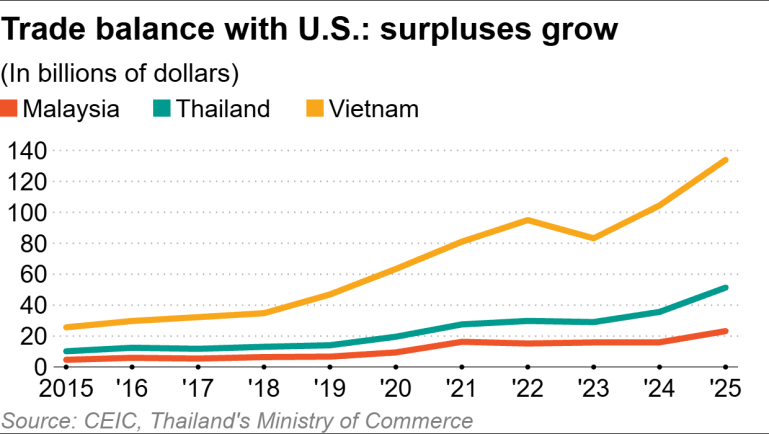
Official statistics show Malaysia, Thailand and Vietnam — three of the region’s major manufacturing hubs and exporters — increased their trade surpluses with the U.S. in dollar terms last year by 45%, 44% and 28%, respectively, boosting their overall trade.
Exports to the U.S. “remained resilient,” Malaysia’s Ministry of Investment, Trade and Industry said in a statement, saying the value expanded 17.2% “supported by robust demand for [electronics and electric] products, machinery, equipment and parts, processed food as well as manufactures of metal.”
Malaysia’s trade surplus with the U.S. surged to $23.2 billion in 2025 from the previous year’s $15.9 billion, according to CEIC Data, based on official statistics. The figure has expanded more than tenfold compared with a decade earlier.
Likewise, Vietnam recorded the largest trade surplus with the U.S. among Southeast Asian nations, hitting a record $133.8 billion in 2025, up 28% year-on-year.
For Thailand, the U.S. trade surplus climbed to $51.3 billion in 2025, up from $35.6 billion a year earlier, driven by growth in electronics products.
Trump announced what he dubbed “reciprocal” tariffs against U.S. trade partners in April in a bid to reduce America’s trade deficit. Some Southeast Asian nations were hit by duties at rates higher than 40%, which were later reduced through bilateral negotiations, and the tariffs took effect in August.
Southeast Asian countries, like many other nations, logged export growth before the tariffs kicked in through front-loading activities by businesses.
Several governments have also continued to negotiate with Washington to reduce the impact on trade.
In October, the U.S. lowered its tariff on most Malaysian goods from 25% to 19%. Additionally, 1,711 items, mainly in semiconductors, aerospace and pharmaceuticals, now benefit from a zero tariff. In return, Malaysia pledged not to impose export bans or quotas on rare earth elements and critical minerals bound for the U.S.
“ASEAN will seek to secure preferential rates to limit the downside impact,” DBS Bank senior economist Chua Han Teng pointed out in a report on Jan. 27. He added, “Notably, Malaysia is actively negotiating with the U.S. to maintain exemptions for its semiconductor exports from fresh tariffs.”
Meanwhile, the three nations’ trade deficits with China increased significantly, suggesting an influx of goods from Asia’s largest economy, which also struggles with high trade tariffs imposed by the U.S.
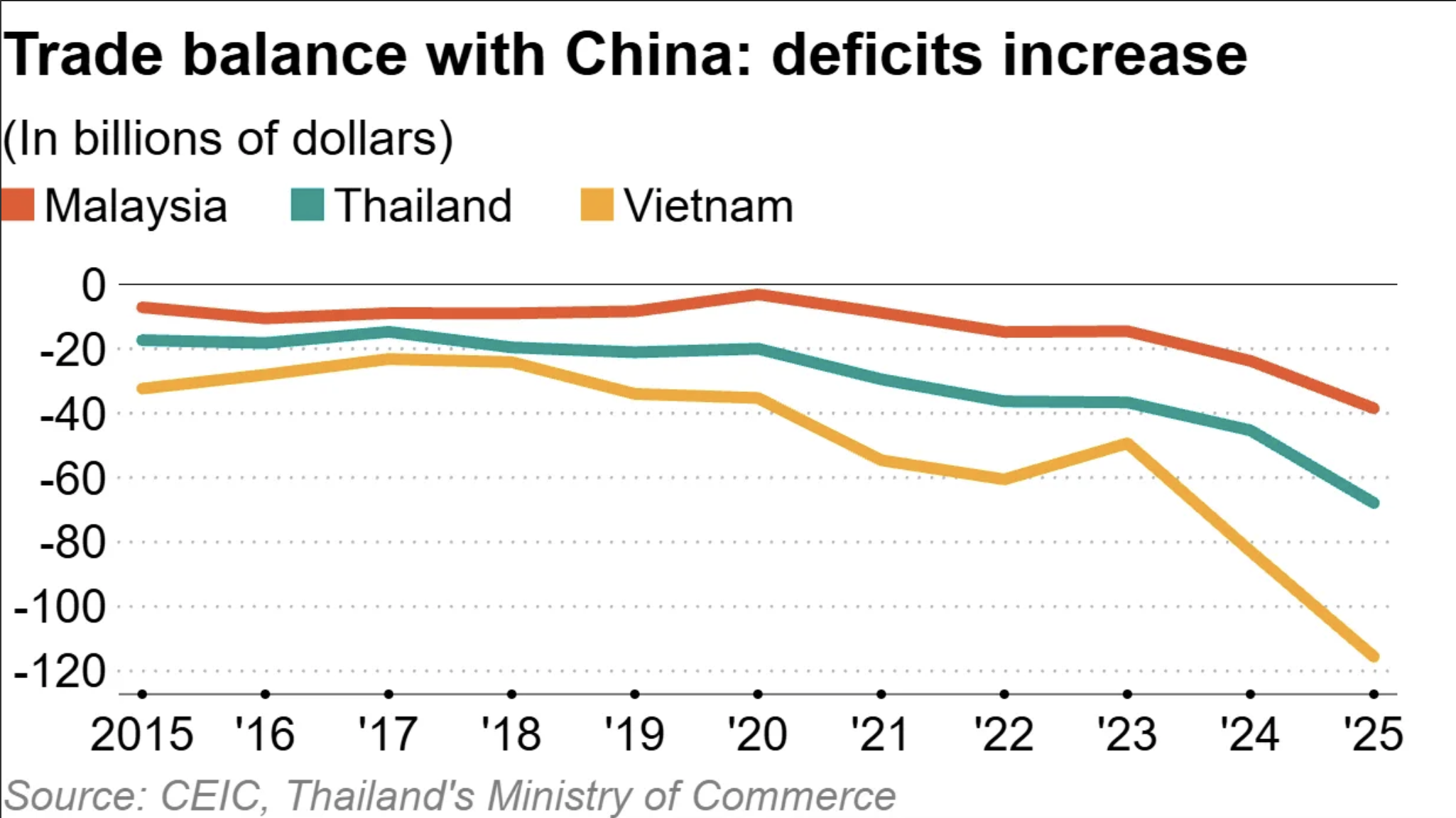
Malaysia’s trade deficit with China widened 62% to $38.4 billion in 2025. Thailand’s trade deficit with China increased 50% to $67.8 billion, while Vietnam’s grew 40% to $115 billion.
“China exports cheap goods, and now with EV imports, [Malaysia’s] trade deficit with China in future could be wider,” Vaseehar Hassan Abdul Razack, the executive vice chairman at KSI Strategic Institute for Asia Pacific, told Nikkei Asia.
As imports from China increased — as did exports to the U.S. — some experts noted that Chinese companies may be routing goods through neighboring Southeast Asian countries like Vietnam before shipping them to the U.S. to bypass higher American tariffs.
Jaideep Singh, an analyst at the Institute of Strategic & International Studies Malaysia, pointed out that Malaysia’s share of domestic exports, which are shipments of goods produced within the country, to total exports fell to 77%, its lowest level in at least seven years.
“This means that while most of Malaysia’s exports are still manufactured and processed domestically, re-exports of goods produced elsewhere are rising,” he said.
Looking ahead, uncertainty around U.S. tariff policy continues into 2026. This month, Trump said he was increasing tariffs on South Korean automobiles from 15% to 25%. The U.S. president also threatened to impose an additional 10% tariff on those European nations that oppose his efforts to acquire Greenland from Denmark, which he later backed down after reaching a “framework” of understanding with European counterparts.
Southeast Asian governments and analysts warn that shipments could slow this year as the Trump tariffs will have an impact on a full-year basis.
Thailand’s Commerce Ministry said in a statement released on Jan. 23 that the country’s export outlook for 2026 is “expected to moderate, reflecting the clearer impact of U.S. tariff measures, both existing and newly introduced, as well as ongoing adjustments in the global trade regime amid intensifying geopolitical tensions.”
Referring to Malaysia, the DBS report pointed out its goods exports are “likely to be negatively impacted by external headwinds from US tariffs.” Chua also pointed out that the tariffs “will pose a major challenge to Vietnam’s export-oriented manufacturing sector and its economy in 2026.”
Archanun Kohpaiboon, visiting senior fellow at the ISEAS-Yusof Ishak Institute, a Singapore-based think tank, sees last year’s trend as less likely to continue this year.
“The [U.S.] trade deal with many countries would be in effect,” he told Nikkei Asia. “Hence, these economies tend to import more from the U.S. and the trade surplus would reduce.
“This would, of course, pose risk to the ASEAN economy in 2026.”
Additional reporting by Norman Goh and Ahmad Mustakim in Kuala Lumpur.
This article was first published in Nikkei Asia, 2 February 2026